


An hour before work, coffee in hand, you step into the backyard. Ten minutes of strokes, a few breaking putts, and you’re back inside. No tee time, no 40-minute drive to the range, no excuses. That’s the everyday case for home putting greens, and it cuts straight to the question people actually ask before reading a single brochure: what are the real benefits — and is one worth the investment?
Yes — because a home putting green pays you back three ways from a single purchase. It sharpens your short game with unlimited, on-demand practice. It ends the recurring cost and chore of lawn care — no mowing, watering, fertilizing, or reseeding. And it lifts your property’s value and curb appeal, turning plain yard space into a feature. Better golf, lower upkeep, a more valuable home, all at once. And the case holds even for households that don’t play. A low-maintenance, high-quality synthetic putting green earns its keep on looks and savings alone.
Key Takeaways
- Better practice, lower scores: Most strokes are lost inside 30 feet, and frequency beats intensity. Those who spread their practice across four days retained more skill than those who crammed the same putts into one session.
- Real water and upkeep savings: Outdoor use is more than 30% of household water — up to 60% in arid regions — and as much as half of irrigation is lost to evaporation, wind, and runoff. Synthetic home putting greens take that line off the bill.
- Higher home value and curb appeal: Landscape upgrades are among the improvements agents most often recommend before listing, and an overall landscape upgrade is estimated to recover close to its full cost.
The Competitive Edge: How a Home Putting Green Improves Your Short Game
Lower scores rarely come from longer drives. They come from the strokes you save inside 30 feet, and those are built by repetition, not by the occasional heroic range session. The biggest thing standing between most amateurs and a sharper short game isn’t talent. It’s access. A green in your own yard erases that barrier.
Practice on Your Schedule, Not the Course’s
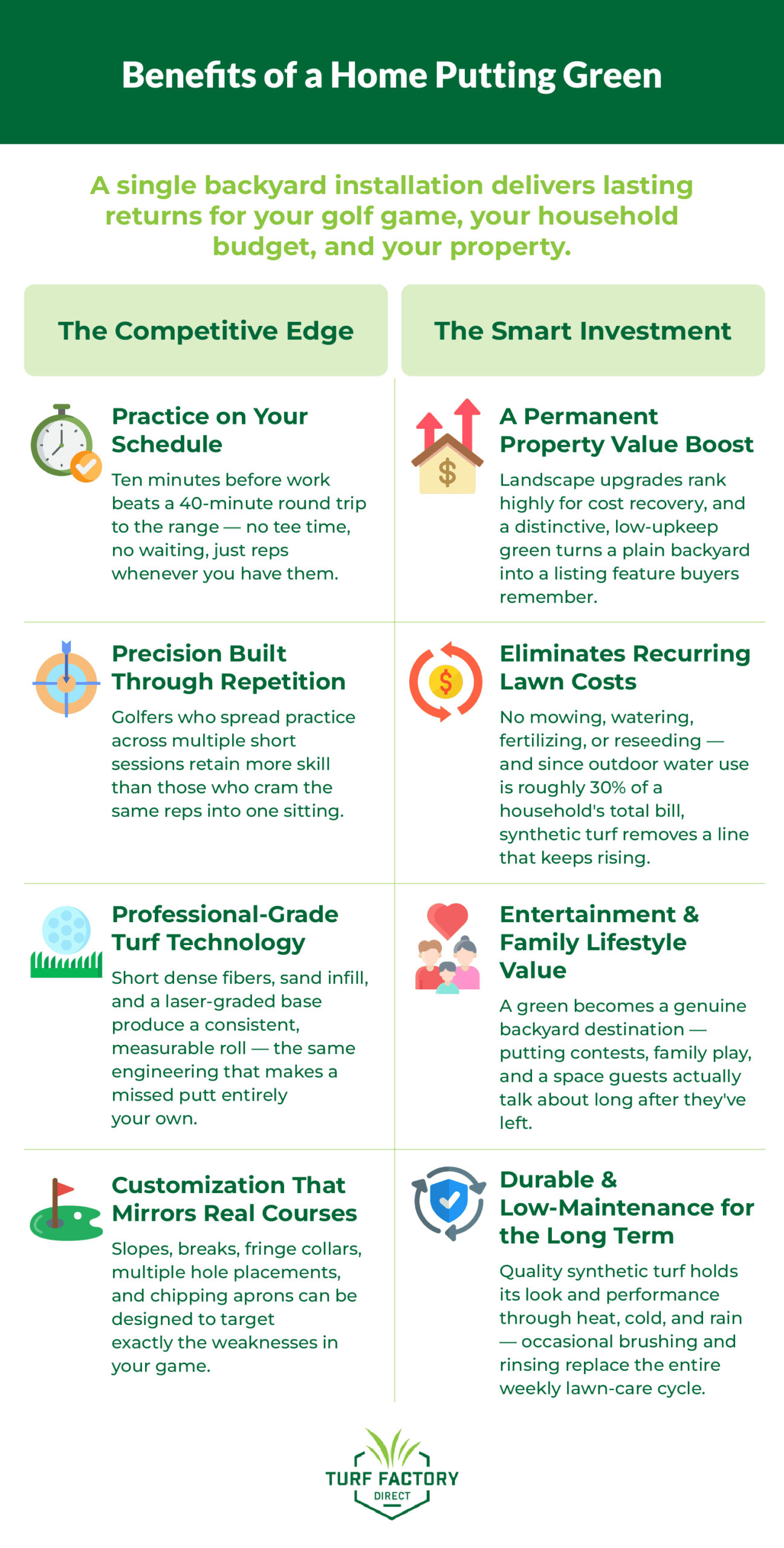
Ten minutes before work versus a 40-minute round trip to the range — that’s the real difference. No tee time to book, no waiting for an open practice green. You can practice golf in your backyard whenever a spare moment opens up, on your clock instead of the course’s.
Consistency is what quietly builds a repeatable stroke, and convenience is what makes you consistent. Short, frequent sessions do more for your game than one sporadic two-hour grind a week. There’s a subtler payoff, too: reps you take alone, with nothing on the line, build the kind of confidence that survives a real putt when it finally counts.
Precision Skills Built Through Repetition
On the course you get one read, one putt, then you move on. At home you can hit the same eight-footer fifty times and feel exactly what a square, on-line stroke does to the ball. A dedicated home putting green turns vague effort into targeted practice.
The research agrees. In a controlled study of 90 novice golfers, those who spread their reps across four days outperformed those who crammed all 240 putts into one marathon session — and the edge held up on later retention tests, not just in the moment. Short and frequent beats long and occasional. A green just steps from your back door is the surest way to make practice frequent.
A few simple drills turn that surface into a training tool:
- Gate drill — Set two tees just wider than your putter head and stroke through the “gate” without clipping either one. Builds a square, on-line stroke.
- Distance ladder — Putt to targets at increasing distances (say, 10, 20, and 30 feet) to train speed and distance control.
- Clock drill — Arrange balls in a circle around the hole, like the numbers on a clock, and hole them in sequence. Builds short-putt confidence and teaches you to read break from every angle.
- Lag-zone drill — On long putts, aim for a defined zone around the hole rather than the cup itself, training the distance control that prevents three-putts.
Professional-Grade Turf Technology at Your Feet
A good synthetic surface can roll as true as a well-kept course green — and it’s worth knowing how, because the build is what separates a real training tool from a backyard novelty.
Three layers do the work. The fibers sit short and dense to mimic closely mown grass, springy enough to hold their shape and grain. A fine sand infill, brushed down between them, adds weight, keeps the blades upright, and gives the ball a true, repeatable roll that slows the way it should. Beneath it all, a compacted, laser-graded base keeps the surface dead even, so it plays the same today as it will next year. Get those three right and the ball behaves; get them wrong and no amount of practice helps.
Speed is measured in a stimp rating — the distance, in feet, a ball rolls off a standardized ramp called a Stimpmeter, the USGA’s long-standing measuring stick. Higher number, faster green — though the blistering speeds you see at televised championships are built up over several days for the event, not everyday conditions. Dialing in that consistent roll is the whole point when you set out to achieve the perfect roll at home:
| Green Speed | Typical Stimp | Feel / Use Case |
| Slow | ~7–8 ft | Forgiving; good for beginners and slope-heavy designs. |
| Medium | ~9–10 ft | The everyday-course “sweet spot” the USGA calls medium. |
| Fast | ~11–12+ ft | Tour-style speed; the fastest championship setups are commonly cited at 13–15. |
A consistent surface also does something a bumpy one never can: it takes itself out of the equation. Miss a putt on a true green and you know the miss was yours, which is exactly what lets you find the flaw and fix it.
Customization That Mirrors Real Course Challenges
Home putting greens can be shaped to play like a slice of a real course, with the contours that genuinely test you. Smart home putting green design puts a few options on the table worth knowing by name:
- Multiple hole placements — practice different lengths and lines
- Undulation — the gentle rolls and slopes built into the surface
- Break — the sideways curve a slope puts on a moving ball
- Fringe — the slightly longer collar of turf ringing the putting surface
- Tiers and chipping aprons — for short-game variety
Designed around your game, a layout can hunt your weak spots: uphill putts, hard breaks, or lag putting, those long approach putts where finishing close matters more than holing out. And as you improve, the green can be reconfigured so it keeps challenging you instead of going stale. Want the full course-in-miniature effect? A thoughtful build can replicate a golf course green at home.
Lower scores are only half the story. A home putting green also works quietly as a financial asset. Here’s how the numbers add up.
The Smart Investment: Financial and Lifestyle Returns That Go Beyond Golf
Here’s what matters even if you never pick up a putter. Strip away the golf and an artificial putting green is still a low-maintenance landscape upgrade that earns its place. The financial and lifestyle returns land for golfers and non-golfers alike.
A Permanent Upgrade to Property Value and Curb Appeal
A professional putting green installation turns a forgettable backyard into one people remember. It reads as a finished, high-status outdoor living space — the kind of detail that stops a buyer mid-scroll and makes them linger on the listing.
Does that translate to resale value? The honest, sourced answer: landscape and outdoor upgrades are among the improvements real-estate pros most reliably endorse. In the National Association of Realtors’ Remodeling Impact Report on outdoor features, the large majority of agents recommended boosting curb appeal before listing, and landscape projects ranked near the top for estimated cost recovery — an overall landscape upgrade was pegged at recovering close to its full cost. Most owners also reported simply wanting to be home more once the work was done. Home putting greens live squarely in that high-appeal category. A striking, low-upkeep feature helps a home stand out and signals lifestyle value to buyers.
Eliminating Lawn-Care Costs Through Synthetic Turf
This is where the math turns persuasive. Swap natural grass for synthetic turf and the lawn’s recurring demands vanish — mowing, watering, fertilizing, reseeding — along with the time and money each one quietly eats.
| Cost Factor | Natural Lawn (ongoing) | Synthetic Putting Green |
| Mowing / labor | Recurring (weekly in season) | None |
| Watering | Recurring + rising water bills | None |
| Fertilizing / reseeding | Seasonal, recurring | None |
| Upfront install | Low–moderate | One-time investment |
| Drainage / standing water | Ongoing issue | Built-in drainage |
The watering line is the one that keeps climbing. Per the EPA’s WaterSense program, outdoor use runs about 30 percent of a typical household’s water nationwide and well beyond half in hot, dry regions. As much as half of that irrigation is lost to evaporation, wind, and runoff before it ever reaches the roots. Synthetic turf takes that line off the bill for good.
The “built-in drainage” claim has real engineering behind it: a quality green sits on a permeable, graded aggregate base with a perforated backing, so rain drains straight down and away instead of pooling. That’s why the surface stays playable and low-upkeep through the wet months.
Frame the install honestly and it’s simple — a one-time cost, chipped away each season you don’t mow, water, or reseed.
Entertainment Value and Family Enjoyment as a Lifestyle Asset
A green is a destination, not just a practice mat. It makes the backyard a place the whole household actually goes for weekend putting contests, somewhere to point guests besides the patio, or kids picking up the game on a forgiving surface a few steps from the door.
That everyday livability is a real return, even if it never shows up on an appraisal. Something people genuinely use for fun, for unwinding, for backyard golf greens that double as a teaching ground. This pays you back every week, not just on the day you list.
Durability and Low Maintenance as a Long-Term Financial Strategy
Quality synthetic turf is built to keep its looks and performance through heat, cold, sun, and downpour, year after year. That toughness is the engine under the savings: no seasonal lawn-care cycle means nothing recurring to pour time or money into.
At its best, it only asks for the occasional brush to stand the fibers up, a rinse to clear pollen and dust, a quick leaf cleanup, and a top-up of infill now and then — minutes here and there, not the weekly tax of a living lawn. Set against the course fees, water bills, and upkeep you’re no longer paying, that one-time install keeps paying you back across the green’s long life.
Your Next Step Toward a Better Game and Higher Home Value
A home putting green gives you a sharper short game built on practice you’ll actually do, frees you from the cost and chore of keeping grass alive, and leaves you with a property that looks and sells better. Not many improvements carry that much from a single decision.
Turf Factory Direct provides customized home putting greens to your yard and skill level. A custom design can include multiple hole placements, slopes and breaks, undulation, fringe collars, and chipping aprons shaped to fit your space and target the parts of your game you want to sharpen. As your skills improve, many layouts can be reconfigured to keep practice challenging. From here it’s easy. Order putting green samples or explore our wide selection of high-quality putting green products today.