


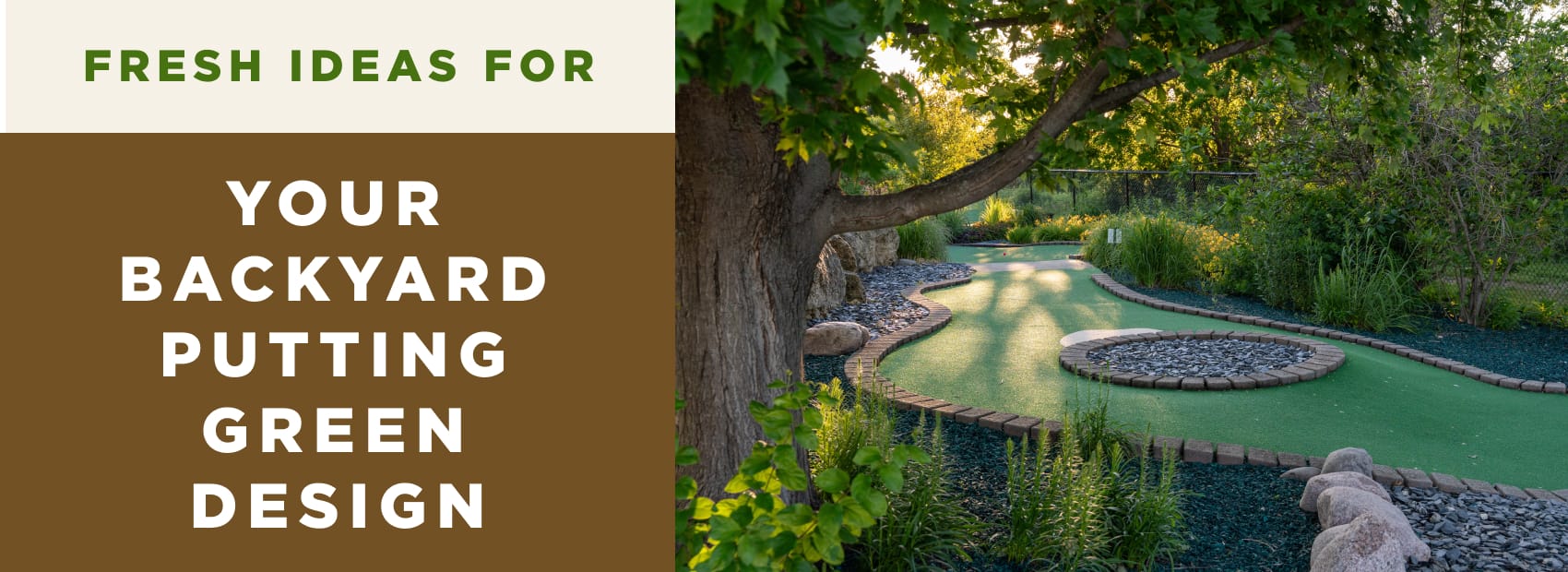
Fresh backyard putting green ideas start with how you shape and position the green within your yard. Design it like a course architect, not a landscaper. The novelty comes from shifting the mindset:
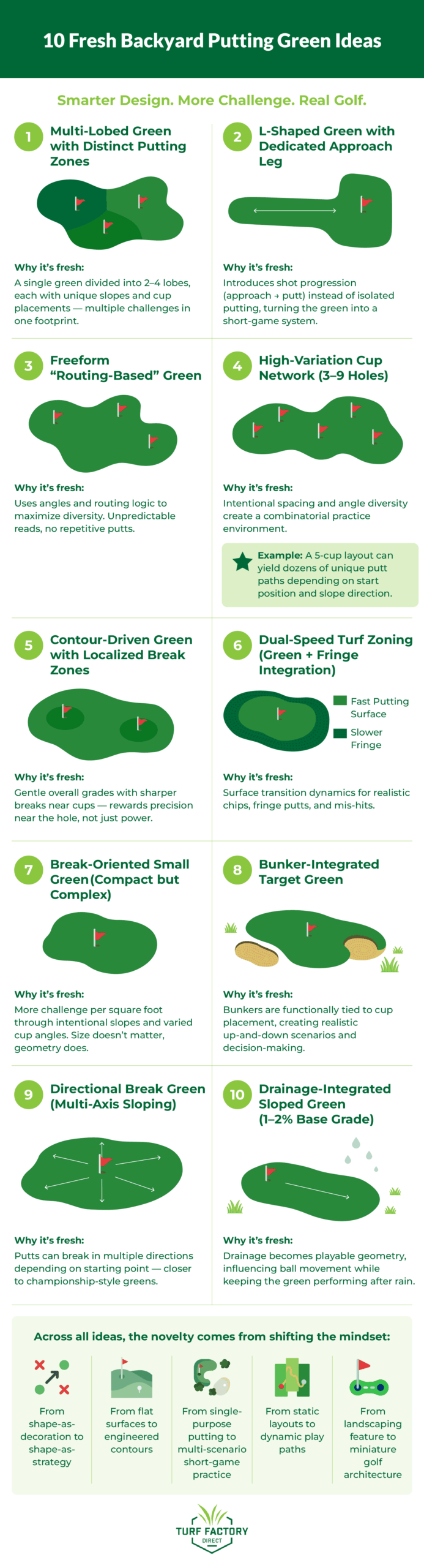
- From shape-as-decoration to shape-as-strategy
- From flat surfaces to engineered contours
- From single-purpose putting to multi-scenario short-game practice
- From static layouts to dynamic play paths
- From landscaping feature to miniature golf architecture
How much space do you need for a backyard putting green? Less than you’d think. Even a small footprint delivers real variety when you vary cup angles and distances instead of chasing square footage. Variety beats size. Cup angles and distances — not square footage — create real practice, so small and irregular yards can play as hard as big ones. Compact greens fit comfortably in modest yards, while larger lots simply allow more cups, longer putts, and added features.
Below are 10 fresh backyard putting green ideas that give you smarter design perspectives for real golf challenges and treat your space like a private miniature golf course.
Examples of Fresh Backyard Putting Green Ideas
- Multi-Lobed Green with Distinct Putting Zones: A single green divided into 2–4 lobes, each with unique slopes and cup placements — multiple challenges in one footprint.
- L-Shaped Green with Dedicated Approach Leg: Introduces shot progression (approach → putt) instead of isolated putting, turning the green into a short-game system.
- Freeform “Routing-Based” Green: Uses angles and routing logic to maximize diversity. Unpredictable reads, no repetitive putts.
- High-Variation Cup Network (3–9 Holes): Intentional spacing and angle diversity create a combinatorial practice environment. Example: A 5-cup layout can yield dozens of unique putt paths depending on start position and slope direction.
- Contour-Driven Green with Localized Break Zones: Gentle overall grades with sharper breaks near cups — rewards precision near the hole, not just power.
- Dual-Speed Turf Zoning (Green + Fringe Integration): Surface transition dynamics for realistic chips, fringe putts, and mis-hits.
- Break-Oriented Small Green (Compact but Complex): More challenge per square foot through intentional slopes and varied cup angles. Size doesn’t matter, geometry does.
- Bunker-Integrated Target Green: Bunkers are functionally tied to cup placement, creating realistic up-and-down scenarios and decision-making.
- Directional Break Green (Multi-Axis Sloping): Putts can break in multiple directions depending on starting point — closer to championship-style greens.
- Drainage-Integrated Sloped Green (1–2% Base Grade): Drainage becomes playable geometry, influencing ball movement while keeping the green performing after rain.
In this guide, you’ll learn how to plan the layout, engineer the surface beneath the turf, choose the turf itself, and layer on the features, surroundings, and financial case for your home putting green design that makes the whole thing pay off.
High-Performance Backyard Putting Green Ideas: Comprehensive Design Strategies, Features, and Planning
Mastering the Layout: Spatial Planning and Shape Strategy for Maximum Playability
Your yard sets the terms first. Existing boundaries — patios, beds, fences, mature trees — fix the green’s footprint and orientation before you pick a single feature, so map them at the start.
Shape is your biggest creative lever, so skip the plain oval. Kidney, freeform, L-shaped, and multi-lobed designs wrap around what’s already there, squeeze more play out of the space, and add real drama — a multi-lobed green creates distinct putting zones, and an L-shape tucks a longer approach down one leg.
Cups are where the green earns its keep. Spread 3 to 9 holes across varied distances and angles and a single green can simulate a whole course, so you’re never rehearsing the same putt twice. Build in a few directional breaks, and a modest footprint will test your short game harder than a flat surface twice its size. Then map the path between green, patio, and gathering zones so play and people never collide.
Don’t write off a small or irregular yard. Variety comes from angle and distance, not square footage — a few well-spaced cups and a break or two beat a big, featureless lawn every time. For tighter spaces, we also cover small putting green ideas.
Putting green shapes at a glance:
| Shape | Best for (yard type) | Play benefit | Visual effect |
| Kidney | Mid-size, curved beds | Natural break lines | Soft, organic |
| Freeform | Irregular lots | Maximum cup variety | Sculptural, custom |
| L-shaped | Long or narrow yards | Separate putt + approach legs | Architectural |
| Multi-lobed | Larger yards | Distinct practice zones | Dramatic, course-like |
| Classic oval | Compact or formal yards | Simple, repeatable reps | Clean, traditional |
Once the shape is set, the surface beneath it is where real course character comes alive.
Engineering the Surface: Contours, Undulations, and Elevation Changes That Elevate Performance
Subtle undulations are what separate a believable green from a flat carpet, and they’re shaped into the base before any turf goes down. Get this layer right, and everything above it plays true.
The base is also where DIY jobs most often go wrong, so it’s worth knowing in plain terms. A professional build works from the ground up: strip the topsoil, lay a weed barrier, then add angular crushed stone — commonly 3 to 4 inches — compacted in thin lifts rather than dumped all at once. A finer layer of decomposed granite is screeded dead level, the contours are sculpted in, and the cups are set before the turf is seamed and infilled. The test for proper compaction is almost comically simple: walk across it, and it shouldn’t hold a footprint.
Here’s why that matters. The base is the green. Synthetic turf hides nothing — every dip and soft spot telegraphs straight into the ball’s path. A break only reads true when the shaping and compaction beneath it are right, which is exactly why a professional contour outperforms a flat backyard lay.
Two rules keep contours fun instead of cruel. Keep them fair — remember that on a faster surface, even a gentle 2 percent grade plays as a real break, so steeper isn’t better. Then concentrate your sharper slopes near the cups, where they reward skill, while leaving the approaches calm.
Drainage is engineered into all of it. The turf needs no watering, but rain still needs somewhere to go, so the base is graded to a gentle 1 to 2 percent slope and built from permeable stone that lets water percolate through instead of pooling. Larger greens may add perforated channels below. Done right, the green stays firm after a storm instead of turning spongy.
The build sequence, from the ground up:
- Excavate the topsoil and clear roots and debris.
- Lay a geotextile weed barrier over the native soil.
- Build the crushed-stone base in compacted lifts to the rough contour.
- Screed a fine top layer dead level and shape the final breaks.
- Set the cups and grade in the 1–2% drainage slope.
- Seam, secure, and infill the turf, then roll it smooth.
For the full walkthrough, see how to install a putting green in your backyard.
With the contours shaped, the turf you roll over them determines how the green looks, feels, and plays.
Choosing the Right Artificial Turf: Textures, Performance Grades, and Aesthetic Finishes
Is artificial turf good for putting greens? Yes. Quality synthetic turf delivers true, consistent ball roll, holds up in sun and weather, and needs almost no upkeep compared with natural grass.
Three terms are worth knowing first:
- Pile height — the fiber length; shorter pile rolls faster and truer.
- Stimp rating — green speed, measured as the distance in feet a ball rolls across the flat; higher means faster.
- Infill — the sand or granules brushed between the fibers to keep them upright and fine-tune the roll.
Matching pile height and infill to your target speed is what makes artificial outdoor putting green play like a real green.
Now the part most homeowners get backwards: faster isn’t better. Fast tournament greens run around 12 to 13 on the stimpmeter, and championship venues can play faster still, while a fine private course sits near 10 to 12 — but at home, a calmer, repeatable surface (roughly 8 to 11) builds a more reliable stroke than a slick green that punishes every misjudged tap. As the USGA itself cautions, more speed isn’t the goal — pushing greens too fast tends to cause more problems than it solves. Match the speed to the player, not to what you saw on Sunday’s broadcast.
That’s where dual-texture zoning earns its place. A shorter, faster putting surface meeting a longer, slower fringe mimics how a real green meets its collar, and the contrast looks the part too. Soften the perimeter with a natural-looking fringe that blends into the planting.
For climate, choose UV-resistant, heat-reflective turf that holds its color and runs cooler than ordinary synthetic surfaces in full sun. Though any artificial turf still heats up more than natural grass under direct sun, so plan for shade or a quick rinse on the hottest days.
Matching turf to its job:
| Turf type | Pile height | Roll speed (stimp feel) | Best zone | Maintenance |
| Tournament putting | Short | Faster | Putting surface | Low |
| All-around putting | Short–medium | Medium | Putting surface | Low |
| Fringe / collar | Medium–long | Slower | Green edge | Low |
| Landscape blend | Long | N/A | Surrounds | Very low |
A great surface invites a real challenge — which is where bunkers come in.
Adding Signature Challenge Features: Bunkers, Sand Traps, and Strategic Obstacles
A scaled bunker beside the green turns an abstract weakness into a Saturday-morning drill — the greenside up-and-down you’ll actually face, rehearsed at home. Fill the traps with decorative gravel, crushed granite, or white sand that’s functional underfoot and sharp to the eye.
Beyond sand, raised mounds and dedicated chipping stations widen practice well past putting alone — pure upside for the serious player, pure drama for the host (see our backyard chipping green ideas). Position bunkers against your hole locations so they double as focal points and force real shot choices, and edge them — timber sleepers, corten steel, or natural stone — to match the surrounding hardscape.
Features like these shine brightest when framed by thoughtful hardscape.
Integrating the Hardscape: Patios, Pathways, and Structural Surrounds
Hardscape is what makes a green read as architecture instead of a lawn ornament. A clean perimeter of pavers, flagstone, or stamped concrete frames the surface and gives the eye an edge to rest on. Just past it, a patio becomes the spectator zone — the spot where guests gather while someone lines up a putt.
Connect the green to the home’s main outdoor room with intuitive pathways so nothing feels bolted on. Where the grade shifts, retaining walls and raised borders define the edge and add dimensional structure, and a raised putting green can be a feature in its own right. Throughout, pull materials that echo both the turf’s palette and the home’s exterior, so the build looks original to the property.
With the hard edges defined, ambient features turn the space into an all-day, all-evening destination.
Enhancing the Ambiance: Lighting, Water Features, and Fire Pit Integration
Lighting is what carries the green past sunset. Spotlights, in-ground LED cup lights, and low-voltage pathway fixtures make evening play immersive, and the same system can graze contours and fringe edges for nighttime depth. The balance to strike: bright enough to read a putt, soft enough to keep the mood. Flood the surface and you flatten the very contours you built — so graze, don’t blast.
A water feature — a cascading wall, a pond edge, a rill — adds a backdrop and the quiet soundtrack that makes a yard feel like a getaway. Anchor the seating with a fire pit, and the evening keeps going long after the last putt drops.
Hard features set the stage; planting brings it to life.
Framing the Green: Landscaping and Purposeful Planting Design
Planting is what settles the green into the landscape instead of stranding it mid-lawn. Ornamental grasses, low shrubs, and specimen trees screen for privacy, while a strategic buffer cuts wind across the surface and adds layered depth at the same time.
One detail protects the low-maintenance promise: pick plants that don’t shed onto the green. Drought-tolerant, low-litter species complement synthetic turf without dropping heavy leaf, seed, or needle debris, so cleanup stays minimal and the surface stays playable. From there, boulders, sculptural plantings, and ground cover blur the line between turf and garden, and a mix of flowering perennials and evergreens keeps the surroundings alive across every season.
With smart backyard putting green ideas and your design vision complete, the practical question is what it costs — and what it returns.
Investing Wisely: Budget, Installation, and Property Value
Cost rides on a few variables: green size, turf quality, contour complexity, and the features you add. Treat the tiers below as planning ranges — your real number comes from a quote built around your space and selections.
Backyard putting green cost planning tiers:
| Project tier | Approx. size | Typical features | Indicative range* |
| Compact | Small footprint | 1–3 cups, gentle contour, fringe | Lower investment |
| Mid | Medium green | 3–6 cups, multiple breaks, light hardscape | Moderate investment |
| Showpiece | Large green | 6–9 cups, bunkers, lighting, water/fire, full hardscape | Premium investment |
*General guidance only. Final pricing depends on size, site conditions, and features; request a quote for accurate numbers.
On installation, the DIY-versus-professional call comes down to performance, drainage, and warranty. DIY saves on labor, but the base and drainage work described above is exactly where amateur jobs fail, and a compromised base undercuts both ball roll and warranty coverage. For most homeowners, professional installation is what protects the investment.
A green adds value where it counts: it turns ornamental lawn into usable recreation space, reads as a turnkey luxury, and carries a low-maintenance, water-wise profile that lands especially well in drought-conscious markets. And curb appeal still moves the needle — 97 percent of Realtors call it important to attracting a buyer — so distinctive, move-in-ready yards tend to draw stronger interest and quicker sales.
The maintenance math closes the case. Against a natural lawn — mowing, watering, fertilizer, seasonal repair — a synthetic green’s running cost trends toward nothing, so part of the upfront premium comes back as years of skipped upkeep. The water savings alone are real: up to 30 percent of a household’s water use typically goes to landscape irrigation, and a no-water surface removes that share for good.
Whichever tier fits your yard, the path forward starts with the turf. Learn more about putting green turf cost factors, then browse putting green turf and order samples to price it accurately.