


It’s dusk. The lights come up over a green that already looks like it belongs at a club — a clean sweep of surface that breaks the way a real course breaks, a fringe collar hugging the edge, a chipping zone off to one side, three pins waiting. No tee time. No crowd. No drive across town. Just you, a wedge, and a surface that does exactly what a championship green does.
That is what a large outdoor putting green can be. And it is entirely within reach, provided you treat it as what it actually is: a piece of sub-surface engineering wearing a luxury landscape finish.
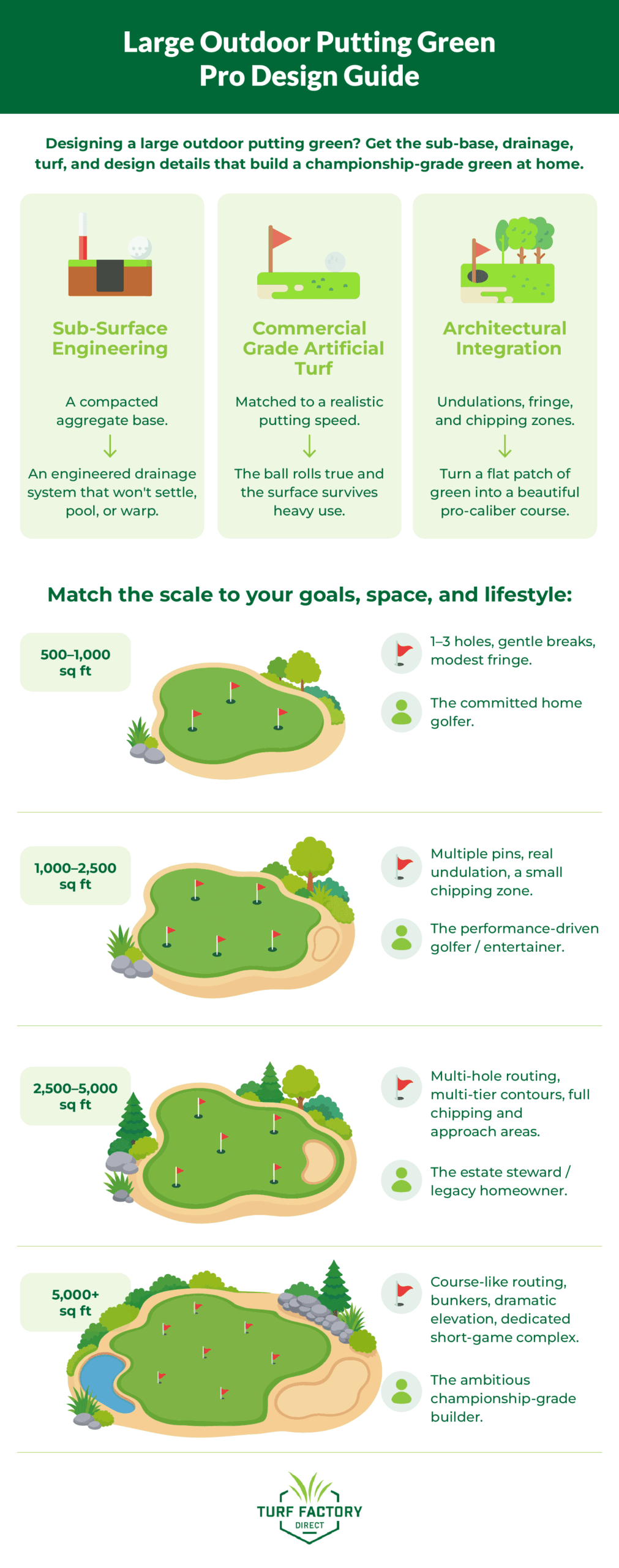
A green of roughly 500 to 5,000+ square feet succeeds or fails on three pillars:
- Sub-surface engineering — a compacted aggregate base and an engineered drainage system that won’t settle, pool, or warp.
- Commercial-grade artificial turf — matched to a realistic putting speed, so the ball rolls true and the surface survives heavy use.
- Architectural integration — undulations, fringe borders, and chipping zones that turn a flat patch of green into a beautiful, pro-caliber course.
Get all three right and you own a flawless, low-maintenance private facility that sharpens your game and elevates your property’s prestige and value. Get any one wrong at scale, and the failure is proportionally larger, which is precisely why going big means going precise.
Why Scale Changes Everything: The Case for a Championship-Grade Private Putting Green
At scale, every choice about size, slope, and base quality is magnified, so the gap between an amateur installation and a professional facility shows up in plain sight. The upside magnifies too: only a large footprint delivers real shot variety, multi-hole routing, and a true short-game environment.
Defining What “Large” Outdoor Putting Green Means
Square footage is the line between a hobby and a sanctuary. A compact green tests one skill — a straight putt over a short distance. Grow the footprint and the surface starts behaving like the real thing: longer lag putts, multiple breaks, chipping approaches, the routing that lets you play holes instead of repeating a stroke.
The shift is psychological as much as spatial. Past a certain size, a large outdoor putting green stops reading as an amenity and starts reading as a destination — the place guests drift toward, the feature that anchors the estate.
| Footprint range | What it enables | Typical user |
| 500–1,000 sq ft | 1–3 holes, gentle breaks, modest fringe. | The committed home golfer. |
| 1,000–2,500 sq ft | Multiple pins, real undulation, a small chipping zone. | The performance-driven golfer / entertainer. |
| 2,500–5,000 sq ft | Multi-hole routing, multi-tier contours, full chipping and approach areas. | The estate steward / legacy homeowner. |
| 5,000+ sq ft | Course-like routing, bunkers, dramatic elevation, dedicated short-game complex. | The ambitious championship-grade builder. |
To make it tangible: 500 square feet is about a two-car garage — enough for genuine, repeatable practice. Two thousand is closer to a regulation tennis court, with room for real variety. At 5,000+, your engineering has to rise to meet the ambition.
Matching Your Vision to Your Property Layout
Read the land before you commit to a shape. A careful topographic assessment — the slopes, the way water moves, the mature trees and structures — tells you whether your property will fight your ambition or amplify it. Existing grade can be a gift, a natural fall that helps you drain the green, or a liability, a low corner that quietly collects every storm. Mature landscaping frames a green beautifully while dictating roots, shade, and sightlines.
Orientation rewards more attention than most homeowners give it. The right aspect means even sun for play and turf health, a commanding view from the home, and shelter from the prevailing weather. The wrong one buries your showpiece in afternoon shadow.
A short checklist before anyone breaks ground:
- Lot survey — confirm boundaries, easements, and usable area.
- Drainage observation — watch where water goes during and after a heavy rain.
- Sun mapping — track shade across the day and the seasons.
- Sightlines — frame the green’s impact from the home and the places you entertain.
- Access — confirm equipment and materials can reach the site.
Once the land is understood, the honest question every serious project must face: what does it cost, and what does it return?
The Investment Mindset: Cost, Value, and Long-Term ROI
A large outdoor putting green is a capital decision, and it earns capital-decision thinking. Where a modest residential putting green might be a weekend upgrade, a build at this scale is closer to a renovation. Realistic budgets span a wide band — roughly $15,000 to $150,000+ — because the cost drivers vary: footprint, drainage complexity, the degree of grading and undulation, turf grade, and finish features like lighting, stone borders, and water elements. Any single number is illustrative, not a quote. The spread is the honest answer.
The reason scale changes everything isn’t simply more square footage to tend. It’s a different engineering problem altogether, and that’s where we begin.
The return arrives in two currencies. First, performance: a surface you use on your schedule, in your privacy, tuned to the speed you want to practice on. Second, prestige and value. A professionally designed green can elevate how an estate appraises and presents — a signature feature that tends to support enjoyment and long-term value, even though no responsible builder will promise a fixed dollar return.
There’s a quieter line worth weighing, too. A natural-grass equivalent demands mowing, irrigation, fertilization, chemical treatment, and skilled labor just to hold a consistent surface. A synthetic turf putting green trades a higher upfront cost for dramatically lower ongoing cost and far steadier playability — a contrast that compounds across a decade of ownership.
For a closer look at the numbers, see our guide to putting green turf cost; for the fundamentals of synthetic systems, our overview of everything you need to know about artificial outdoor putting greens.
| Scope tier | Approx. footprint | Key cost drivers | Indicative range |
| Entry premium | 500–1,000 sq ft | Base prep, turf grade, basic drainage | $15,000–$35,000 |
| Mid estate | 1,000–2,500 sq ft | Undulation, chipping zone, perimeter drainage | $35,000–$75,000 |
| Full estate | 2,500–5,000 sq ft | Complex grading, multi-tier contours, lighting | $75,000–$120,000 |
| Championship complex | 5,000+ sq ft | Bunkers, water features, full short-game complex | $120,000–$150,000+ |
Ranges are illustrative and vary by site, region, and finish; they are not quotes or guarantees.
Scoping your budget? Explore our full range of putting green products to see what fits your vision.
Engineering the Perfect Surface: Design, Construction, and Performance at Scale
Everything a golfer feels — the true roll, the predictable break, the firmness that holds a chip — is decided beneath the surface, long before the turf goes down. This is the heart of the build, and the line between a green that plays like a course and one that merely looks like it. We’ll work from the ground up: foundation, drainage, grading, turf, layout, customization, installation, maintenance.
Sub-Surface Engineering: The Foundation That Defines Playability
The base is the most important factor in how a large green performs and how long it lasts. The turf is the skin; the engineered sub-base is the skeleton — and on a large footprint, the skeleton carries far more load.
A professional base is a layered, compacted system, never a dumped pile of stone. Builders excavate to a planned depth — commonly six inches or more, deeper where contours and drainage demand — then place crushed aggregate in successive lifts, compacting each before the next. The target is a platform so firm and uniform it won’t take a footprint when you walk on it. A finer top course sets the finish, because the green hides nothing: every dip beneath the turf becomes a flaw you can see and feel.
This is why size raises the stakes. A quarter-inch of settling vanishes on a small green. Spread that same fault across 3,000 square feet and it becomes a low spot that pools water, deflects a rolling ball, and announces “amateur” to everyone who plays it. More area, more consequence. At scale, compaction standards and load-bearing planning aren’t refinements, they’re the whole game.
A firm base only earns its keep if the water it sheds has somewhere to go.
Mastering Drainage System Design for Large Outdoor Putting Greens
Drainage complexity scales directly with size. A bigger surface collects more water in a storm, and an undersized system doesn’t fail gracefully — it fails all at once, in pooling, soft pockets, lifted seams, and mineral staining that shortens the surface’s life.
Here’s the distinction most homeowners miss. A natural green drains down: water percolates through a deep rootzone into gravel and out through perforated pipe. A synthetic green works the other way, because the turf backing is typically non-porous — the water has to move across and off the surface. So the base is deliberately crowned or sloped to a target, paired with a gravel drainage layer, perforated pipe at the perimeter and low points, and grading that carries runoff clear of play. On a large green, those slope-to-drain pathways and pipe runs become a genuine network, not an afterthought.
A few principles govern a sound plan:
- Slope-to-drain grading. A subtle, consistent pitch moves water off while preserving a fair roll — the balance we return to under grading.
- Engineered collection. Gravel and perforated pipe gather water to a planned outfall, integrated with existing irrigation and stormwater management.
- Climate-specific spec. A high-rainfall region needs more capacity than an arid one — and dry climates still need real planning, because a brief, intense storm and a little patio runoff can overwhelm a green built as if it never rains.
For more on a surface engineered to drain and perform outdoors, see our guide to choosing the best outdoor putting green turf for your climate.
Grading, Undulations, and Elevation Changes That Replicate Championship Conditions
Grading is where engineering turns into artistry. Professional shaping builds realistic undulations, subtle breaks, and multi-directional slopes — the kind of surface where reading the line actually matters. Done well, the elevation changes train real skill while reading as dramatic and intentional from the house.
The hard part is a tension few amateur builds resolve: the surface needs enough pitch to shed water, yet must stay true enough for a fair, consistent roll. Hold both across a large, contoured footprint — a predictable roll over every rise and fall, without surrendering drainage — and you have the signature of a pro-grade build.
It also pays to set a realistic speed target. Putting speed is measured with a Stimpmeter, in feet of ball roll. Well-maintained everyday courses generally run 8 to 10 feet, and the USGA cautions that holding a green above 10 feet on a consistent basis tends to cause difficult-to-manage turf problems and is not recommended; championship venues are widely reported to exceed 13 feet, with the fastest greens often cited near 15. The instinct is to chase the highest number, but faster isn’t automatically better. On an undulating green, too much speed turns gentle breaks unplayable, sending every slope racing past the hole. The expert move is to build to a true, fair target — often around 10 to 11 — fast enough to feel premium and demanding, yet still rewarding skill rather than punishing it.
For more on bringing real course conditions home, see our guide to replicating a golf course putting green.
Turf Selection: Choosing the Right Surface for a High-Performance Large Green
Turf is where playability becomes something you can touch. The right surface delivers a consistent speed, receives a chip the way a real green does, and shrugs off years of heavy use without matting or wearing through. Large greens are exactly where this matters most: more traffic, more area, and a character that has to stay uniform across all of it, which is why this calls for commercial-grade specifications, not residential-grade shortcuts.
Performance comes down to fiber type, pile height, density, and infill. Shorter, denser piles generally roll faster and truer; slightly taller fibers soften impact and help hold a lofted chip. The craft is matching surface to job — and on a large green with both a putting surface and a chipping zone, the right answer may differ from one area to the next.
| Fiber type | Pile height | Density | Typical stimp range | Durability | Best use |
| Nylon | Low | High | Fast (≈10–12) | Excellent | Putting surface |
| Polyethylene blend | Low–medium | Medium–high | Medium–fast (≈9–11) | Very good | Putting / fringe |
| Polypropylene | Medium | Medium | Medium (≈8–10) | Good | Fringe / chipping |
Stimp ranges are representative and depend on infill, base firmness, and maintenance.
The surest way to choose is to feel it — pile density and roll character don’t translate through a screen.
Architectural Layout: Hole Placements, Contours, Fringe Borders, and Chipping Zones
Layout is what turns a putting surface into a practice facility. Strategic hole placement across a large green maximizes shot variety and lets you simulate real routing — different distances, different breaks, a fresh look every session. Fringe borders and collar transitions draw the visual boundary and add genuine short-game complexity, demanding the touch shots a flat green never asks for. Chipping zones, bunker obstacles, and approach areas complete the picture, so the green trains the whole short game instead of a single stroke.
A few principles separate a thoughtful layout from a busy one:
- Variety — pins and distances that keep practice fresh and progressively harder.
- Realistic break — contours that reward reading the line, not random bumps.
- Safe runoff — slopes that carry missed shots predictably, never toward the house or hardscape.
- Sightlines — a composition that looks intentional and dramatic from the home and gathering spaces.
With the playing architecture set, one more layer lifts a great green into a true luxury build.
Customization Features That Elevate a Large Green to a Luxury Build
This is where the build becomes a custom putting green in the fullest sense. Integrated lighting extends play into the evening and turns the green into a glowing feature after dark, as much entertainment as utility. Water features, natural-stone borders, and ornamental planting settle the green into the landscape so it reads as designed, not dropped in. Adjacent spaces — seating, a pavilion, a viewing terrace — give it a second life as a place to gather, not only to practice.
For the homeowner chasing a showpiece, this is the payoff: a feature that holds a room’s attention, frames an evening, and tells everyone the whole estate was composed with intention. Lean into the lifestyle here — the green is both a proving ground and a stage.
Ambitious features demand disciplined execution, which makes the build sequence its own craft.
Installation Steps and Project Management for a Large-Scale Build
A large green is a coordinated construction project, and sequencing decides the outcome. Each phase sets up the next, and a checkpoint missed early becomes an expensive correction later, magnified across a large footprint. Coordinating the trades — landscaping, drainage, turf — under one clear plan is what keeps a complex build on track.
The phased sequence, with what to verify at each step:
- Site clearing & survey — clear vegetation and debris; confirm grade, boundaries, access. Verify: the plan fits the land.
- Grading & shaping — establish sub-grade, slopes, and rough contour. Verify: slope-to-drain targets and undulation design.
- Drainage installation — set perforated pipe, gravel layers, and outfalls. Verify: positive flow to the outfall, no low traps.
- Base compaction — place crushed aggregate in lifts, compacting each. Verify: firmness (no footprint), uniformity, finished grade.
- Turf laying & seaming — roll out, cut, seam, and secure. Verify: tight, invisible seams and true alignment.
- Infill & finishing — apply infill, brush, set cups, install borders and features. Verify: consistent roll, level cups, clean edges.
Because a large build lives or dies on experienced execution, know what to look for in putting green companies when you seek out established professionals.
Maintenance Considerations That Protect a Premium Large Green Investment
A synthetic green is far lower-maintenance than natural grass — no mowing, no watering to keep it alive, no fertilization or chemical program. What it does ask for is consistent, light attention. Routine brushing keeps the fibers upright and the roll true; periodic infill redistribution keeps speed and cushioning even; debris removal keeps the surface clean and draining. Each season, check drainage performance and watch for infill migration or any early sign of compaction before it touches play.
The principle scales cleanly: small, regular care prevents large, expensive correction. A few minutes of brushing and minimal upkeep protect the investment for decades.
| Task | Frequency | Purpose | Why it matters at scale |
| Brushing | Weekly–monthly | Keep fibers upright, roll true. | Uneven nap shows fast across a large surface. |
| Debris removal | As needed | Keep surface clean and draining. | More area collects more leaves and runoff. |
| Infill top-up / redistribution | Seasonal | Maintain speed and cushioning. | Migration creates inconsistent speed zones. |
| Drainage check | Seasonal / post-storm | Confirm flow, catch issues early. | Large greens load drainage harder. |
Building Your Private Golf Sanctuary
A large green rewards ambition only when ambition is matched by rigor. Get the three pillars right — engineer the base, select the turf, integrate the architecture — and you end up with a surface that plays like a real course and a landscape feature that lifts the entire estate. That’s the dual payoff: a pro-caliber practice surface you use every day and the enduring value and prestige of a signature landscape asset.
Picture it finished. The lights rise at dusk, the fringe frames a green that breaks like the real thing, and the only thing standing between you and a sharper short game is the next putt. A well-built large outdoor putting green is that sanctuary — private, flawless, and yours.
Your next step: Browse putting green options →