


How to make a backyard eco-friendly? Divide it into three zones: a living zone of native plants, trees, and pollinator beds does the ecological work, a closed-loop zone of compost, mulch, and rain capture recycles what the yard produces, and a high-traffic zone takes the wear that grass was never going to survive.
Can artificial turf belong in a yard like this? Yes, in the high-traffic zone. What it does is permanently remove irrigation, mowing emissions, fertilizer, and pesticide from ground that’s compacted, shaded, or walked on too hard for grass to hold.
That subtraction is the point. The water, hours, and money freed from ground that was never going to thrive are what make an eco-friendly backyard realistic. What follows is the system: six upgrades, and how to tell whether it’s working.
Key Takeaways
- Zone the yard first. Every plant and product decision gets easier once the living zone, closed-loop zone, and high-traffic zone areas are drawn.
- Cut irrigation demand by matching water to zone instead of watering everything equally.
- Divert kitchen scraps and yard waste into compost that replaces what you’d buy in a bag.
- Capture what falls so rain stays on site instead of running to the storm drain.
- Surface high-traffic ground with a material that needs no water, fuel, or chemicals.
- Track recovery through your water bill, your bloom calendar, and what shows up in the beds.
The Three-Zone Backyard
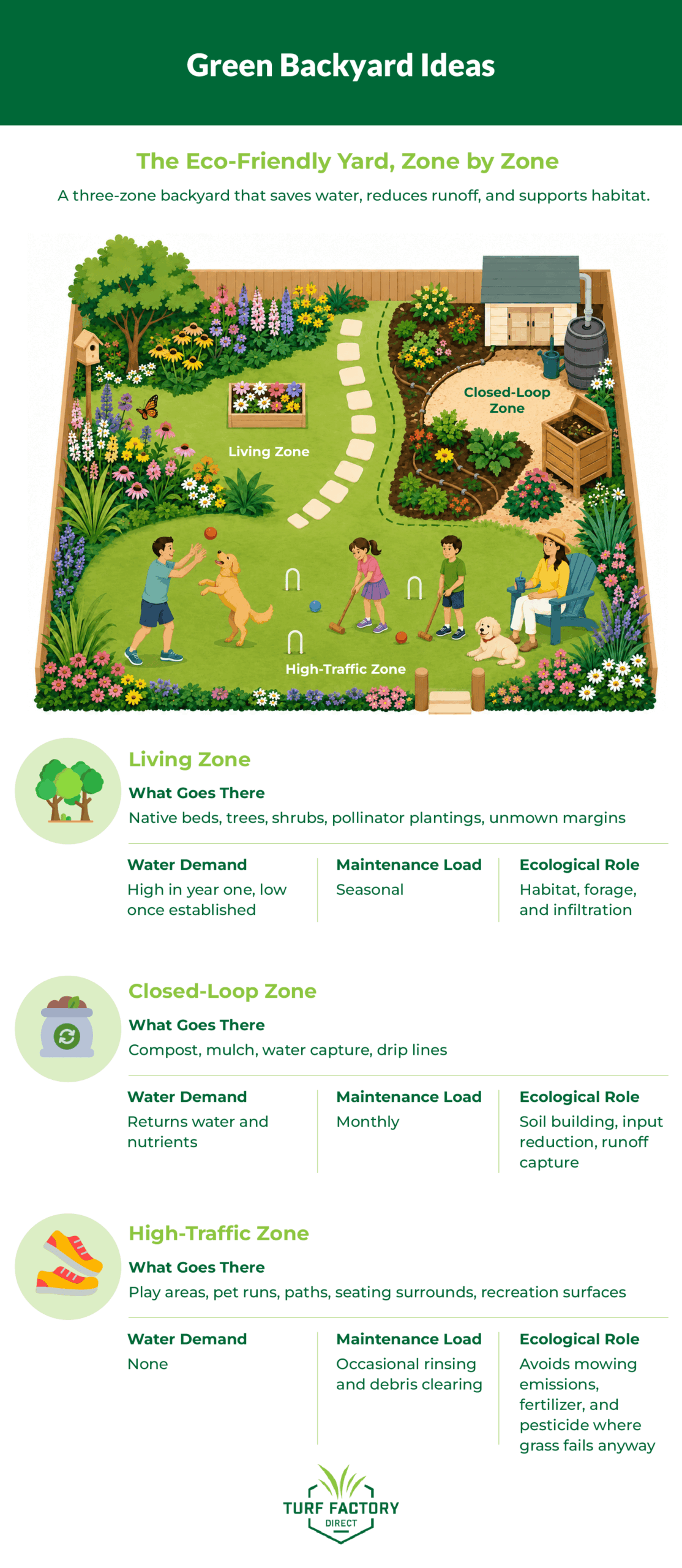
| Zone | What goes there | Water demand | Maintenance load | Ecological role |
| Living zone | Native beds, trees, shrubs, pollinator plantings, unmown margins | High in year one, low once established | Seasonal | Habitat, forage, and infiltration |
| Closed-loop zone | Compost, mulch, water capture, drip lines | Returns water and nutrients | Monthly | Soil building, input reduction, runoff capture |
| High-traffic zone | Play areas, pet runs, paths, seating surrounds, recreation surfaces | None | Occasional rinsing and debris clearing | Avoids mowing emissions, fertilizer, and pesticide where grass fails anyway |
Why Your Backyard is the Most Powerful Eco-Change You Can Make at Home
Zoning Your Backyard Into Three High-Performance Areas
The most sustainable yards aren’t uniformly manicured — they’re deliberately divided.
The living zone is where the ecology happens: native beds, trees, shrubs, and the margins you stop mowing. The closed-loop zone recycles the yard’s own output. The high-traffic zone is everything the family uses hard — the path to the gate, the dog’s run, the strip beside the patio that turns to mud every March.
You don’t need a survey to find these. Walk the yard twice. An hour after heavy rain, mark where water still stands; that means compaction or a low point, and either way the spot isn’t telling you lawn. At three on a hot afternoon, mark the shade. Then find the worn tracks between the door, the gate, and the swing set. Those lines were chosen by use, not design, and fighting them is one of the most expensive mistakes you can make in a residential yard.
The zones have drawn themselves. What goes in the high-traffic one has more range than people expect — there are creative uses for green turf in your landscape well beyond a rectangle of play space. Zoning also does something eco-friendly landscaping is rarely credited for: it creates edges, and edges are what the eye reads as design. First, though, count what the alternative costs.
Understanding the Hidden Environmental Cost of the Traditional “Perfect” Lawn
A uniformly manicured grass lawn is the single most resource-intensive and least ecologically productive surface most homeowners own.
Start with water. Of the roughly 29 billion gallons US households use daily, nearly 9 billion gallons — about 30 percent — goes outdoors, and in hot months or dry climates that share can reach 70 percent. EPA puts the waste alongside it: as much as half the water used outdoors is lost to wind, evaporation, and runoff caused by inefficient irrigation methods and systems.
Then the equipment. Lawn engines pollute heavily per hour because the standards they meet are far less stringent than the ones cars do. California’s Air Resources Board reports that an hour on a commercial mower produces roughly the smog-forming pollution of driving a new passenger car 300 miles; for a commercial leaf blower, about 1,100. These engines have been regulated in California since 1990 and are now 40 to 80 percent cleaner, yet their total smog-forming emissions in the state still exceed those from passenger cars. Those figures describe professional equipment and smog rather than carbon dioxide, but the mechanism scales down to the machine in your garage.
Runoff is the cost that leaves the property. Rain crossing compacted ground picks up fertilizer, pet waste, and clippings and carries them to the storm drain with no soil or treatment in between.
None of this makes a lawn a moral failure. It makes the lawn a mismatch — one asked to be habitat, playing surface, drainage layer, and design element at once, doing three of those badly while consuming more water and labor than anything else you own. Shrinking a lawn carbon footprint starts by narrowing what you ask the lawn to do.
Reframing the Backyard as a Regenerative Outdoor Sanctuary
The shift that makes everything else easier is deciding you’re managing an ecosystem, not a surface.
A maintained surface asks one question weekly: does it look uniform? An ecosystem asks a better one across a season: is it filling in, holding water, feeding something? That reframe is why suburban rewilding has taken hold among homeowners who care how a yard photographs as much as how it performs.
Ecological and polished only conflict when a planting goes in without design. A crisp boundary reads as intent; a feathered one reads as neglect. Four moves keep it deliberate: a hard edge of steel, stone, or cut spade on every bed; odd-numbered masses of five, seven, or nine rather than one of everything; something low and structural holding the front of the bed through dormancy; and a designed junction where planting meets paving.
That last one is where amateur installations announce themselves. The sustainable backyard ideas that last are the ones you’re still proud of in February.
Rewild, Replace, and Regenerate: The Core Eco-Upgrades that Transform Your Backyard
Living zone first, then closed-loop, then high-traffic — the order you’d build an eco-friendly backyard in.
Replacing Conventional Lawn with Native Plants and Pollinator-Friendly Landscapes
Native plantings do more ecological work per square foot than any other surface in a residential yard.
Once established, natives suit local rainfall and soil in a way imported turfgrass never does, so they need less water, no fertilizer, and little intervention. Their deep roots put carbon into the soil rather than into clippings, and a bed that’s never tilled and never fed keeps that carbon in place.
The species doing that work in Vermont aren’t the ones doing it in Arizona. The Xerces Society publishes regional native plant lists for the continental US, flagging which species feed adult pollinators, which host caterpillars, and which support specialist bees. Your state native plant society can narrow the list of native plants for pollinators further.
Among native plants for pollinators, what matters most is which bloom when. Overlapping bloom windows from spring through frost feed insects all season and fix the garden that peaks in June, then goes quiet. Pollinator-friendly landscaping and year-round color are the same problem.
Around those beds sits the permanent layer.
Anchoring the Yard with Trees, Mulch, and Reclaimed Hardscape Materials
Trees and mulch are the longest-lived investments in the yard, and the cheapest to get right at the start.
Coarse organic mulch suppresses weeds, holds moisture, and feeds soil life as it breaks down. Iowa State Extension puts the effective depth at two to four inches, coarser materials at the top of it; thinner does little, deeper brings waterlogging and shallow rooting. Pull it back from trunks — mulch piled against bark keeps that tissue too wet and opens a route for insects and disease, a slow and common way to kill an expensive tree.
Tree placement is where eco-friendly landscaping meets your utility bill. Landscaping for energy-efficient homes directs homeowners to shade south- and west-facing windows and walls from summer sun while letting winter light reach the south side. Utah State University Extension sequences it: shade west-facing surfaces from 3 to 7 p.m., east-facing ones from 7 to 11 a.m. West first, because late-afternoon sun arrives when the house has absorbed a full day of heat and cooling demand peaks. East second. South last, deciduous only — a tree there shades the building in summer only if it reaches over the roof, and in winter, when that warmth is worth money, it shades too much.
Give a shade tree ten to twenty feet of clearance — Utah State’s range for a tree of at least twenty-five feet mature height — so the canopy reaches the roofline and roots stay off the foundation. One placement earns double: a deciduous tree shading the high-traffic zone through mid-afternoon is the simplest answer to the surface-heat trade-off below. For hardscape, recycled landscaping materials carry a fraction of the embodied carbon of new material — broken concrete as paths, salvaged brick for edging, reclaimed timber for raised beds you can fill with the soil you’ve built yourself.
Building a Composting System that Closes the Loop on Yard and Kitchen Waste
Composting turns two waste streams into the only soil amendment most yards need.
Here’s the part that surprises people: the kitchen bin matters more than the yard bin. Yard trimmings are already largely diverted nationally through landfill bans and municipal collection. Food isn’t. EPA’s own research puts food at about 24 percent of what’s buried in US municipal landfills, and attributes an estimated 58 percent of the fugitive methane escaping those landfills to food waste as its quick decay rate produces more methane than any other landfilled material.
Backyard composting intercepts that stream and hands back an amendment that replaces bagged fertilizer.
Choosing a Composting Method
| Method | Space needed | Time to finished compost | Effort level | Best for |
| Hot composting | Largest — a pile big enough to hold heat | Fastest of the three when turned regularly | High | Steady volume of yard and kitchen waste |
| Vermicomposting | Smallest — a bin in a garage or under a counter | Moderate and continuous | Low, but needs consistency | Small lots and kitchen scraps, not woody waste |
| Tumbler | Contained and tidy | Moderate, limited by drum volume | Low | Anyone wanting the process enclosed and neat |
Timelines shift with temperature, moisture, and particle size, so treat published figures as ranges. One free upgrade regardless of method: leave clippings on whatever living lawn you keep. They return nitrogen straight to the soil — a rare zero-waste yard practice that removes a chore instead of adding one.
Water is the other input worth capturing before it leaves.
Designing a Water-Smart Backyard with Rain Barrels, Drip Irrigation, and Rain Gardens
Water-smart infrastructure is the upgrade with the fastest visible return on a utility bill.
An inch of rain on 1,000 square feet of roof produces roughly 600 gallons. That arithmetic explains why one barrel fills and overflows in a modest storm, and why the useful question isn’t capacity but where the overflow goes. Into a planted bed, it keeps working. At a foundation or downhill toward a neighbor, it becomes someone else’s problem. Fit a sealed lid; Colorado’s Division of Water Resources requires one specifically to keep insects and other pests out of stored water.
Check local rules first. Most states permit residential collection and several in the West regulate volume — Colorado limits most households to two barrels totaling 110 gallons, rooftop-collected and used outdoors on the same property. Your state water authority confirms what applies; HOA covenants can add restrictions where state law doesn’t.
Drip irrigation makes the other half of the case mechanically: it delivers water at the root zone at a rate soil can absorb, sharply reducing the ways sprinklers lose it — evaporation, wind drift, and runoff when application outpaces infiltration. No system removes them entirely; Utah State University Extension puts application efficiency across system types at 50 to 99 percent, with deep percolation a fourth loss. That’s water-wise landscaping at its most literal: same plants, less water, no change in what the yard looks like.
A planted infiltration basin closes the loop. Build one in five steps.
- Site it. Ten feet minimum from the foundation and thirty-five feet from a septic drain field, somewhere already receiving runoff — but not where water stands permanently. Portland’s standard is complete drainage within 24 hours of a storm; treat that as the target.
- Size it. Extension guidance puts a rain garden at roughly 10 percent of the impervious area draining into it — smaller in sand, larger and shallower in clay. Test by filling a hole and timing how long it empties.
- Excavate it. Dig a flat-bottomed basin four to eight inches deep with sloping sides and a low berm on the downhill edge. Surface area matters more than depth.
- Amend it. Loosen the base and blend in compost to restore infiltration in compacted soil. This is the step people skip and the one that decides whether it drains in a day or holds water for a week.
- Plant it. Use natives tolerant of both saturation and drought — wettest-tolerant in the low center, drier species on the edges.
Every system so far assumes soil that gets to rest. The next zone is where nothing does.
Surfacing the High-Traffic Zone with Artificial Turf Instead of Struggling Grass
The ground your family actually uses is the ground where living grass costs the most and delivers the least.
You know the spots. The arc worn under the swing set. The dog’s route along the fence. The strip beside the driveway reseeded every spring that gives up by July. These places absorb water, seed, fertilizer, and weekends, and return mud. Using landscaping turf there isn’t a compromise on the plan — it’s what makes the rest of the plan affordable.
What turf does is subtract. When people ask about artificial turf water savings, this is the honest version: irrigation demand for that footprint goes to zero and stays there, along with mowing emissions, fertilizer, pesticide, and the runoff those inputs generate. What stops going into failing grass becomes the budget for the living zone. The applications run past the play area — pathways, seating surrounds, pet turf, backyard croquet, or a putting green as a dedicated recreation surface.
Lawn vs. Native Planting vs. Artificial Turf, by Zone
| Surface | Irrigation demand | Equipment emissions | Chemical inputs | Routine tasks | Habitat value | Best zone |
| Conventional lawn | High | Mowing, trimming, blowing | Fertilizer, herbicide, pesticide | Mowing, watering, feeding, weeding, overseeding | Low | Small sunny areas |
| Native planting | High year one, low after | None | None once established | Seasonal cutback, occasional weeding | High | Living zone |
| Artificial turf | None | None | None | Debris clearing, periodic rinsing, keeping the base clear | None | High-traffic zone |
Swapping High-Emission Equipment for Clean, High-Performance Alternatives
Once the yard is zoned, the remaining mowable area is usually small enough that a battery mower covers it on one charge.
That sequence is what makes this upgrade painless, and it’s why electric lawn equipment feels aspirational before you zone and obvious afterward. Removing hours removes emissions; removing the gas engine takes the fuel storage, oil changes, and winterizing with it. Solar on a shed roof or pergola can run the replacements.
Together the six upgrades compound. Mulch holds the moisture that lets roots go deep; those roots build the soil that compost feeds; compost replaces the fertilizer that was running off; captured rain covers what irrigation used to; and a zoned high-traffic surface keeps wear off all of it. The system asks less of you each year. What it needs is a rhythm.
The Eco-Friendly Green Backyard in Action: Sustaining Momentum, Measuring Impact, and Inspiring Your Community
Creating a Seasonal Maintenance Rhythm that Keeps Your Eco-Backyard Thriving Year-Round
A zoned yard runs on a seasonal rhythm, not a weekly obligation.
A low-maintenance backyard front-loads effort into spring and fall and asks little in between, close to the inverse of a lawn’s demands.
The Seasonal Green Backyard Calendar
| Season | Living zone | Closed-loop zone | High-traffic zone |
| Spring | Cut back last year’s stems; divide and add plants. | Turn the pile; check barrels and drip lines. | Clear winter debris; check the base edges. |
| Summer | Water new plantings deeply and less often. | Add scraps; empty barrels between storms. | Rinse periodically, especially pet areas. |
| Fall | Leave the stems standing; plant trees and shrubs. | Add leaves to the pile; disconnect barrels before freeze. | Clear leaf fall before it mats. |
| Winter | Leave it alone. | Keep adding kitchen scraps. | Nothing. |
Many native bees and beneficial insects overwinter inside hollow plant stems and in leaf litter, so a bed cut to the ground and raked bare in November removes the habitat you spent spring building. Penn State Extension advises waiting until regular mowing starts or the plums have finished blooming — better still, until the apples are in bloom, by which point the early bees have emerged. Better for the garden, and less work in a busier month.
It also explains the pest control. A planting that regulates its own pests does so by housing the predators that eat them, and those insects have to overwinter somewhere. As pesticide and fertilizer use tapers, soil biology recovers and the yard asks for fewer interventions. Then you can start counting.
Measuring the Real-World Environmental and Financial Returns of Your Green Backyard
Every upgrade in this system produces a number you can actually track.
Skip the carbon math — household-level carbon figures for a landscape change are guesswork. Three simpler measurements tell you more:
- Gallons per billing cycle: your water utility statement — a flattening summer curve in year one, a lower one in year two.
- Bags at the curb: count them — a visible drop within a season of starting compost.
- Hours behind equipment: your own calendar — the clearest financial signal you have, since it’s the input you were never billing yourself for.
Keep the tools public. EPA WaterSense’s Water Budget Tool compares a designed landscape’s estimated water use against standard practice, zone by zone. The USDA Forest Service’s i-Tree suite quantifies what individual trees do for stormwater interception and energy use. Your water utility almost certainly has a usage portal you’ve never opened, and your extension office will test your soil, usually for a modest fee. That test is the surest way to verify that water-wise landscaping is rebuilding what’s underneath.
One honest expectation: year two looks better than year one. Plants need establishing water, soil biology takes seasons, and a native bed is sparse before it’s full. The returns compound — faster when they don’t stop at your fence line.
Turning Your Backyard into a Neighborhood Model for Sustainable Outdoor Living
The ecological return on one yard is real; the return on a connected block is a different order of magnitude.
According to the Xerces Society, most of the native bee species on this continent travel no more than a few hundred yards between nest and forage. That single fact reframes everything: your planting isn’t a contribution to something distant. It’s habitat for insects living within a block of your own fence, and what your neighbors do determines what survives in your yard. At pollinator scale, a suburban block is the landscape.
Which makes the neighborly part strategic rather than merely pleasant. Split perennials in spring and hand off divisions. Save seed. Share compost with whoever asks what you’re doing back there, and someone will ask, because a well-edged native bed is conspicuous on a street of lawns. Your native plant society and municipal sustainability program are worth a look for plant sources, rebates, and people who’ve already made the mistakes you’re about to.
The corridor builds one yard at a time. Yours can start this season, and the order matters more than the ambition.
Your First Season: Where to Start and What to Skip
Six steps, sequenced by what they return for what they cost. Most sustainable backyard ideas stall because they arrive all at once; these are ordered so each one funds the next.
- Map the three zones. Two walks and a handful of markers. Every decision downstream gets easier.
- Audit the irrigation. Free, one afternoon, and one of the highest-return actions here — most suburban systems run a schedule nobody has adjusted in years, with at least one head watering a fence.
- Start composting. A bin and a countertop container. Immediate diversion, with finished compost typically arriving within a season or two.
- Convert one lawn section to native planting. One bed, well-edged, sourced from a regional list.
- Address the high-traffic zone. The largest single project, and the one that frees the budget for everything else.
- Replace equipment as it fails. Never all at once.
What to skip in year one: The full lawn conversion. The infiltration basin — genuinely, wait, because you can’t site one well until you’ve watched a year of where water moves. And any equipment that still runs. Deferring these isn’t the lazy choice; with the basin it’s the better one.
So: zone the yard, put artificial turf where grass was already losing, and let the water and hours it frees fund the living zone that does the real work. A green backyard isn’t one thing done perfectly — it’s three zones, each doing the job it’s suited for. Work in that order and the yard stops being a surface you maintain and becomes a system that pays you back: in gallons, in Saturdays, and in what starts showing up in the beds.
The piece worth a professional eye is the high-traffic zone. Get in touch with Turf Factory Direct about your backyard space and high-traffic zone project.