


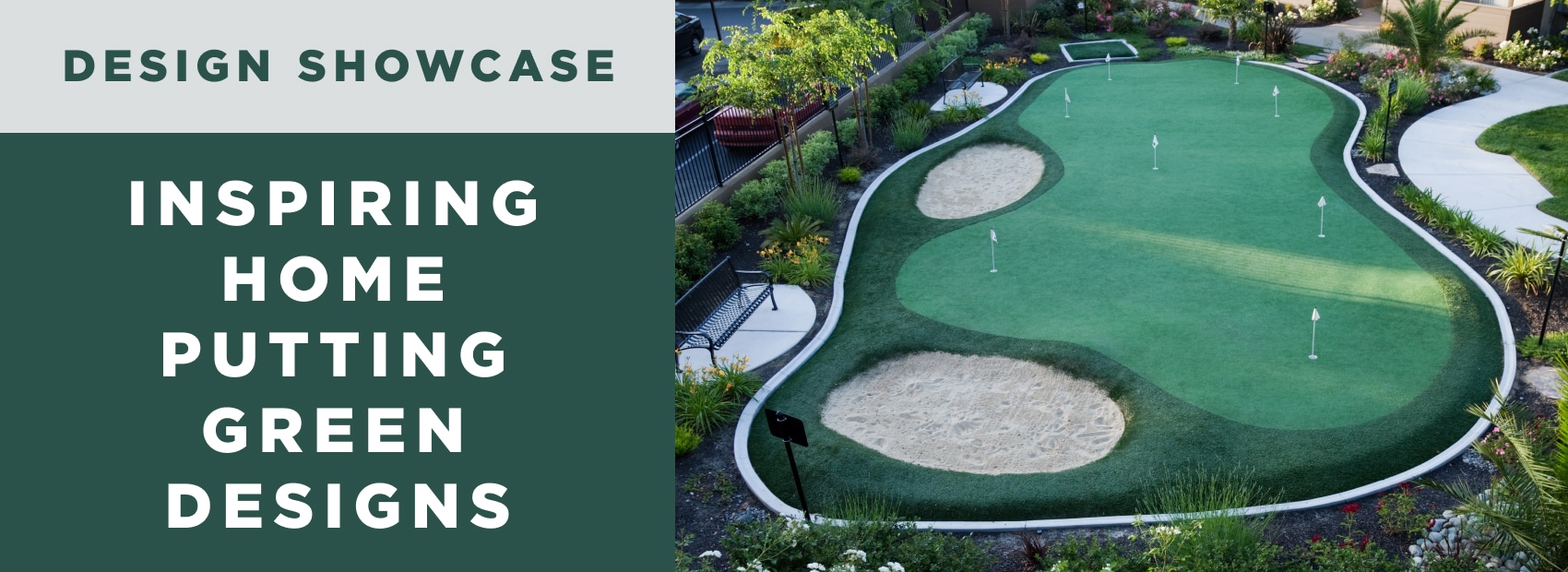
A well-designed home putting green looks like it belongs in your yard. The surface curves to meet a patio edge. A band of taller, darker fringe softens the perimeter. Ornamental grasses lean in from the flanks, and at dusk, a low cup-ring light throws a warm halo across the hole.
This showcase walks through the five elements that turn a synthetic putting surface into a signature backyard feature: style and theme, scale matched to the space, shape and contour, landscaping integration, and signature details like lighting, water, and custom flags. Get those right and the green reads as intentional at any size, from a compact urban backyard to a multi-hole estate installation.
Key Takeaways
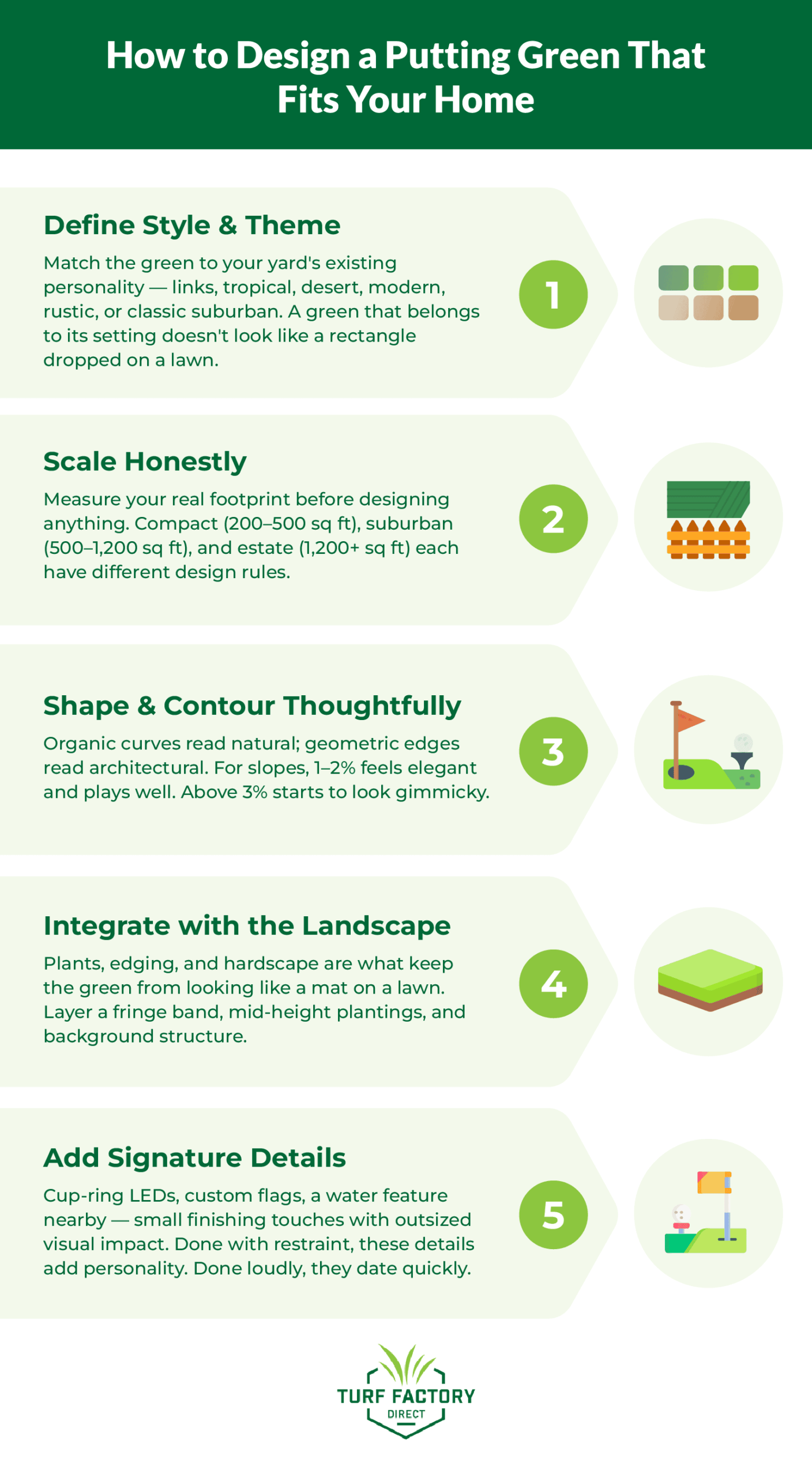
- Scale honestly, then design intentionally. Compact (~200–500 sq ft), suburban sweet-spot (~500–1,200 sq ft), and estate-scale (1,200+ sq ft) each have their own visual signature and characteristic failure modes.
- Contour with restraint. USGA guidance counsels keeping most of a green’s puttable area below a 3% slope, with steeper sections becoming unplayable as green speeds rise. Gentle 1–2% slopes read as elegant; steeper reads as gimmicky.
- Fringe is the most underrated detail. A missing or undersized fringe is the single most common reason a home green looks cheap.
- Turf choice is a four-variable decision: color, pile height, texture, and infill (silica sand is the industry standard — the Synthetic Turf Council’s guidelines identify it as a chemically inert, durable natural infill that supports the pile).
- Design for sightlines and signature details. Where the green is seen from — kitchen window, patio door, pool deck — matters as much as the green itself. Cup-ring LEDs, custom flags, and restrained lighting are the small levers with outsized impact.
From Backyard Dream to Backyard Green
Whatever your yard size, style, or budget, there’s a putting green design that fits your home. The sections below walk through the full spectrum of home putting green design ideas, beginning with the style families that set the tone, then moving through scale, and finally into the shaping and contour choices that give a green its character.
The Spectrum of Home Putting Green Styles and Themes
The look of a home putting green is set by the design language around it. The putting surface itself is a relatively neutral element — a well-chosen synthetic turf, shaped deliberately, with a contrasting fringe. Everything else — plants, hardscape, stone, edging, lighting — tells you which style family you’re standing in. These six cover most of the putting green design ideas homeowners gravitate toward:
- Links-style. Fescue-toned fringe, soft mounding that rolls rather than peaks, natural stone edging, and restrained planting. Horizon-oriented and quietly authentic.
- Tropical. Saturated green turf against palms, broad-leaf plantings like bird of paradise, and curved organic edges. At its best poolside, in warm climates.
- Desert / xeriscape. Agave, yucca, muhly grass and blue fescue, decomposed granite borders, boulder accents. Low water, high visual drama.
- Contemporary / modern. Geometric edges, concrete or porcelain paver borders, mass plantings of a single ornamental grass, restrained monochrome palette. The green reads as sculpture.
- Rustic / traditional. Native perennials, natural stone, lavender or catmint borders, informal hedging, weathered wood. Softer, lived-in, deeply flexible.
- Classic suburban. Boxwood framing, azaleas or hydrangeas at transitions, mulched beds, brick or bluestone hardscape. The most adaptable style for a mid-size yard.
A cohesive style does more than flatter the green itself. It ensures the green reads as an extension of the home’s outdoor personality rather than an imported object.
Compact to Mid-size Designs vs. Sprawling Luxury Installations
Scale is the most honest design constraint a homeowner faces, and once accepted, the design gets much easier. Three tiers cover most residential putting green installations, each with its own visual signature.
| Tier | Typical Footprint | Hole Count | Signature Design Features | Best-Fit Homeowner |
| Compact / Urban | ~200–500 sq ft | 1–2 | Single clean shape, contrasting fringe, one signature detail | Urban or small-lot homeowner wanting a real green in a tight footprint |
| Mid-size / Suburban | ~500–1,200 sq ft | 2–4 | Freeform or kidney shape, landscape integration, layered fringe | Most suburban homeowners — the design sweet spot |
| Estate / Luxury | 1,200+ sq ft | 3+ holes, optional chipping area | Multi-hole layout, elevation changes, bunkering, integrated water or lighting | Large-property owners seeking a destination-caliber backyard |
Size ranges are ballpark; exact footprint depends on available space, sightlines, and desired features.
Compact and urban designs make a virtue of limitation. A small footprint tucked between a patio and a property line works hardest when it embraces a single clean shape, one fringe contrast, and one signature detail — a cup-ring light, a custom flag, a short putting strip extending off the main surface. Overdesigning a small space is the most common failure at this scale. Readers drawn here will find deeper treatment in compact backyard green designs.
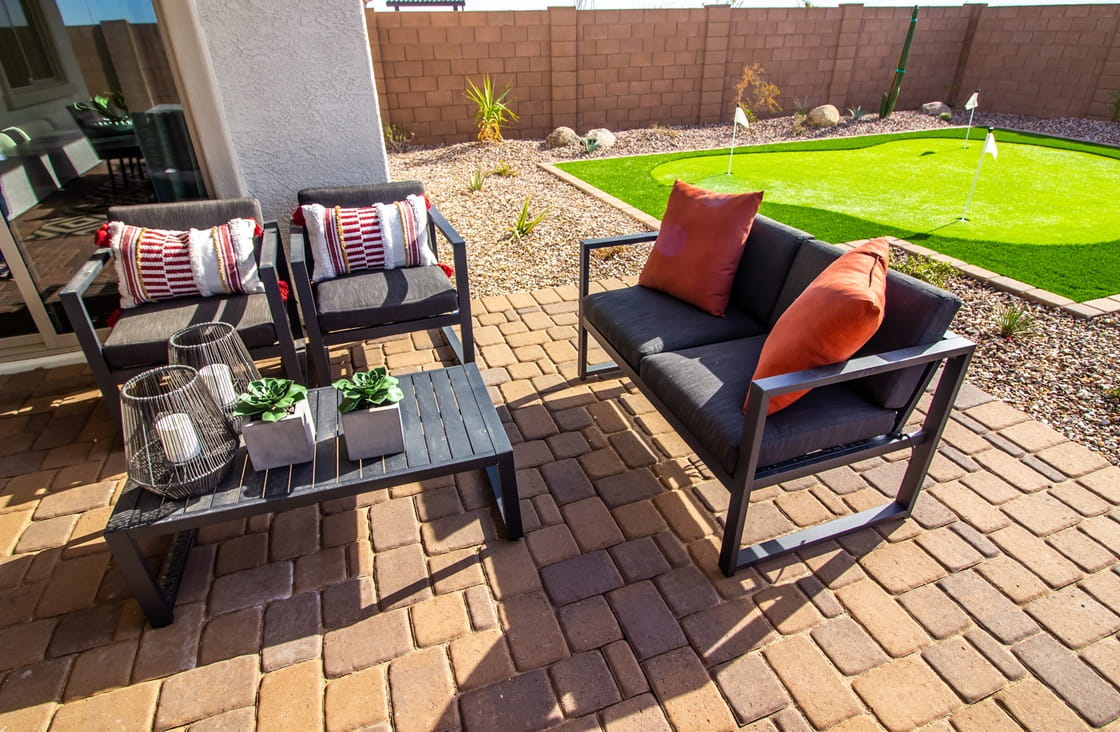
A compact putting green integrated alongside a patio
Mid-size suburban designs are the sweet spot for most homeowners, giving room to balance aesthetics, function, and budget. Picture a green curving around a patio edge, two or three cups at varied distances, a fringe band substantial enough to read from the kitchen window, and landscaping that ties the green into the rest of the yard. This is where the five design pillars come together most comfortably.
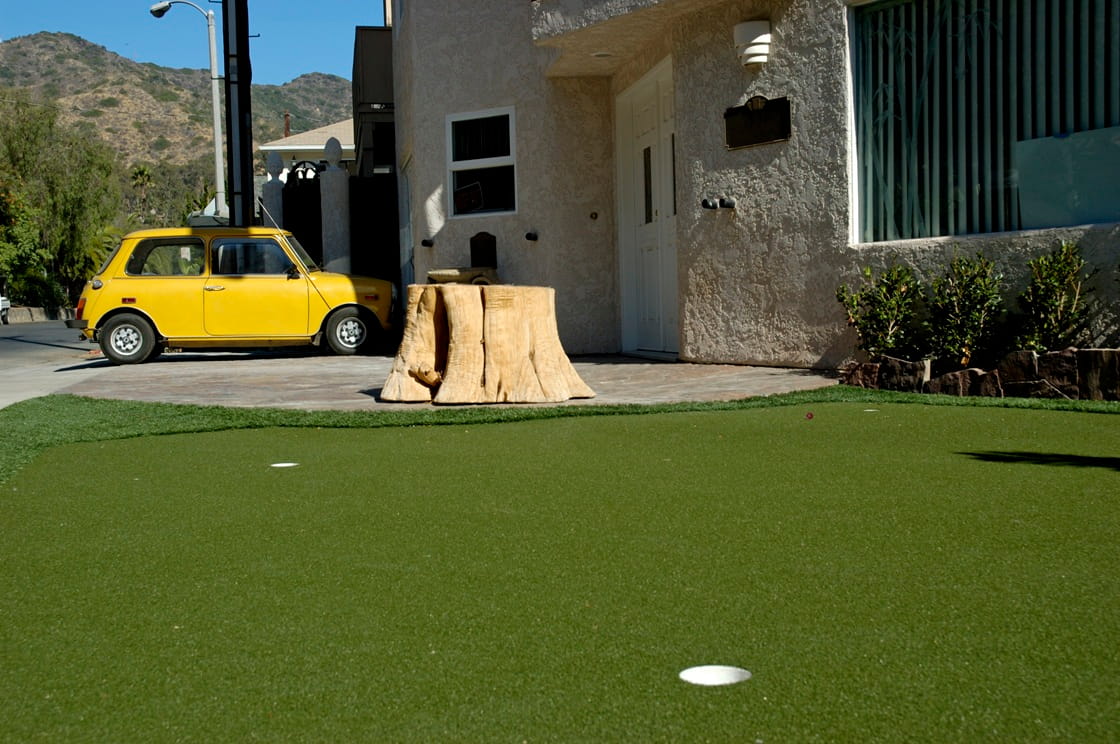
Suburban putting green design that balances aesthetics, function, and budget
Estate and luxury installations often include multiple holes, dramatic elevation changes, integrated chipping areas, bunkering, and water features. The design challenge flips: you’re maximizing a small footprint but orchestrating sightlines across a large one. The most successful examples borrow composition principles from professional course architecture, framing the backyard golf green so it reads beautifully from the main patio, pool deck, and rear terrace.
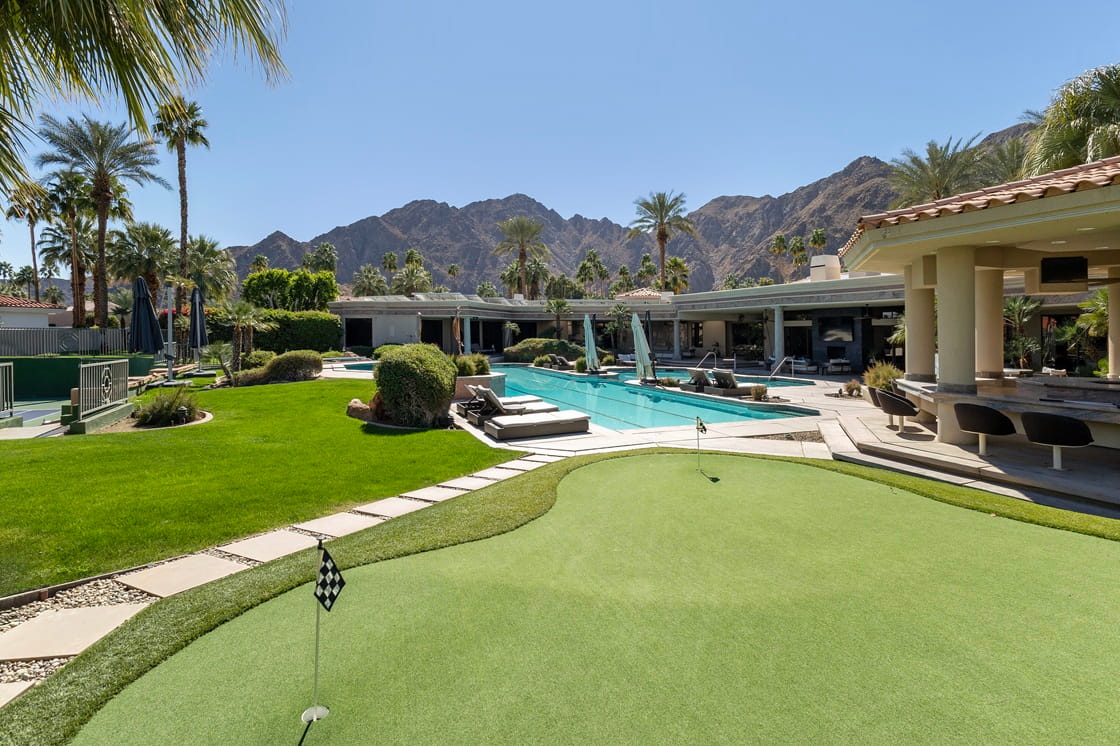
Putting green installation in luxury estate
Shape, Layout, and Contour: The Design Elements That Define a Green
Shape, layout, and contour are where a green earns its character. Two greens the same size can feel completely different depending on how they’re shaped, sloped, and edged.
Shape comes down to organic versus geometric. A kidney-bean green curving around a patio reads as natural, course-like, and visually forgiving — the eye follows the curve rather than catching a hard corner. A rectangular or stepped geometric green reads as architectural and contemporary, usually paired with clean hardscape and a restrained plant palette. Neither is better. They belong to different style families.
Contour is where design restraint pays off. USGA guidance advises keeping most of a green’s puttable area below a 3% slope, with steeper sections reserved for challenging terrain or intentional architectural drama. The same ranges translate well at home. Gentle slopes of 1–2% read as elegant and play honestly; anything much steeper starts to read as gimmicky — and on faster greens, slopes of 3% or more become too steep for hole use at Stimpmeter readings of 10′, a playability ceiling that frustrates casual rounds with guests. A gentle two-tier green with a rear slope that echoes a classic greenside bunker line delivers visual drama without sacrificing playability. For designs that push contour further, a raised putting green design opens up a different set of opportunities — retaining walls, dramatic perimeter stonework, seating-height transitions.
Layout scales with hole count. Single-hole greens center around one cup and one primary line of play. Multi-hole greens require planning for multiple break patterns and realistic approach angles — the quiet mark of an estate-scale installation that feels like a real practice facility rather. Fringe is the single most underrated detail in residential putting green design. The most common reason a home green looks cheap is a missing or undersized fringe — a putting surface dropped directly onto lawn or pavers with no transitional turf. A proper fringe is taller, darker, and texturally distinct, ringing the putting surface like a frame around a painting. A quality putting green fringe like TFD Supreme Fringe or TFD Elite Fringe handles that transition.
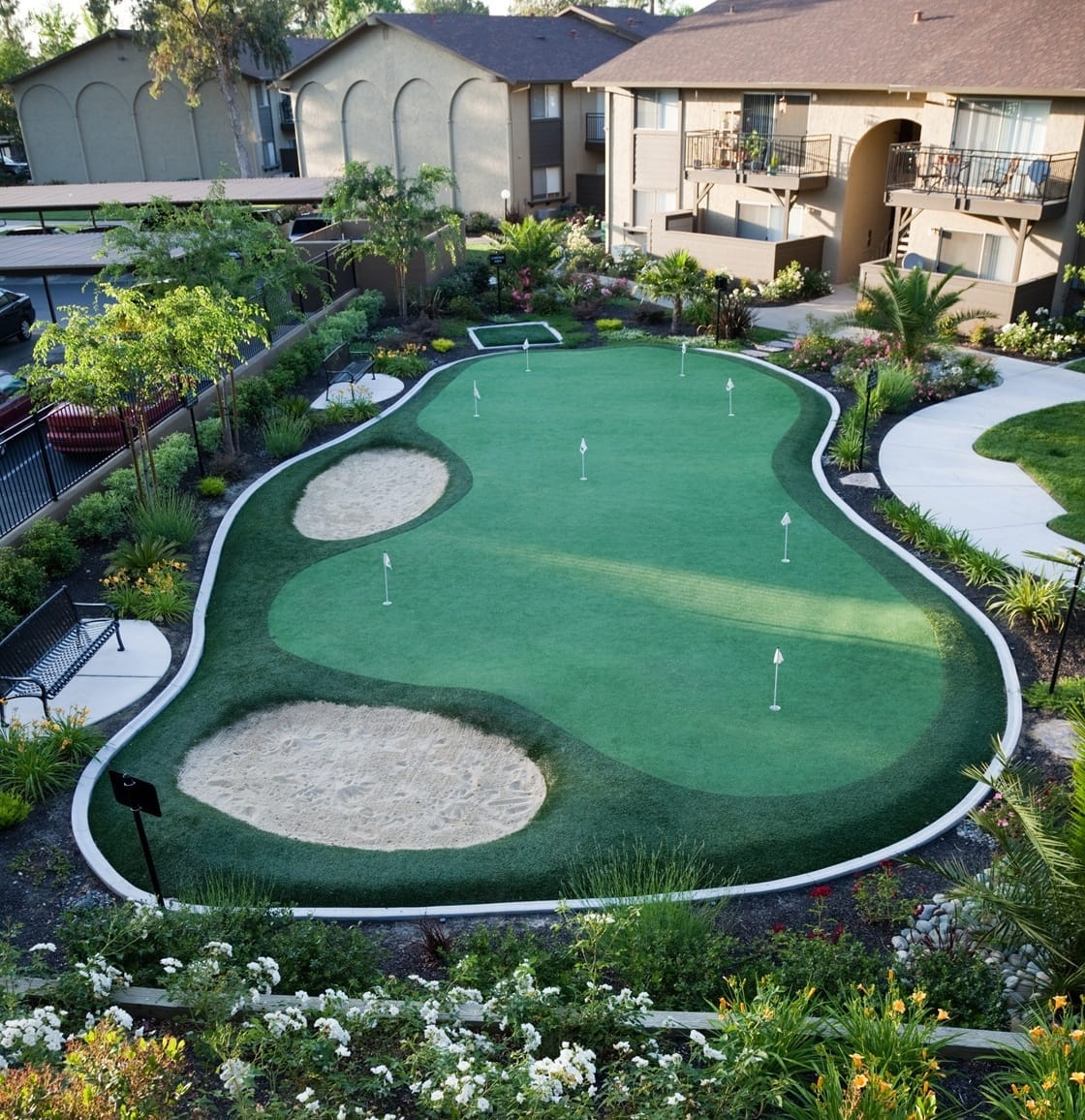
Shape, layout, contour, and fringe give this green its character
Designs That Prioritize Outdoor Living Integration
The most inspiring home putting green designs treat the green as a room in a larger outdoor floor plan, not an amenity sitting off to the side. Three scenarios show how that thinking plays out:
The curved green wrapping a sunken fire pit lounge. The green follows the curve of a stone fire pit seating ring, with a fringe band and low plantings separating play from lounge. Guests drift between putting and conversation. From the primary patio door, the composition reads as continuous landscape.
The poolside green framed by a pergola and outdoor bar. A rectilinear green anchored along the pool deck, edged in porcelain pavers that match the pool coping. A teak pergola overhead and a bar at one end turn the green into the active side of a pool day. Dual-tone turf carries the architectural geometry of the hardscape.
The entertainment-first suburban design. A mid-size freeform green set between an outdoor kitchen and a covered lounge, with a short chipping area off one edge. The green becomes the gravitational center of summer evenings. For homeowners drawn to expanding their short game into the design, backyard chipping green ideas go deeper on that integration.
The connecting thread across all three: the green is never the only reason to walk outside. It’s the reason to stay outside.
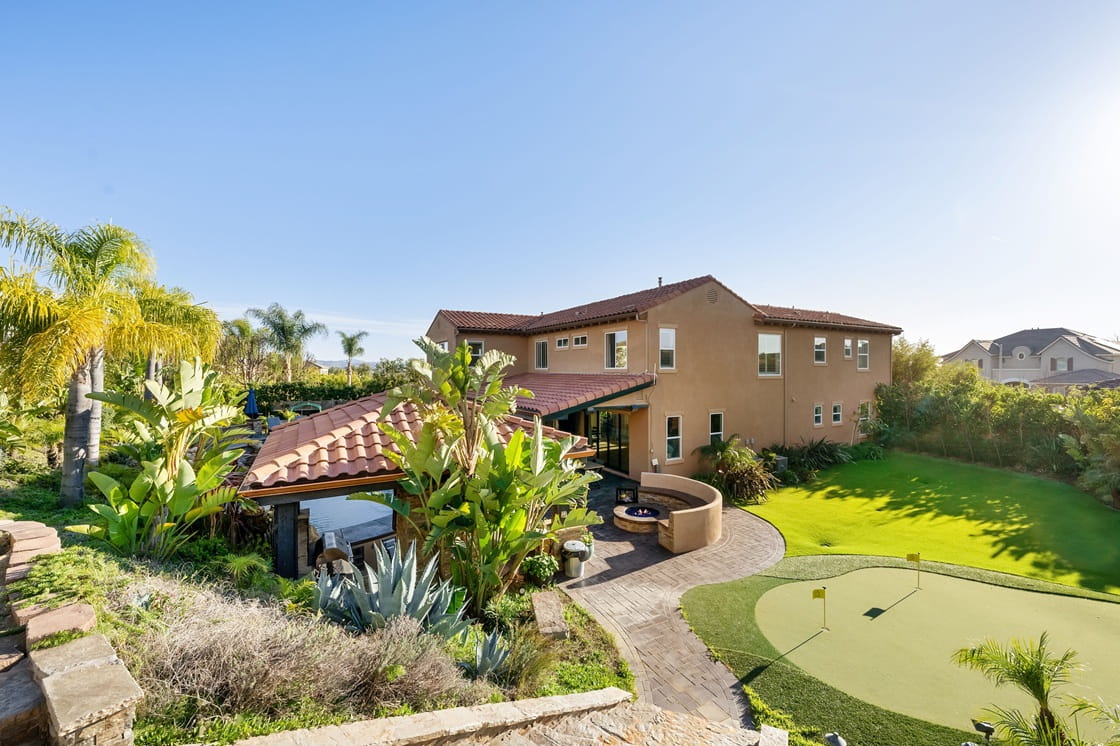
Putting green integrated into a multi-surface outdoor living space
Emerging Design Trends Shaping the Future of Home Putting Greens
A handful of clear trends are shaping the most interesting home putting green designs right now:
- Naturalistic shaping. Moving away from tidy ovals toward organic, course-inspired shapes with asymmetric fringe and irregular mounding — greens that look grown rather than installed.
- Multi-surface entertainment zones. Greens flowing directly into chipping areas, short-game stations, bocce lawns, and decorative turf spaces. One continuous backyard composition rather than isolated features.
- Dramatic elevation. Raised greens with retaining-wall aesthetics, tiered putting surfaces, and intentional bunker-style transitions — borrowed from course architecture, adapted at residential scale.
- Signature landscape pairings. Mass-planted ornamental grasses at fringe lines, architectural agaves against modern edges, drift plantings of native perennials behind a suburban green. Moving beyond generic boxwood framing.
- Year-round visual hold. Designs engineered to read beautifully off-season, leaning on turf color stability, structural plantings, and hardscape that holds its own when deciduous plants rest.
Together, these trends signal a larger shift. Residential putting greens are increasingly designed with the same composition principles that govern a backyard turf putting green at the higher end — landscape architecture first, practice surface second.
The Details That Make a Putting Green Design Extraordinary
Big-picture decisions establish a green’s character; the finishing details elevate a good green to a signature one. What follows covers the turf, planting, hardware, and lighting choices that separate a standard install from a backyard statement.
Synthetic Turf Options and Surface Customization
A synthetic putting green surface does two jobs at once: it delivers a realistic ball roll, and it defines the visual surface. Four variables shape how a green looks and plays:
- Color. Modern putting green turf ranges from classic bent-grass emerald to warmer fescue tones. Dual-tone turf — two complementary shades blended or striped into the surface — adds natural-looking depth and helps a manicured green avoid the flat, uniform look that dates a cheap install. Designers chasing a more course-authentic read often reach for dual-tone putting green turf specifically for this effect.
- Pile height. Putting-surface piles are short — noticeably shorter than landscape or sports turf — which is what delivers faster, truer ball roll. Fringe turf is intentionally taller; its job is to create visual and playable contrast at the perimeter. See our backyard golf turf selection guide for deeper specification-level guidance.
- Texture. Monofilament, slit-film, and nylon blends each catch light differently, roll differently, and wear differently. A good designer selects texture based on climate, sun exposure, and how the green will be viewed.
- Infill. Silica sand supports the pile, stabilizes roll, and keeps the surface consistent over time. The Synthetic Turf Council’s industry guidelines identify silica sand as a standard infill material — chemically inert, durable, and functionally integral to how the system performs. A small technical detail most homeowners never see, but a meaningful part of why a quality artificial turf putting green plays honestly.
One honest framing on green speed: faster isn’t automatically better at home. Tournament greens can roll at speeds that punish casual play. Keep course greens in the 9’6″ to 10’6″ range, where real practice happens without wrecking a friendly round. For design purposes, the point is to choose a turf that looks right and plays right for how the green will be used.
Customization ranges from subtle to expressive. A custom putting green can feature monogrammed cup rings, dual-tone fringe patterns that echo fairway stripes, and flags that match the home’s color palette. Done with restraint, these details add personality. Done loudly, they date quickly.
Landscaping Integration: Blending the Green Into Its Surroundings
Landscaping is what keeps a putting green from looking like a putting green airlifted onto a yard. The frame matters as much as the picture. Strong putting green landscaping works at three layers: the transition edge, the mid-height framing, and the background structure.
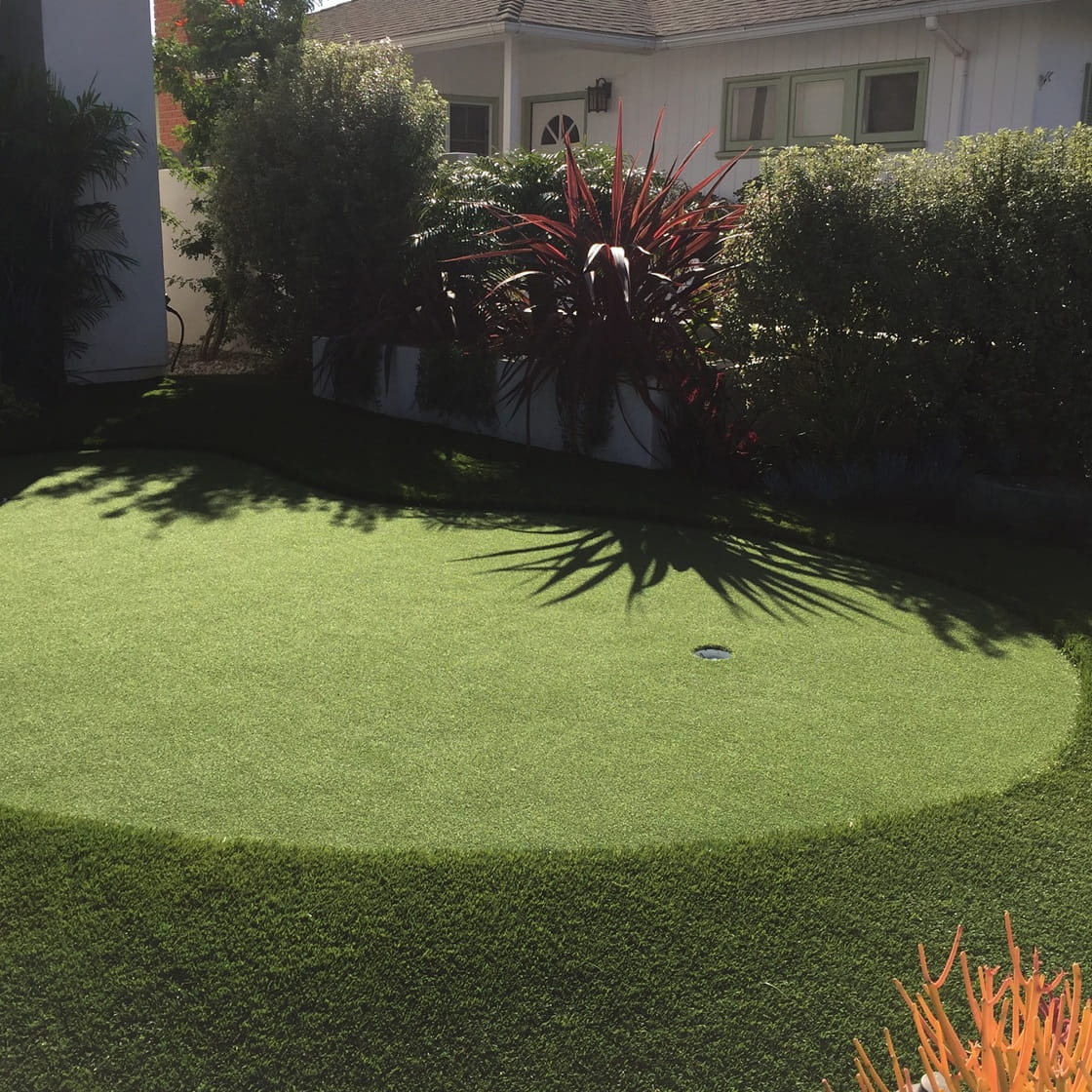
Seamless transition between play surface and surrounding landscape
The transition edge is what the ball and the eye encounter first — the fringe turf, any stone or paver border, and the low groundcover plantings that soften the perimeter. Ornamental grasses at varying heights work beautifully here; low sedum, creeping thyme, or dwarf mondo grass fill negative space at a paver interface. A bunker or sand trap — functional hazard and visual anchor at once — belongs in this layer when scale allows. At estate scale it reads authentic; at small scale, it reads like a costume.
The mid-height framing is where design themes become legible. Boxwood hedging for a classic suburban green. Massed feather reed or karl foerster grass for a contemporary green. Agave and yucca for a desert green. Hydrangeas or azaleas for a traditional green. This layer also controls privacy and sightline framing, lifting the eye off the fringe and toward the composition as a whole.
The background structure — larger shrubs, small ornamental trees, specimen plantings — gives the green something to live against. A Japanese maple at one end of a contemporary green. An olive tree or pindo palm anchoring a Mediterranean composition. Multi-trunk river birch behind a suburban installation. It’s the layer that makes the green read as part of a landscape rather than an object in a field.
A final landscape principle worth naming: sightlines. Where the green is seen from — the kitchen window, the primary patio door, the pool deck — matters as much as the green itself. Orient the visual composition toward the places where it’ll be viewed most, and the design does more work with less material.
Flags, Cups, Obstacles, and Signature Design Features
The small hardware on a putting green carries disproportionate design weight. A standard white flag on a standard white pole says practice surface. A muted navy flag, a weathered bronze cup, and a hand-stamped family marker say this was designed.
- Custom flags. Color and material are the quiet design levers. A canvas flag in a muted tone reads warmer than a polyester tournament flag. Embroidered monograms add personality.
- Cup details. Weathered brass, aged bronze, or painted rings around the cup catch the eye. Cup-ring LED lights — a small-cost, high-drama detail — transform an evening green with no other lighting changes.
- Bridges and decorative crossings. At estate scale, a small footbridge across a stream separating two holes is stunning. At compact scale, it would overwhelm. Match the feature to the footprint.
- Mounds and micro-terrain. Subtle mounding around the fringe adds visual rhythm and playing interest.
- Replica-hole touches. A fringe line echoing a famous hole, a stone placed in homage to a favorite course, a flag color borrowed from a tour event.
The shared principle across all of them: signature features read as intentional when they’re restrained and personal, and gimmicky when they’re loud and generic.
Lighting and Water Features
Lighting and water are the two design levers that elevate the putting green experience.
Lighting. Four categories cover most residential installations:
- Pathway lighting — low, spaced fixtures along the approach to the green. Functional and directional.
- Landscape uplighting — warm low-wattage fixtures aimed up into surrounding trees and plantings. Creates the ambient background glow that makes a green feel inhabited at night.
- In-ground LEDs — subtle strips or pucks at fringe transitions, stone edging, or perimeter. Defines the shape without dominating it.
- Cup-ring LED lights — small rings illuminating the cup itself. The single most photograph-worthy lighting detail and the easiest evening-use upgrade.
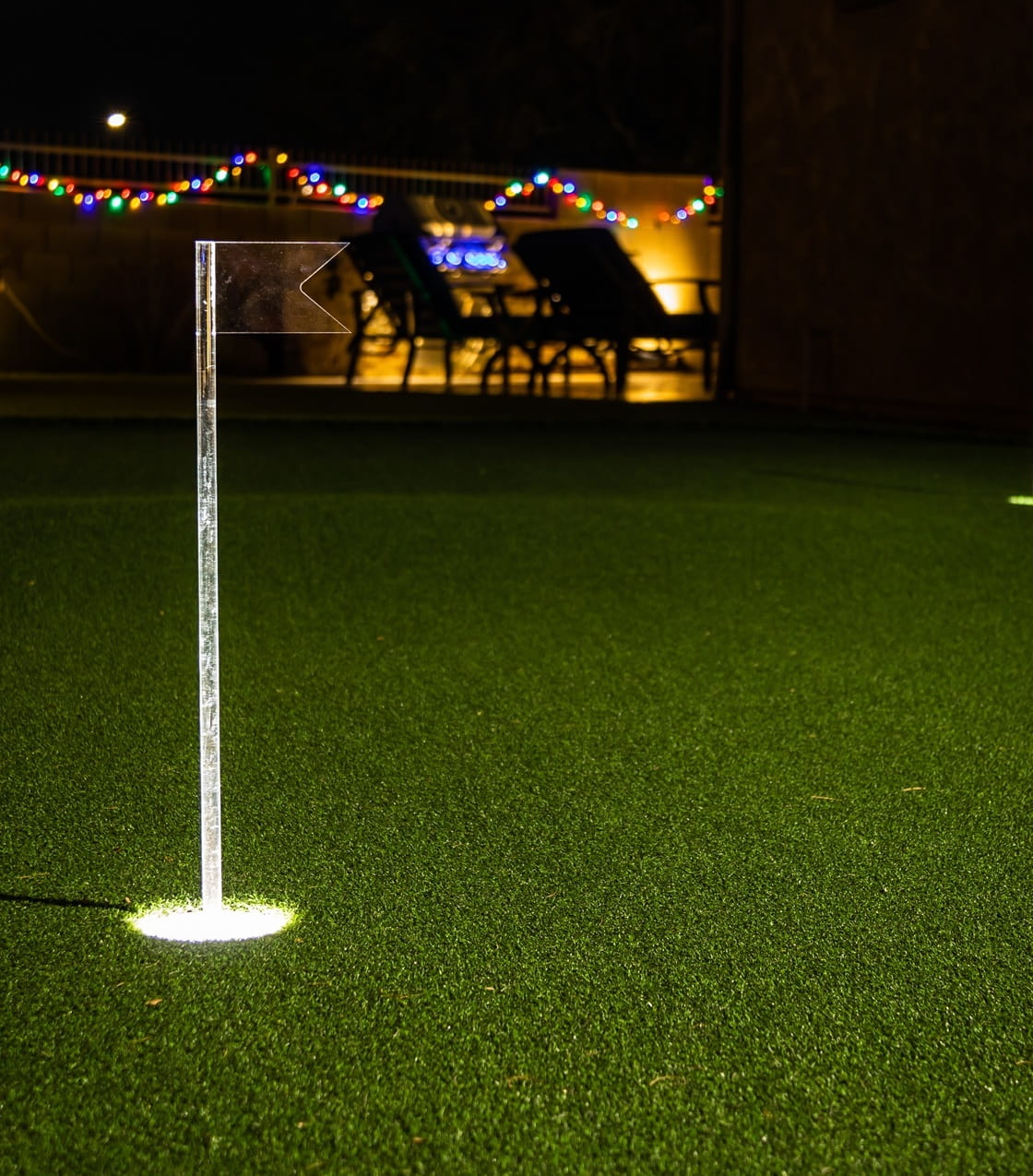
Evening lighting transforms the putting green into a social space
Water features. Streams, ponds, and small fountains set beside or behind a green — never in the playing surface — extend the garden-oasis effect. Scale matters more here than almost anywhere else: a koi pond beside an estate-scale green reads elegant; the same feature squeezed into a compact design reads forced. Sound is part of the design too. A quiet recirculating stream adds the auditory layer that makes an outdoor space feel complete.
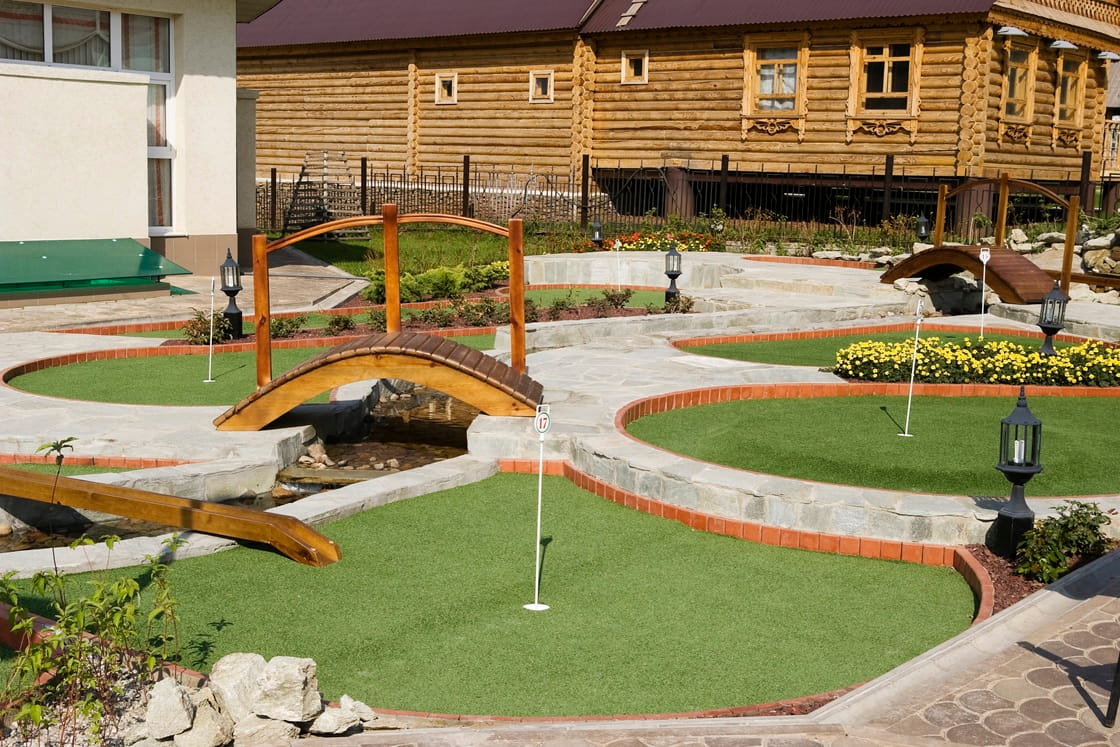
Complementary water feature near putting green surface
Together, lighting and water features push a home putting green firmly into outdoor living amenity territory — not just a place to practice, but a place to gather.
Frequently Asked Questions
How much space do I need for a home putting green? As little as 200 square feet can deliver a genuinely designed compact green with one or two cups. Five hundred to 1,200 square feet is the sweet spot for most suburban homes, and estate-scale multi-hole installations run 1,200 square feet and up. The right size depends on how you want to play and entertain.
What’s the difference between a putting green and a chipping green? A putting green is built for rolling and short-putt practice — shorter, faster synthetic turf optimized for true roll. A chipping green includes longer fringe, rough, and approach areas for pitches and chips. Many residential designs combine both for a complete short-game setup.
Do synthetic putting greens look realistic? Modern synthetic turf — especially dual-tone varieties with quality fringe contrast — reads as authentic from both distance and close-up. The design details around the green (landscaping, edging, sightlines) do as much work as the turf itself in selling a realistic look.
How do I choose the right turf for my home putting green? Evaluate four variables: color, pile height, texture, and fringe contrast. Order samples to see them in your own outdoor light. Match the turf to both your aesthetic direction and how you plan to use the green — practice, entertainment, or both.
Can a home putting green increase property value? A well-designed, professionally installed synthetic green can add outdoor living appeal that many buyers value, particularly in golf-friendly markets. The National Association of Realtors and National Association of Landscape Professionals underscores how much curb appeal matters at sale time: nearly every Realtor surveyed flagged it as important to attracting buyers, and the vast majority routinely recommend landscape improvements before a home is listed. Like any landscape feature, impact depends on the quality of design and installation, and on how well the green integrates with the overall property.
Next Steps From Inspiration to Installation
Having seen what’s possible, the next question is: where do I start? The five design elements — style, scale, shape and contour, landscaping integration, and signature details — work as a planning order, not just a design framework.
Start with style. Identify the outdoor personality your home already has, whether contemporary, traditional, tropical, desert, rustic, or classic suburban. The green should belong to that family.
Measure your space honestly. Real footprint numbers open up or close off design choices. Compact, suburban sweet spot, or estate-scale.
Choose turf by look and feel. Color, pile, texture, and fringe contrast are the decisions that determine how the green reads. Ordering putting green turf samples and seeing color, pile, and fringe contrast in your own outdoor light tells you more than any photograph. From there, browse our full putting green turf selection for options that fit your direction.
Plan landscaping and signature details last. The plantings, lighting, hardscape transitions, and custom flags come together once the green itself is shaped.
An inspiring home putting green design is achievable at any scale. Style anchors the green in its setting. Shape and contour give the green its character. Landscaping turns the object into a room. And signature details — the right flag, the right cup ring, the right pool of light at dusk — are what make it unmistakably yours.