


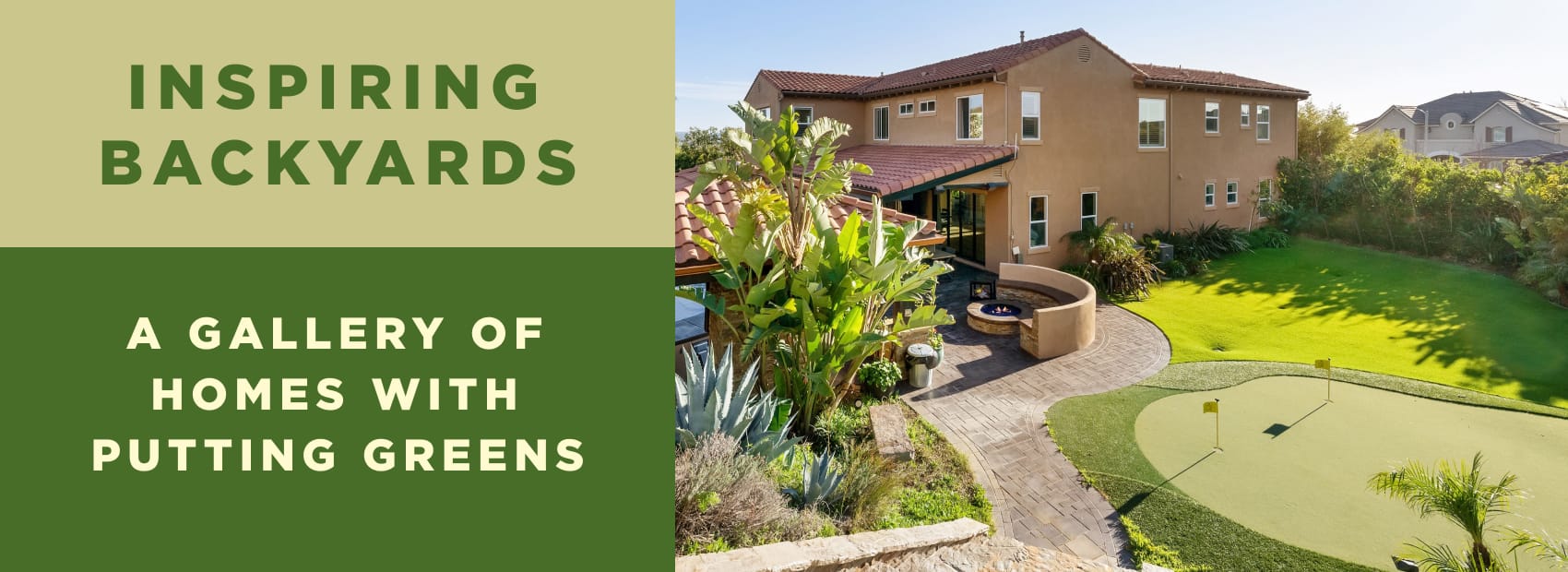
Eighteen months ago it was a rectangle of tired grass. Forty minutes on the mower every week, brown by August, crossed daily and used never. Now the back door opens onto a putting surface with three cups and a real break in it, and somebody rolls a dozen putts out there before dinner most nights.
That is what successful backyards with putting greens have in common: an underused patch of yard became the reason people go outside.
What follows are 8 backyard putting green design ideas matched to yard size, terrain, and way of playing. If you are still deciding whether a putting green suits your property, our guide to backyard golf greens covers the fundamentals.
Matching a Putting Green Style to Your Yard
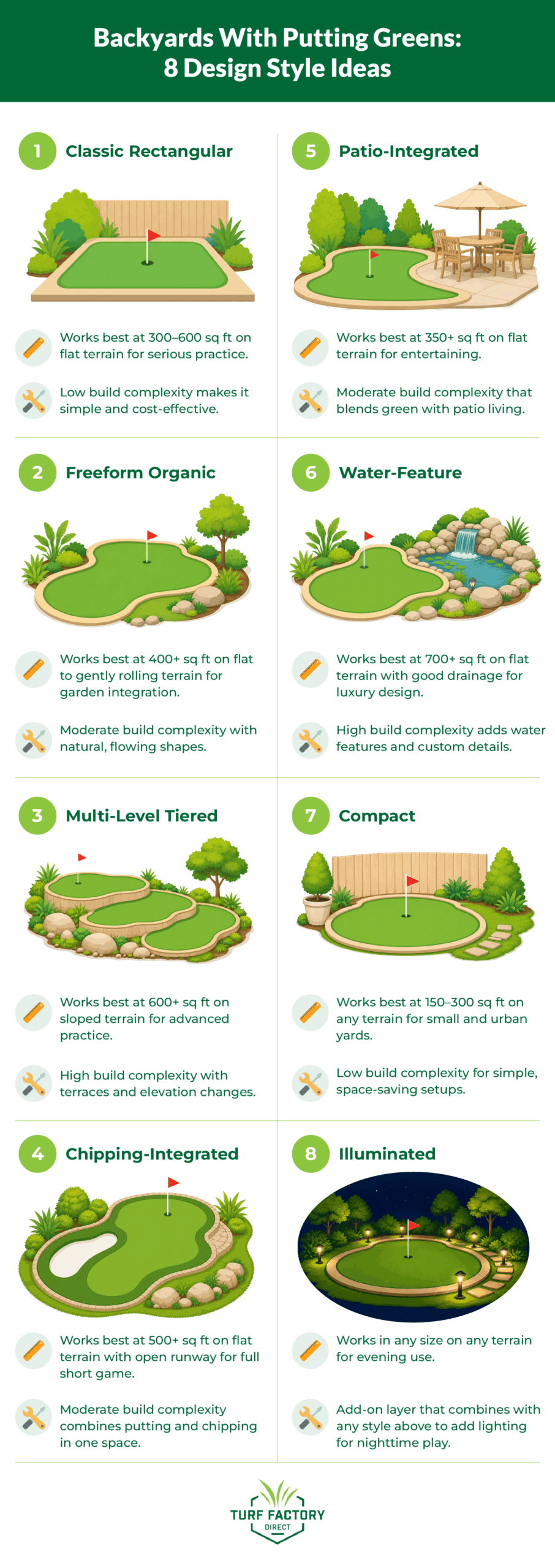
Three things settle which of these backyards with putting greens belongs in your yard: how much usable area you have, whether the ground moves, and whether you practice more than you host.
| Design style | Works best at | Terrain needed | Best for | Build complexity |
| 1. Classic rectangular | 300–600 sq ft | Flat | Serious practice | Low |
| 2. Freeform organic | 400+ sq ft | Flat to gently rolling | Garden integration | Moderate |
| 3. Multi-level tiered | 600+ sq ft | Sloped | Advanced practice | High |
| 4. Chipping-integrated | 500+ sq ft | Flat with open runway | Full short game | Moderate |
| 5. Patio-integrated | 350+ sq ft | Flat | Entertaining | Moderate |
| 6. Water-feature | 700+ sq ft | Flat, good drainage | Luxury design | High |
| 7. Compact | 150–300 sq ft | Any | Small and urban yards | Low |
| 8. Illuminated | Any size | Any | Evening use | Add-on layer |
Treat those square footages as typical ranges, not specifications. And the eighth style is not a choice against the other seven — lighting is a layer that goes over any of them.
Eight Inspiring Backyard Putting Green Design Ideas
1. The Classic Rectangular Putting Green: Clean Lines for the Serious Golfer
A rectangle gives a standard backyard the most usable surface and the shape that vanishes fastest into a landscape. It pairs with clipped hedges, stone borders, and furniture that stays out of the way.
Works best at 300–600 sq ft on flat terrain for serious practice. Low build complexity makes it simple and cost-effective.
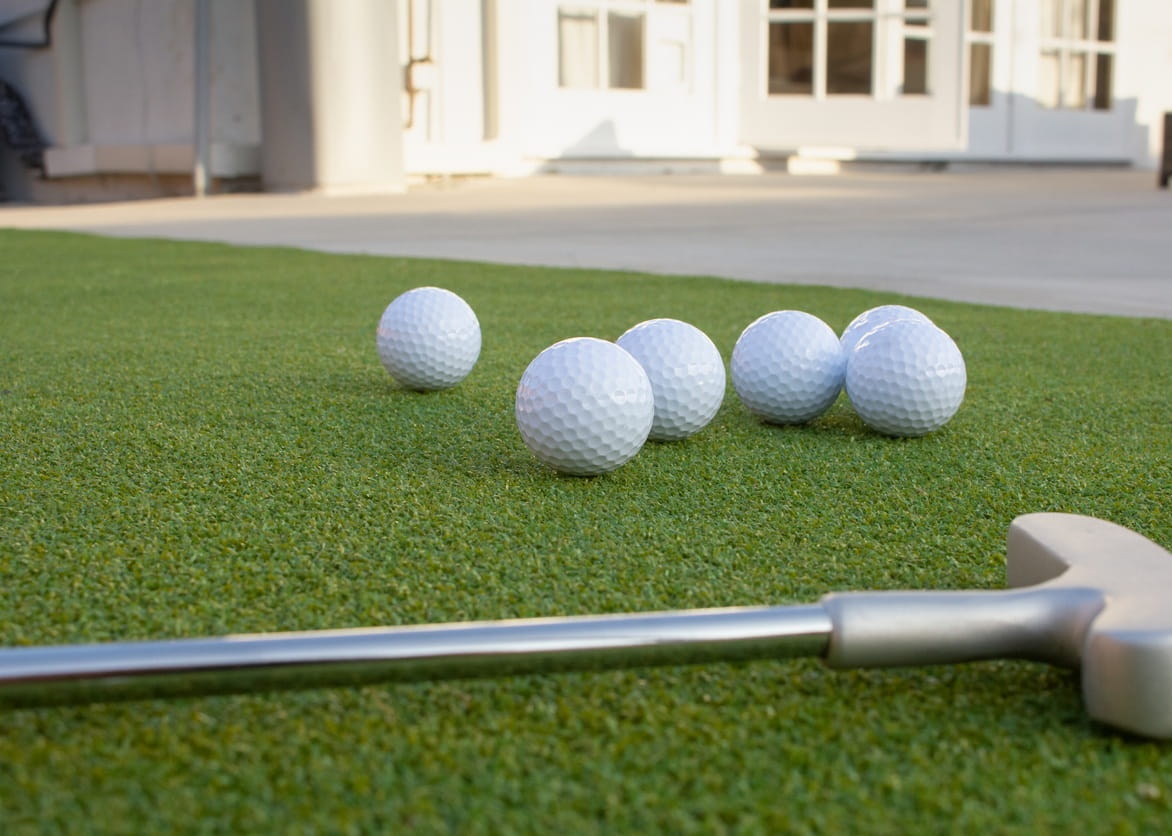
The professional-feel claim is the one worth examining. Pile height on a synthetic surface is manufactured rather than grown — identical front to back, in July and January, in year three and year ten. Bentgrass responds to heat, shade, traffic, and mowing direction — which is why courses fight grain, and why a green putts differently at nine in the morning than at four in the afternoon. Years of USGA championship data show green speeds slowing steadily as the day goes on, not rising. The USGA, which gave the game its measure of green speed, now weighs firmness, surface strength, smoothness, and trueness alongside it. Smoothness and trueness — two of the qualities that shape ball roll — are where a manufactured surface competes.
Cup placement does the rest. Three to five cups turn one shape into dozens of putts, and what changes is the line, not the hole. Cups are also set during construction and cannot be relocated the way they can on a grass green, so decide how many you want before the base goes in.
In a heavily planted yard, though, straight edges fight everything around them.
2. The Freeform Organic Putting Green: Where Landscaping Meets Golf
Curved edges let the surface settle into a garden. Beds, ornamental grasses, and mature trees all work against a curve.
Works best at 400+ sq ft on flat to gently rolling terrain for garden integration. Moderate build complexity with natural, flowing shapes.
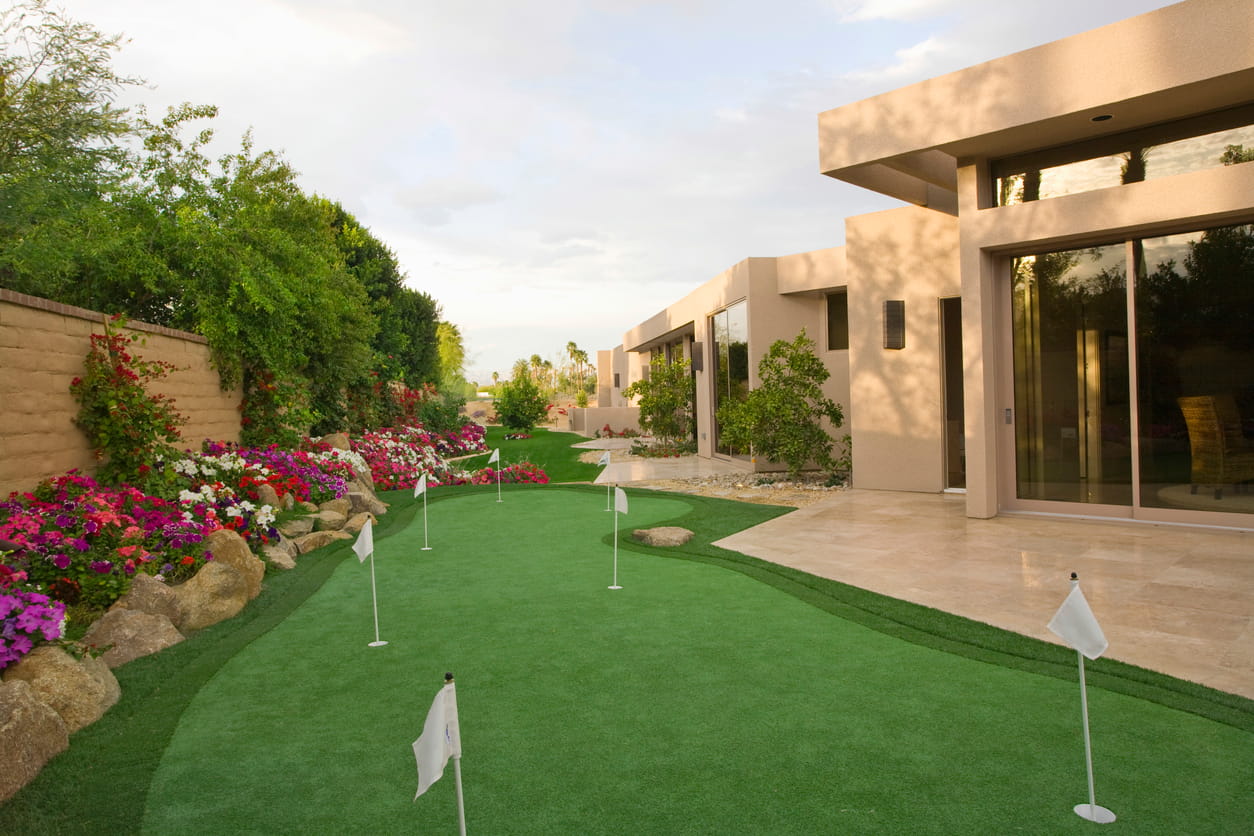
Why curves read as native is simple: nothing else in a garden is rectangular. A straight edge announces an installation. A curve lets the eye keep moving. With no mower path or sprinkler coverage to design around, shape is where synthetic has the freer hand.
The honest note is cost. A curve runs higher than a rectangle of equal area, because more perimeter means more edging and more shaping means more seaming labor.
Curves solve flat ground. Slopes need something else.
3. The Multi-Level Tiered Putting Green: Elevation Changes That Change the Putt
Gentle slopes and raised platforms reproduce what happens on a course, where almost no putt is flat. A tiered residential putting green gives a yard a middle distance it did not have.
Works best at 600+ sq ft on sloped terrain for advanced practice. High build complexity with terraces and elevation changes.
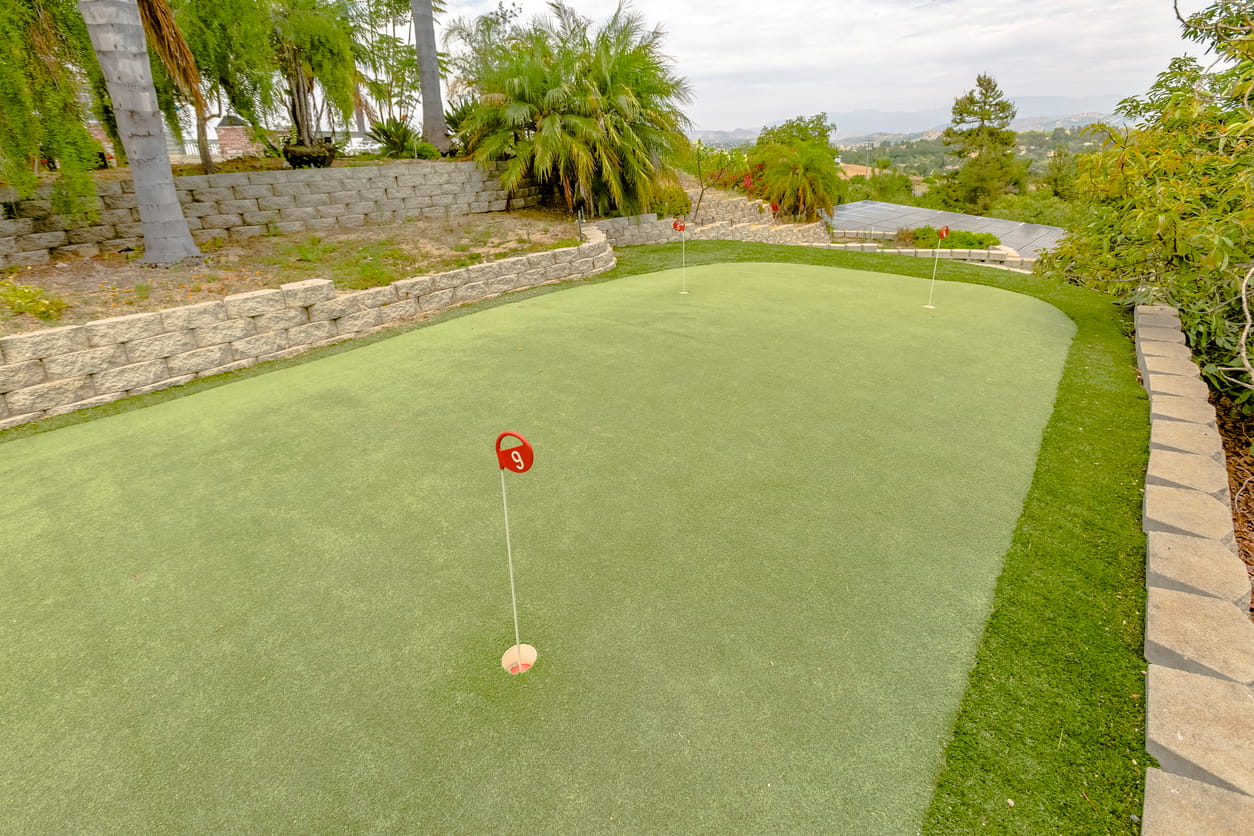
A slope is dead square footage — no table sits level on it, and mowing it is the worst twenty minutes of the week. Tiering turns the least usable part of a property into the most used, which is why a large outdoor putting green across grade changes often becomes the organizing feature of the yard.
Tiered builds depend on base preparation and drainage more than any other style, because what sits under the surface is the build. The USGA makes the same point: slopes complicate construction, and grading, retaining walls, and access all raise the price. Verify local grading rules, HOA guidelines, and retaining-wall requirements early.
Elevation adds difficulty to a putt. The next style adds a second shot.
4. The Chipping-Integrated Putting Green: The Full Practice Retreat
A putting surface with a fringe chipping zone attached is the backyard build that comes closest to covering the whole short game. Sand bunkers and rough-turf borders add realism and texture.
Works best at 500+ sq ft on flat terrain with open runway for full short game. Moderate build complexity combines putting and chipping in one space.
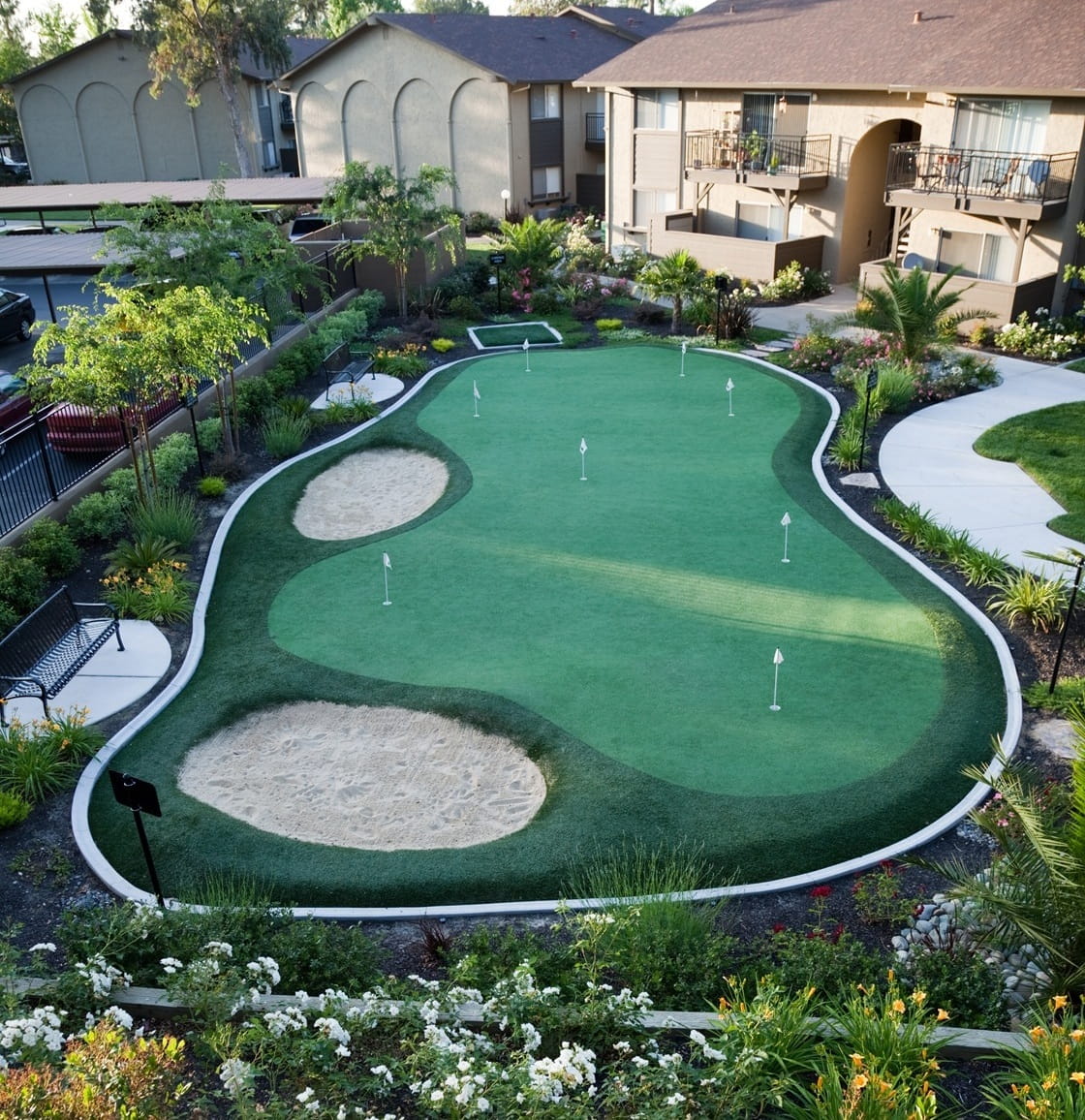
It is also the style that changes scores, because it practices the shots that cost strokes rather than the ones that are pleasant to hit.
Feasibility comes down to three things you can check from the back step in about ninety seconds: clear distance behind the green to stand and swing, overhead clearance for a lofted shot, and somewhere harmless for anything that flies long. Our backyard chipping green ideas guide carries the layout detail.
5. The Patio-Integrated Putting Green: Where the Yard Gathers
Here the green stops being a practice facility and becomes the center of the yard. Pavers, stamped concrete, or composite decking frame it as a centerpiece. Seating, fire features, and outdoor kitchens arrange around it the way furniture arranges around a hearth.
Works best at 350+ sq ft on flat terrain for entertaining. Moderate build complexity that blends green with patio living.
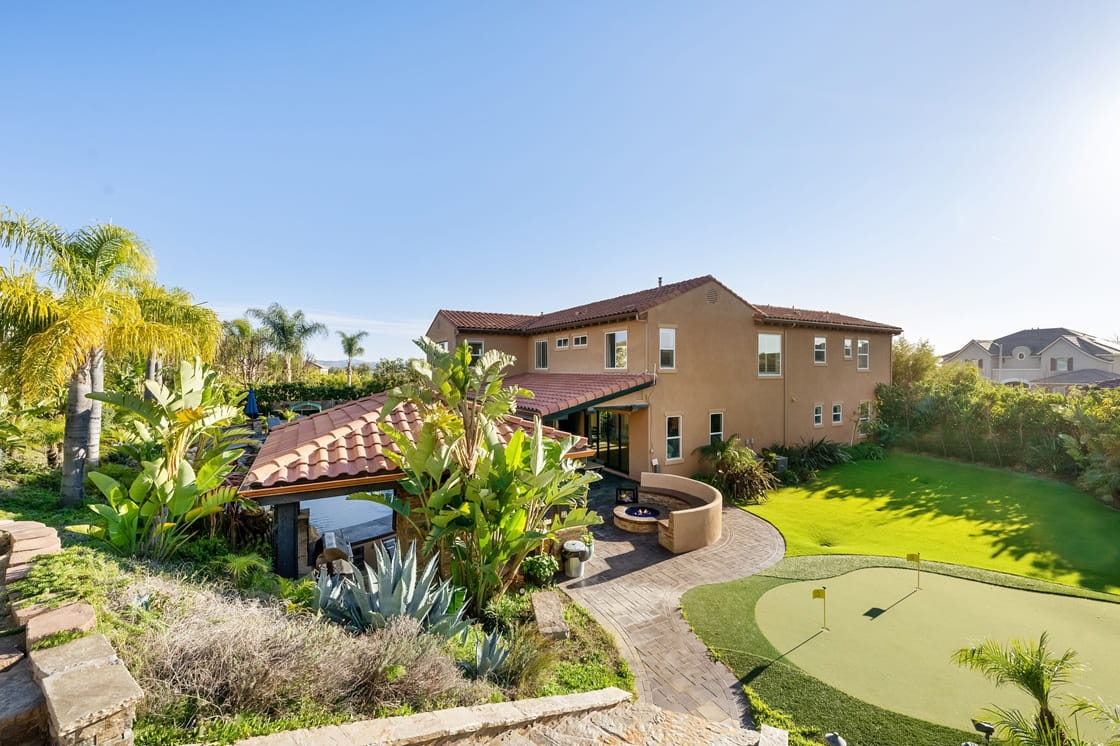
A green gives a gathering a center of gravity that a lawn does not — they do something on a green. Children who would otherwise drift back inside stay out. And the surface holds up in normal shoes, at dusk, with a drink in hand, on ground that is never muddy.
Whether it reads as designed or added on comes down to one detail: the transition where hardscape meets turf. A flush edge disappears. A lip catches a ball, then a toe.
Hardscape frames a green with hard edges. Water frames it with movement.
6. The Water-Feature Putting Green: Water as Boundary, Not Hazard
A stream, pond, or fountain beside the surface changes the character of a space more than almost any other addition. Sound arrives, movement arrives, and the green acquires a setting rather than a location — a signature of custom residential putting green design.
Works best at 700+ sq ft on flat terrain with good drainage for luxury design. High build complexity adds water features and custom details.
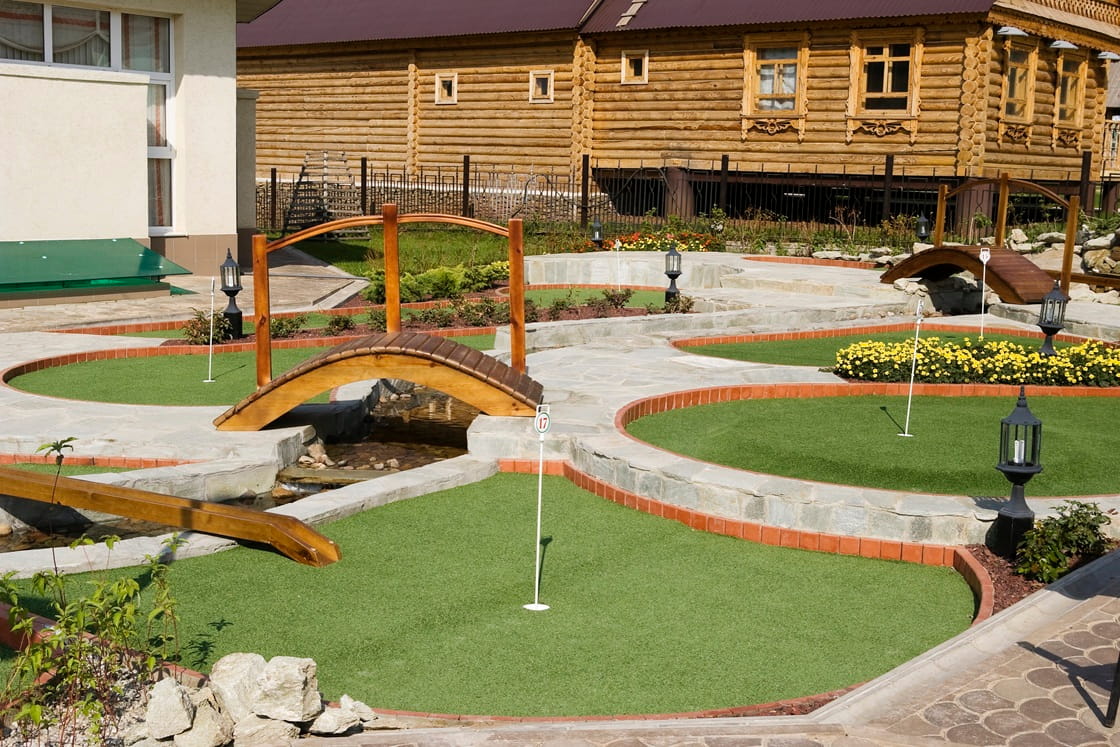
Three rules make it work. Keep water off the primary putting sightline, because the eye tracks movement and the stroke follows the eye. Use the water as a boundary or a backdrop, never a hazard. And scale it down, since an oversized water element visually shrinks the green beside it.
Water adjacency also raises drainage and splash-management questions that are cheaper to settle at the design stage, and any pump circuit should be checked against local code.
7. The Compact Putting Green: Big Impact in Small Backyards
Modest dimensions are not the obstacle most homeowners assume. A well-proportioned small green looks deliberate; an oversized one in a tight yard looks crowded no matter how good the turf is.
Works best at 150–300 sq ft on any terrain for small and urban yards. Low build complexity for simple, space-saving setups.
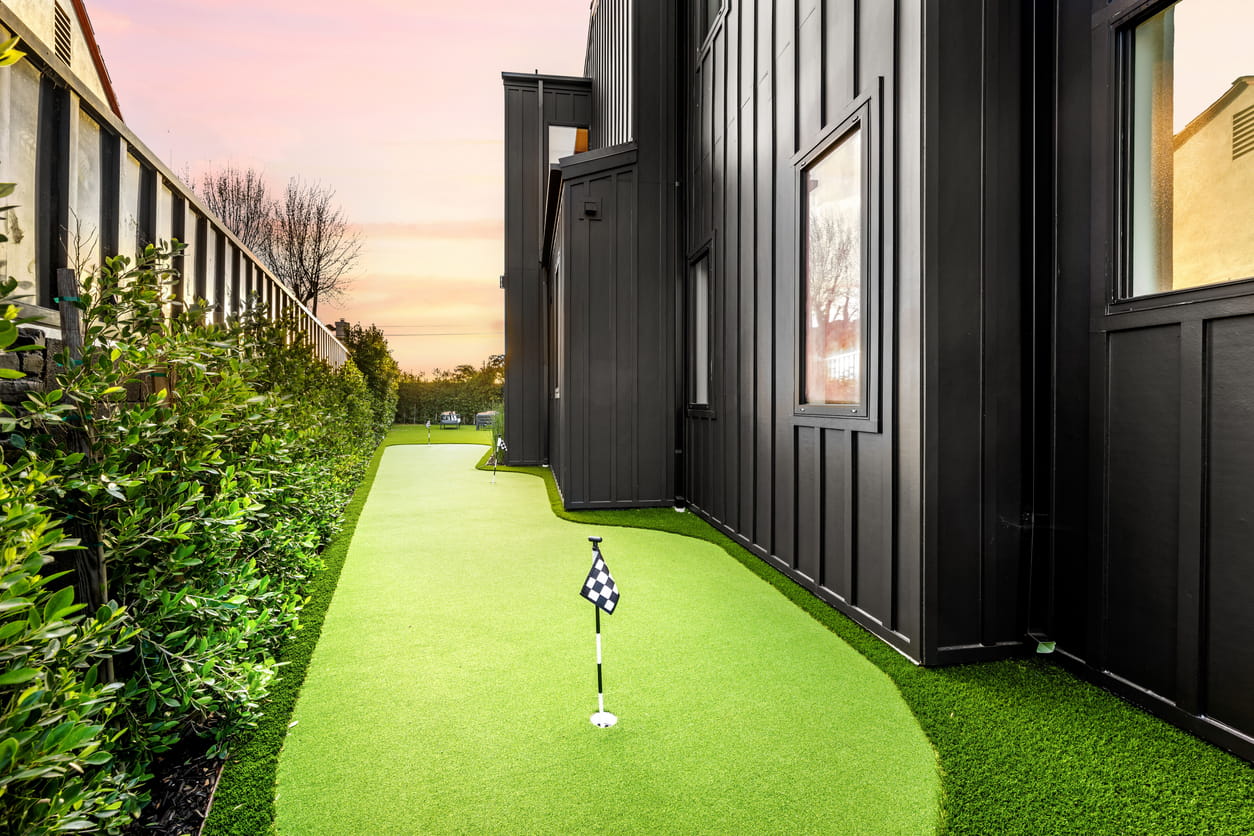
Three layouts do most of the work. Corner placement borrows two boundaries the yard already has. A narrow strip converts a dead side yard into a long straight putt. A wraparound routes around an existing patio and planting beds instead of demolishing them.
It is also among the most commonly built backyard putting green designs because it fits the square footage most people have. Our small putting green guide goes deeper on the layouts that suit a putting green for small backyard conditions.
Proportion beats size. One well-placed cup with genuine break is worth more than three crammed cups producing the same four-foot putt.
8. The Illuminated Putting Green: Play Day or Night
Low-voltage landscape lighting, LED cup lights, and path fixtures extend the green past sunset and turn it into something the house looks out onto. Solar and low-voltage options keep running costs negligible.
Works in any size on any terrain for evening use. Add-on layer that combines with any style above to add lighting for nighttime play.
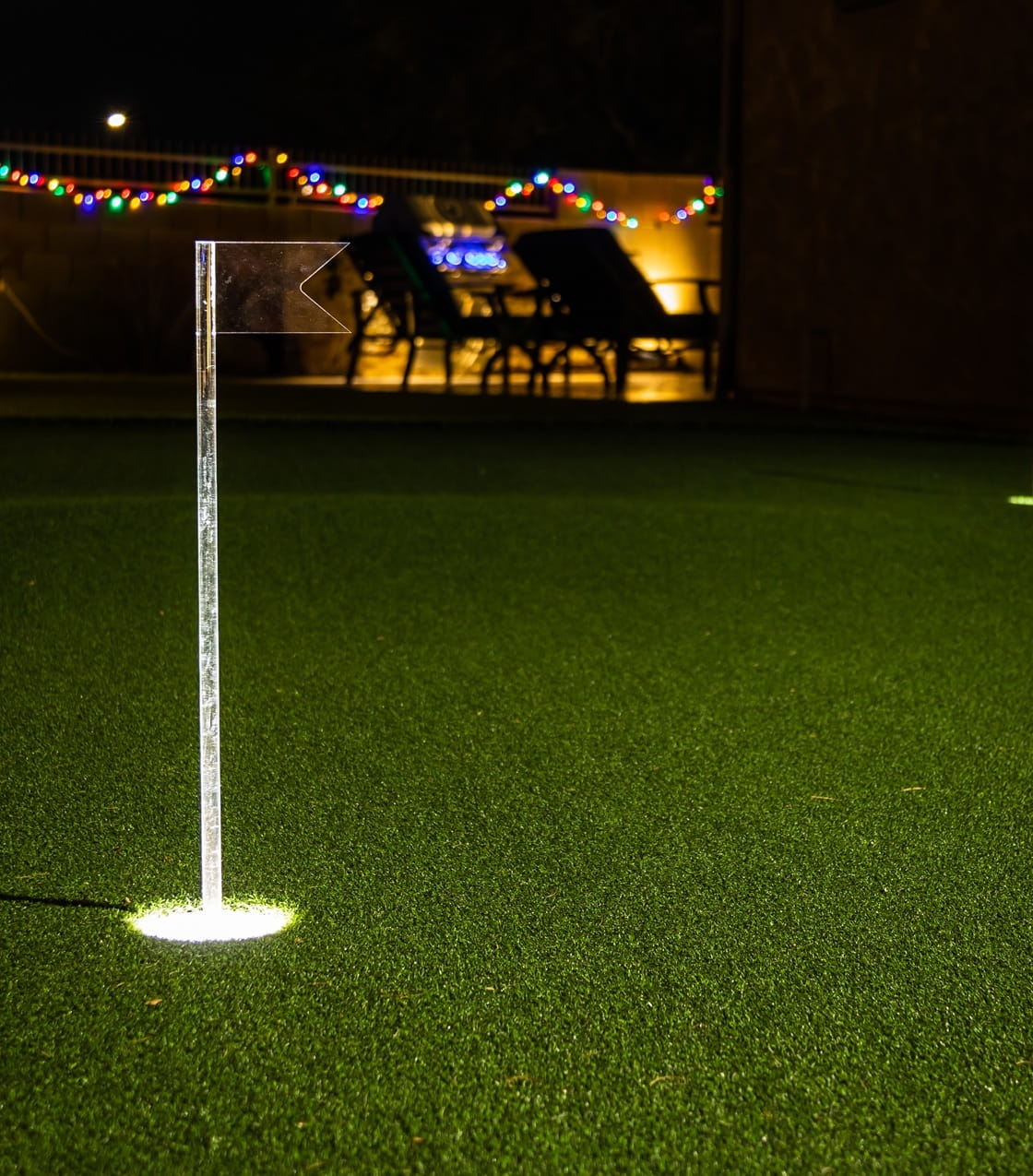
Lighting increases how often a green actually gets used. For most working households the free hours are after dark, and in hot regions the evening is often the only comfortable time to be outside in July. A green that would sit unused all summer becomes a nightly habit.
This is a layer that goes over any of the seven styles above. Low-voltage systems are homeowner-manageable; anything requiring a new circuit is not, so verify local electrical requirements first.
The Putting Green as a Property Value Investment
The gallery shows what these spaces look like. This is what they are worth.
Lower Upkeep, Higher Use: The Everyday Return
The EPA’s WaterSense program reports that outdoor use accounts for more than 30% of a household’s water nationally, and as much as 60% in arid regions. The program also reports that the average American household uses more water outdoors than for showering and washing clothes combined. That is the recurring expense an artificial putting green backyard removes. In regions with seasonal watering restrictions, that is a water conservation gain as much as a maintenance one.
| Ongoing task | Natural grass lawn | Synthetic putting green |
| Mowing | Weekly in growing season | None |
| Watering | Regular, at prevailing local rates | None |
| Fertilizing and weed control | Seasonal applications | None |
| Reseeding and patching | Annual or as needed | None |
Curb Appeal and Buyer Interest: How Putting Greens Read to the Market
Research from the National Association of Realtors and the National Association of Landscape Professionals found that 92% of Realtors have suggested sellers improve curb appeal before listing. The same report puts landscape-category work at the top of estimated cost recovery — an overall landscape upgrade at 100% — while a large single-purpose amenity such as an in-ground pool recovers 56%, the lowest figure on the list.
This is useful information for backyards with putting greens as a resale category: the market rewards outdoor work that reads as maintained landscape and discounts work that reads as an amenity the next owner inherits. A permanently green surface with no dormant season reads as the former. NAR is explicit that recovery varies with design, materials, location, and the home’s age and condition.
Choosing Your Style: Key Factors that Decide for Backyards with Putting Greens
Factors such as usable square footage, ground movement, and whether the space will be used primarily for practice or for hosting will narrow eight backyards with putting greens down to one or two before personal preferences even come into play.
Three steps from here:
- Measure the usable area, and note its slope and where the afternoon sun falls.
- Identify which of the eight styles matches those conditions.
- Evaluate turf in your own yard, in real light, before committing.
Browse putting green surfaces or request samples to judge roll quality, blade color, and how the green reads against your fence and beds.
Eighteen months from now, the forty minutes on the mower are gone. Somebody walks out the back door before dinner, drops a ball, and stays out there until dark.