Two backyard greens are laid with putting grass that looks identical in the installer’s photos. Three summers later, one still rolls true. The other is faded, lumpy and lifting at the seams, and putts break where there is no slope.
The difference comes down to five things: the yarn, the pile height and density, the backing, the infill system and the manufacturer behind them. The first four are printed on the spec sheet; the fifth decides whether you can trust that sheet.
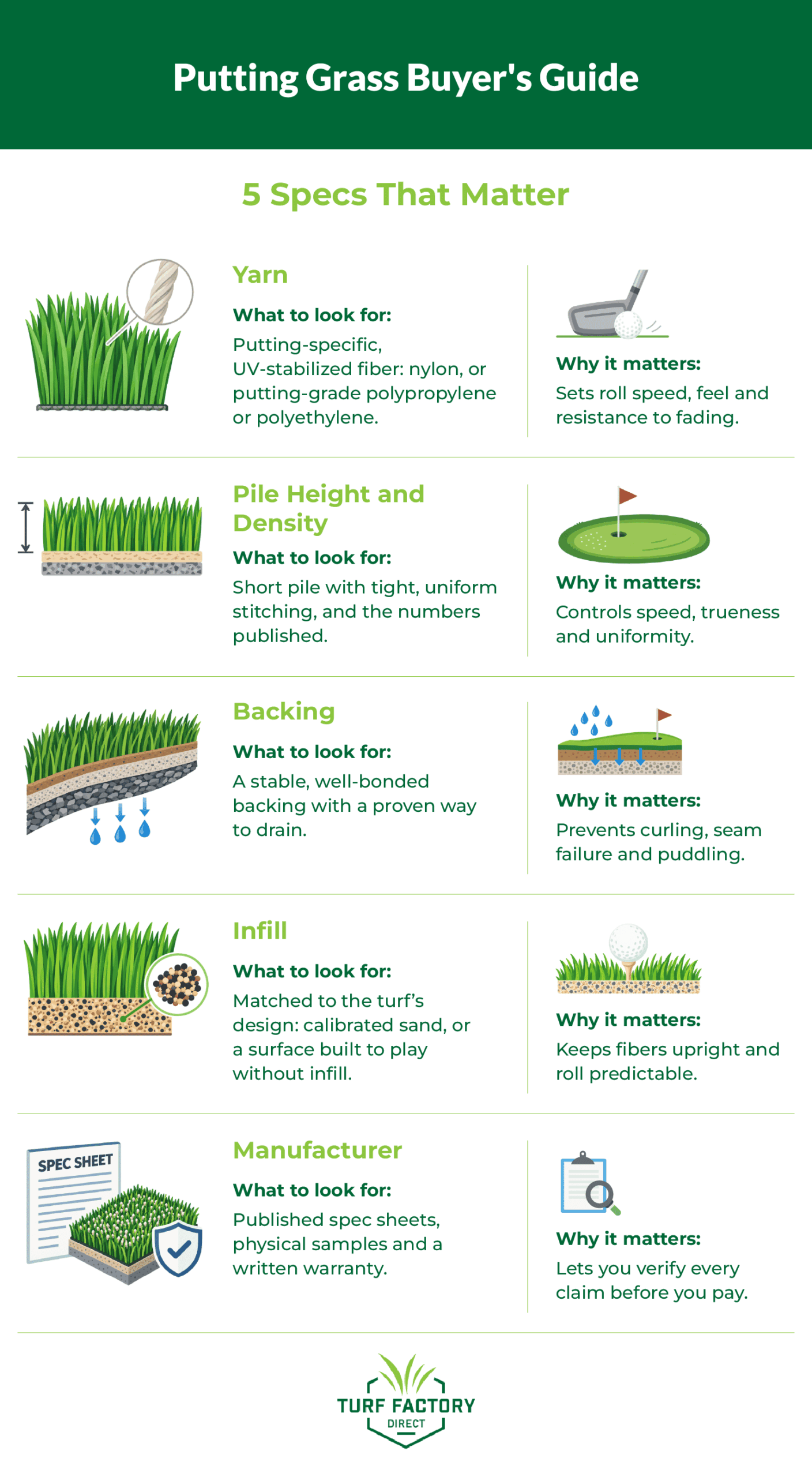
| Spec | What to look for | Why it matters |
| Yarn | Putting-specific, UV-stabilized fiber: nylon, or putting-grade polypropylene or polyethylene | Sets roll speed, feel and resistance to fading |
| Pile height and density | Short pile with tight, uniform stitching, and the numbers published | Controls speed, trueness and uniformity |
| Backing | A stable, well-bonded backing with a proven way to drain | Prevents curling, seam failure and puddling |
| Infill | Matched to the turf’s design: calibrated sand, or a surface built to play without infill | Keeps fibers upright and roll predictable |
| Manufacturer | Published spec sheets, physical samples and a written warranty | Lets you verify every claim before you pay |
This guide takes each spec in turn: what it is, what it changes under the ball and what a weak version costs you later. If you’re still deciding whether a green suits your yard, start with our overview of artificial outdoor putting grass.
Key Takeaways
- Five specs decide performance: the yarn, the pile height and density, the backing, the infill system and the manufacturer behind them.
- Performance means more than speed. Judge a green on speed, trueness, consistency and longevity; a smooth, true roll beats a high Stimpmeter number.
- Verify every claim before you pay. Ask for a full technical data sheet and independent test reports, then put physical samples through five simple checks at home.
- Read the warranty as three promises. Check that wear, fading and structural failure are each covered in writing, and whether coverage is full or pro-rated.
- Compare cost per year, not sticker price. A surface that costs 30% more but lasts twice as long works out about 35% cheaper per year.
What Separates a Championship-Grade Putting Surface from an Expensive Mistake
The Hidden Cost of Getting It Wrong: Why a Putting Surface Is Not a Commodity Purchase
Walk a failed green in its third summer and the damage is plain to see. A matted lane runs from the patio to the cup. The sunny side has gone straw-colored, a seam shows as a faint ridge and one edge has curled after a heat wave.
None of that showed in the photos. Products that look alike from above can differ in fiber chemistry, stitch density, how firmly each tuft is anchored and how the backing handles heat and water.
You pay for a failed green twice: first in seasons of practice on a surface that got worse every month, then in removal, rework of the base and a second purchase. Treat the purchase as a long-term performance asset, not a landscaping accessory, because every one of those failures traces back to a spec you can check before you buy.
Speed, Trueness and Consistency: What “Performance” Means on a Putting Surface
Four measures decide whether a green is worth putting on:
- Green speed: how far the ball rolls on a flat section, measured with a Stimpmeter. The Stimpmeter is a 36-inch grooved bar; a ball is released from a notch as the bar is raised to about 22 degrees. The average of three rolls in each of two opposite directions is the reading in feet. Higher means faster.
- Trueness: the ball goes where the slope says it should, with no wobble, hop or drift.
- Consistency: the same speed in every direction and on every part of the green. On synthetic surfaces, the usual enemy is grain: fibers leaning one way, so putts run faster with the lean than against it, just as they do with and against the grain on a natural green.
- Longevity: holding all three for years, not months.
Faster isn’t the goal in itself. In its explanation of the updated Stimpmeter, the USGA says a bigger number doesn’t necessarily mean better conditions, and that average golfers can’t detect a difference of less than a foot. A smooth, true roll beats an impressive number.
Each of these outcomes traces back to a handful of specifications.
The Four Technical Specs That Determine Putting Grass Performance
Yarn Construction: The Engine Behind Every True Roll
The spec. Three polymers dominate. Nylon is the most resilient: it holds its shape under high stress and springs back after foot traffic, which is why nylon putting turf is used on many high-performance greens, including designs that play without infill. Polypropylene is also used on putting surfaces, usually texturized and paired with sand. Polyethylene is soft and realistic, better suited to fringe and surrounding landscape than to the putting surface.
Construction matters as much as polymer. Monofilament yarns are single upright strands, while fibrillated yarns are flat tapes slit into a net that spreads to hold infill. Texturized yarn is heat-set into a curl that helps fibers stand up, locks sand in place and reduces grain, though it usually needs infill and plays a little differently from straight fiber.
Thickness is quoted in denier (grams per 9,000 meters of fiber) or dtex (grams per 10,000 meters, a unit of the ISO-approved tex system). Thinner gives a finer surface, but a fiber too fine for its length flattens under traffic and doesn’t spring back.
UV stabilizers, blended in when the fiber is made, are just as important. Without them, the sunniest parts of the green fade and turn brittle first.
The feel. Yarn decides how the ball comes off the putter face, how far it rolls out and whether the surface looks like a green or a lawn from ten feet away.
The cost. Yarn is the one component you can’t repair. Once the fibers fade or mat, the only fix is a new surface.
| Yarn type | Feel | Roll behavior | Durability | Best use |
| Nylon | Firm, resilient | Fast and true, holds speed under traffic | Highest resistance to crushing | Putting surface, including many no-infill designs |
| Polypropylene | Firm, fine | True when properly infilled | Good, relies on infill for support | Putting surface, usually texturized and sand-filled |
| Polyethylene | Soft, lawn-like | Slower, grabbier | Looks good, flattens under repeated rolls | Fringe, collars and surrounding landscape |
Ask your supplier:
- What polymer is the putting surface made from, and is it monofilament, fibrillated or texturized?
- What is the denier or dtex?
- Is the yarn UV-stabilized, and do you have independent UV test results?
- Where is the yarn made, and does the warranty cover fading?
Pile Height and Pile Density: The Precision Variables Many Buyers Overlook
The spec. Pile height is the length of the fibers from the top of the backing to the tips. Putting surfaces are short; fringe and chipping areas run taller. The right height depends on the design, because a sand-filled surface and a no-infill surface reach the same speed at different heights. Judge height together with infill, not on its own.
Pile density is how tightly the tufts are packed, often quoted in stitches per square meter. In putting grass turf specifications, density comes from two lines. Gauge is the spacing between tuft rows, and stitch rate is the number of tufts per unit of length along each row. A finer gauge and a higher stitch rate mean a denser, more even surface.
Face weight, the ounces of yarn per square yard, is the number sellers like to lead with. It’s useful, but taller fibers inflate it without adding density. Compare face weight only between products with the same pile height, and use gauge and stitch rate to see how tightly the fibers are really packed.
A short pile isn’t a maintenance shortcut: it shows every flaw in the base and needs a precise infill level. In low, angled light, thin stripes or visible rows point to poor manufacturing control and predict uneven wear.
The feel. Density decides trueness. A dense surface supports the ball evenly and keeps grain to a minimum, while a sparse one lets the ball settle and wobble.
The cost. Thin or uneven density shows up as worn lanes and patchy speed within a few seasons.
| Spec sheet line | What it tells you |
| Yarn type | Resilience, heat tolerance and whether infill is needed |
| Pile height | Base speed, and whether the product is for the putting surface or the fringe |
| Face weight | Amount of yarn; compare only at the same pile height. |
| Gauge | Row spacing; finer means denser. |
| Stitch rate | Tufts per unit of length; together with gauge, sets the density. |
| Backing | Stability and how the turf drains |
| Tuft bind | How firmly the fibers are anchored |
| Infill | Required type and fill rate, or none needed |
If roll speed is your priority: focus on gauge, stitch rate and how precisely the infill can be set. If your green has fringe or chipping areas: plan a taller product that holds a ball the way a real collar does, rather than a compromise height across the whole green.
Ask your supplier:
- What are the pile height, gauge, stitch rate and face weight?
- Is this product designed for putting, or also sold as lawn turf?
- Can I see samples from two different production runs?
Backing Material: The Structural Foundation That Determines Longevity
The spec. The primary backing is the fabric the fibers are stitched through. The secondary backing is a coating on the underside that locks each tuft in place. Together, they decide whether the turf keeps its size and shape through heat, cold and rain.
A weak backing stretches and shrinks with the temperature, causing curled edges, split seams and ripples; turf specifiers weigh a backing’s stability across the expected weather for exactly this reason when planning seams. On putting grass, even a small ripple sends the ball off line.
Latex coatings are common and cost-effective. A polyurethane backing resists water damage better than latex and is generally more durable, which is why it has largely replaced latex on demanding outdoor turf, typically at a higher cost. Rubber and rubberized backings are heavy, which helps the turf lie flat and stay put.
The number that links backing to lifespan is tuft bind: the force needed to pull a tuft out, measured under the ASTM D1335 test method and usually listed on spec sheets in pounds. When tuft bind is low, fibers loosen first at seams, along edges and on the paths people walk.
Water leaves a synthetic green in one of three ways: through perforations, through a fully permeable backing, or off the edges into a prepared base. Each works when matched to the site, and standing water is often a base problem as much as a turf one; a separation fabric under the base that clogs with sediment can cause drainage failure on its own. Ask how the product drains and what base it needs.
The feel. You never feel a good backing, only a bad one’s failures: ridges, soft spots and a ball that drifts.
The cost. Backing failures are the most expensive to fix: re-stretching, re-seaming and, if the backing separates from the fibers, a whole new surface.
| Backing type | Strength | Drainage | Heat and moisture tolerance | Relative cost |
| Latex coating | Good | Through perforations | Moderate, can weaken with long exposure | Lower |
| Polyurethane coating | Durable, resists water damage | Perforated or permeable designs | High | Higher |
| Rubber or rubberized | Heavy, lies flat and stable | Often drains off the edges into the base | Good | Varies by product |
If appearance and longevity are your priority: the backing is what keeps the green looking flat and new, so weigh tuft bind and stability above anything visible in a photo.
Ask your supplier:
- What are the primary backing and the coating made of?
- What is the tuft bind, and how was it tested (for example, to ASTM D1335)?
- How does this product drain, and what base does it need?
- Does the warranty cover the backing separating and seams failing?
Infill Material: The Invisible Performance Multiplier
The spec. On a sand-filled green, fine sand fills the gaps between the fibers. It holds them upright, sets how firm the surface is and keeps the roll predictable. Some surfaces, often dense nylon, are built to play without infill. Both approaches work; what matters is using the one the turf was designed for.
The standard putting grass infill is clean, dry, evenly sized silica sand. The shape of the grain matters: rounded grains flow in easily and stay loose, while angular grains pack firmer. Ask which grain the product was designed and tested with. Crumb rubber belongs on sports fields, where its shock absorption helps players; on a putting surface it slows the roll and makes the ball hop.
Sand depth needs to be right and even across the green, because speed follows depth. Too little sand lets fibers lie down, and speed jumps in patches; too much buries them, and the surface plays hard and bumpy. Within the recommended range, owners can fine-tune speed with the sand level and brushing.
Infill also settles with rain and foot traffic, so occasional brushing and top-ups are normal. A well-built green is low-maintenance, and brushing and top-ups are the maintenance it needs.
The feel. The right infill gives a firm, even roll; the wrong infill feels spongy, bumpy or patchy.
The cost. Wrong or uneven infill means repeated top-ups, uneven wear and matted fibers, and it can affect warranty coverage.
| Infill type | Firmness | Roll effect | Suitable for putting? |
| Silica sand, uniform grain | Firm | Fast and true; speed adjusts with depth. | Yes, the standard for sand-filled greens. |
| Rounded or coated sand | Firm | Similar to silica; flows in easily. | Yes, when the manufacturer specifies it. |
| Crumb rubber | Soft, springy | Slows the roll and adds bounce. | No; built for sports fields. |
| None (turf designed for no infill) | Set by fiber density | Consistent with no top-ups. | Yes, when the turf is built for it. |
Ask your supplier:
- Does this product need infill? If so, what type, grain size and fill rate?
- How often will it need topping up?
- Does using a different infill affect the warranty?
How to Evaluate Putting Grass Manufacturers and Suppliers
A spec sheet is a set of claims; this section is about checking them. For a wider look at vetting a company, see how to choose the right putting grass company.
Supplier Credibility: Separating Real Data from Marketing Noise
A credible manufacturer hands over a full technical data sheet without being chased. It can also provide independent lab reports for UV resistance and tuft bind. Ask where the yarn and raw materials come from. A supplier that controls its sourcing can keep batches consistent and match a replacement roll years later.
Then check that the product was made for putting. Genuine putting grass turf has a short, dense pile, putting-grade yarn, stated infill requirements and speed data from installed greens. Repurposed landscape turf gives itself away with soft blades, a lawn-length pile and one listing marketed for both lawns and greens.
For a neutral benchmark, the Synthetic Turf Council guidelines include a non-proprietary specification for synthetic turf systems, plus separate guidelines for landscape installation and base construction, that you can check claims against.
Red Flags: Warning Signs in Product Listings
Many weak products announce themselves before you ever see a sample.
| Red flag | What it usually means |
| Vague specs (“premium,” “tour-quality”) with no numbers | The numbers aren’t competitive, or aren’t known |
| No technical data sheet | No manufacturing control to document |
| Performance claims you can’t verify | Marketing, not measurement |
| A warranty with no written terms | Coverage that disappears when you need it |
| One product sold for both lawns and greens | Landscape turf repurposed for putting |
| Speed claims with no test method | A number with nothing behind it |
Samples and Testing: Verifying Claims Before You Buy
A sample in your hand tells you more than any photo. The USGA recommends a level rolling area about 12 feet long for a Stimpmeter reading, so ask the supplier for speed readings from installed greens.
Then run five checks at home:
- Look at it in daylight. Check the fiber shape, whether the color is consistent and how evenly the tufts are spaced.
- Press and release. Flatten the fibers with your palm and watch how quickly they spring back.
- Tug a few fibers. Firm resistance suggests good tuft bind; fibers that slide out are a warning.
- Check how the backing drains. Look for perforations or a permeable structure, or confirm the drainage method the supplier states.
- Roll a ball across it. Watch for hops or drift, and compare samples on the same flat surface.
The simplest way to start is to request putting grass samples and put them through these checks before you buy.
A credible product is only half the equation. The other half is what it costs you over its full life.
The True Cost of Owning Putting Grass: Warranty, Installation and Lifespan
The price on day one is only the first number. For typical ranges, see our guide to the cost of artificial putting grass; here, the focus is what that price buys over time.
Warranty Terms: What Coverage Actually Protects
A warranty is three separate promises: against surface wear such as matting and fiber loss, against fading beyond a stated level, and against structural failure such as the backing separating or tufts pulling out. Check that each one is written down.
Then read the exclusions: typically installation errors, incorrect or missing infill, misuse such as spikes or reflected heat, and undocumented maintenance. Finally, check whether coverage is full or pro-rated. Full coverage replaces the product at no cost for the whole term, while pro-rated coverage pays a shrinking share as the surface ages.
Installation Quality: Why Product and Fitting Both Matter
Expert installation can’t rescue a weak product, and a strong product still needs a firm, compacted, properly graded base, tight seams and secure edges. The base decides flatness and drainage; the product decides how long the surface keeps performing on top of it. Budget for both to be done well.
Hidden Costs: What a Cheap Green Adds Up To
Each hidden cost leads back to a spec from earlier in this guide.
| Hidden cost | What causes it | Which spec prevents it |
| Infill replacement | Loose, sparse fibers that don’t hold sand | Pile density, texturized yarn |
| Re-stretching | Backing that moves with temperature | Backing stability |
| Seam repair | Weak tuft bind and a poor bond at the seams | Tuft bind, backing coating |
| Early full replacement | Fading, matting or the backing separating | UV-stabilized, resilient yarn, backing quality |
Cost-Per-Year: Calculating the Real Price of Your Green
The fairest comparison between two surfaces is cost per year of good performance.
- Add the purchase price and the installation cost.
- Add the upkeep and repairs you expect over the surface’s life.
- Divide the total by the number of years it will perform well.
The results can flip a decision. A surface that costs 30% more but lasts twice as long works out about 35% cheaper per year. If you’d like help running the numbers for your own green, contact us.
With every spec and cost in view, the last step is weighing them side by side.
Making the Final Decision: A Framework for Buying with Confidence
The Decision Matrix: Scoring Every Spec in One Place
Score two or three shortlisted products side by side:
| Criterion | What “strong” looks like | Product A | Product B |
| Yarn | Putting-grade polymer, UV-stabilized, denier or dtex published. | ||
| Pile | Short and dense; gauge, stitch rate and face weight published. | ||
| Backing | Stable coating, stated tuft bind, clear drainage method. | ||
| Infill | Type and fill rate specified, or designed for no infill. | ||
| Manufacturer | Full data sheet, samples, independent test reports. | ||
| Warranty | Written; covers wear, fading and structure; says whether it’s full or pro-rated. | ||
| Cost per year | Calculated, not guessed. |
Matching Specs to Your Green, Climate and Goals
The right specs for backyard putting grass depend on where it sits and what you want from it:
- Hot, high-UV climates: favor strong UV stabilization, resilient yarn such as nylon and a stable backing, and watch for heat reflected from windows.
- Climates with hard freezes: favor stability and drainage, because water trapped in the base freezes, heaves the surface and shifts the backing.
- Shaded yards: drainage and debris control matter more than UV, and leaves need regular clearing to keep the roll true.
- Greens with chipping areas or fringe: pair a taller fringe product that holds the ball with a putting surface firm enough for chips to stop.
- Speed vs. appearance: speed-focused owners should weigh density and infill precision most; appearance-focused owners, UV stability and backing.
Premium Value: Why the Highest Price Is Not Automatically the Best
Price reflects materials, but also branding and margin. Real premium value shows up in the numbers (yarn, density, tuft bind, backing) and in a warranty that puts them in writing.
Common Questions About Synthetic Putting Grass
Is putting turf the same as regular artificial turf?
No. Putting turf uses shorter, denser, putting-grade fiber engineered for a fast, true roll, and is often designed around sand infill. Landscape turf is longer and softer, built for looks and comfort, so a ball rolls slowly on it and wanders off line.
How long does a quality synthetic putting grass last?
It depends on sun exposure and foot traffic, which both break down the fibers, and on how well the infill is kept up and the green was installed. The length and terms of the written warranty are the best indicator of how long the manufacturer expects it to perform.
What is the best putting grass infill?
For sand-filled greens, it’s clean, evenly sized silica sand at the fill rate the manufacturer specifies. Some surfaces are built to play without any infill. Crumb rubber isn’t suitable, because it slows the roll and makes the ball bounce on every putt.
How much maintenance does a synthetic putting grass need?
Not much, but some. Clear debris regularly, brush now and then to keep fibers upright and grain neutral, and top up infill occasionally on sand-filled greens. After heavy storms, walk the edges and seams to catch small issues before they grow.
Can I chip onto an artificial putting grass?
Yes, if it’s built for it. Chips stop best on a firm, well-infilled surface, and a taller fringe catches balls that come up short. Ask whether the product is rated for chipping; if it isn’t, use a hitting mat or a dedicated landing area.
How fast should a backyard putting grass be?
Aim for a speed close to the courses you play most, so your practice carries over. For context, the USGA’s original Stimpmeter guidance rated 8 ½ feet as fast for everyday club play and medium for tournaments, where 10 ½ feet counted as fast. A smooth, true roll matters more than chasing a higher reading.
Your Investment-Grade Putting Grass Checklist
Five specs decide: yarn, pile, backing, infill and the manufacturer behind them. A photo can’t show you any of them, but a spec sheet, a sample and a written warranty can.
What an investment-grade surface shows on paper and underfoot:
- Putting-grade, UV-stabilized yarn, with the polymer, construction and denier or dtex published
- Published pile height, gauge, stitch rate and face weight, consistent across production runs
- A stable backing with a stated tuft bind and a clear drainage method
- A specified infill type and fill rate, or a design built to play without infill
- A full data sheet, physical samples and independent test reports
Questions to ask before you sign:
- Is this product built for putting, or also sold as lawn turf?
- What is the tuft bind, and how was it tested?
- What does the written warranty cover, is it full or pro-rated, and what does it exclude?
- What is the expected cost per year over the surface’s life?
Your next three steps:
- Compare TFD putting grass specs against this checklist.
- Request putting grass samples and test them at home.
- Contact us to talk through your green’s design, climate and goals.
Buy by the spec sheet and the cost per year, and your green becomes one that still rolls true after several years.