


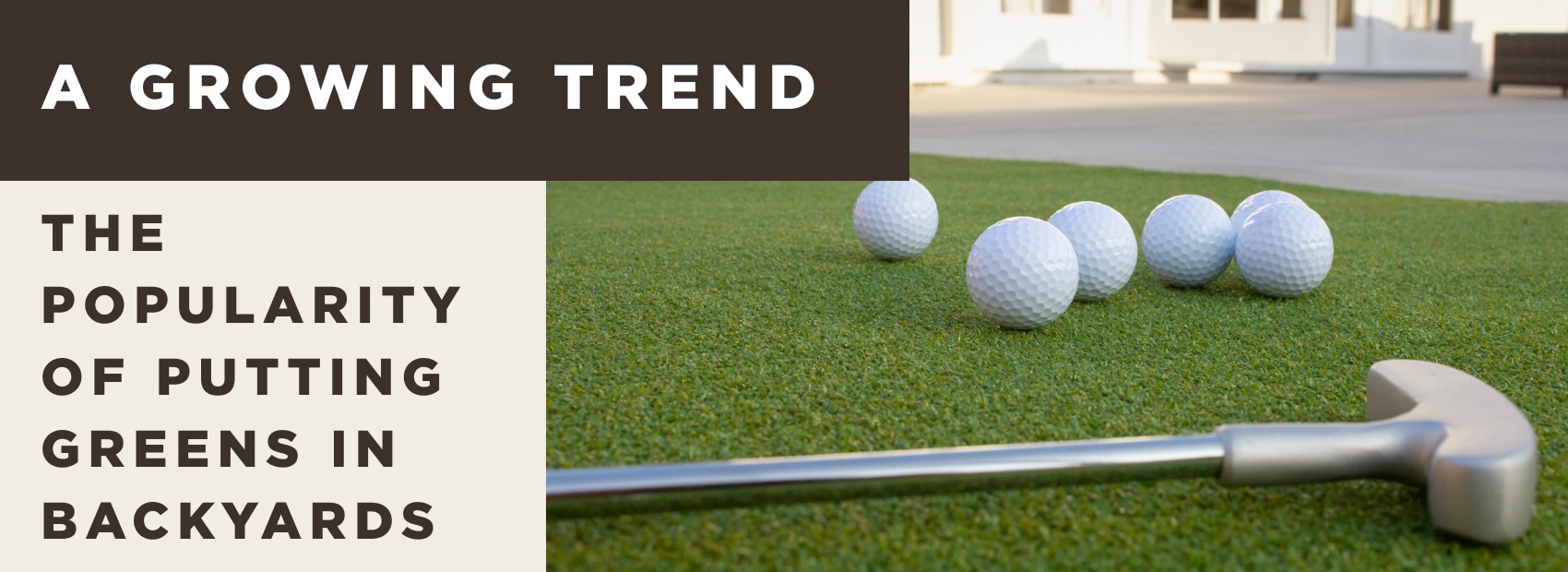
Backyard putting greens are surging because three forces converged at once: pandemic-era home investment shifted discretionary spending toward permanent property improvements, golf participation grew 16% in five years¹ to reach 28 million on-course players, and synthetic turf technology finally delivers tour-quality ball roll without tour-level maintenance.
The numbers tell the story. The putting green market reached approximately $110 million and is climbing 7.1% annually toward $160+ million by 2030.² Professional installations typically run $15-$40 per square foot.³ Well-integrated landscape improvements can return up to 217% of investment, according to the National Association of Realtors’ Remodeling Impact Report.⁴
For golf-engaged homeowners weighing the decision, this guide covers why the trend has staying power, what home putting green installation actually involves, realistic costs by tier, and the property value implications that determine whether a backyard putting green makes sense for your situation.
Key Takeaways
- Why now: Golf participation hit 28.1 million on-course players in 2024—the highest since 2008—while synthetic turf technology has finally matched natural grass performance.
- Market momentum: The putting green market reached $110 million with 7.1% annual growth projected through 2030.
- Cost reality: Professional installations run $15-$40 per square foot; total projects range from $800 DIY to $80,000+ custom builds.
- Maintenance advantage: Synthetic greens require no watering, mowing, or fertilizing, with 10-15+ year lifespans.
- ROI potential: Quality landscape improvements can recover 100-217% of costs at resale, though returns depend on buyer demographics.
- Best candidates: Golf-committed households with 400+ square feet, $8,000+ budgets, and long-term ownership plans or golf-heavy local markets.
Why Now? The Convergence That Changed Everything
The morning commute to improve your short game used to mean loading clubs, driving to the course, and hoping the practice green wasn’t crowded. For a growing number of homeowners, that commute now ends fifty feet from the back door.
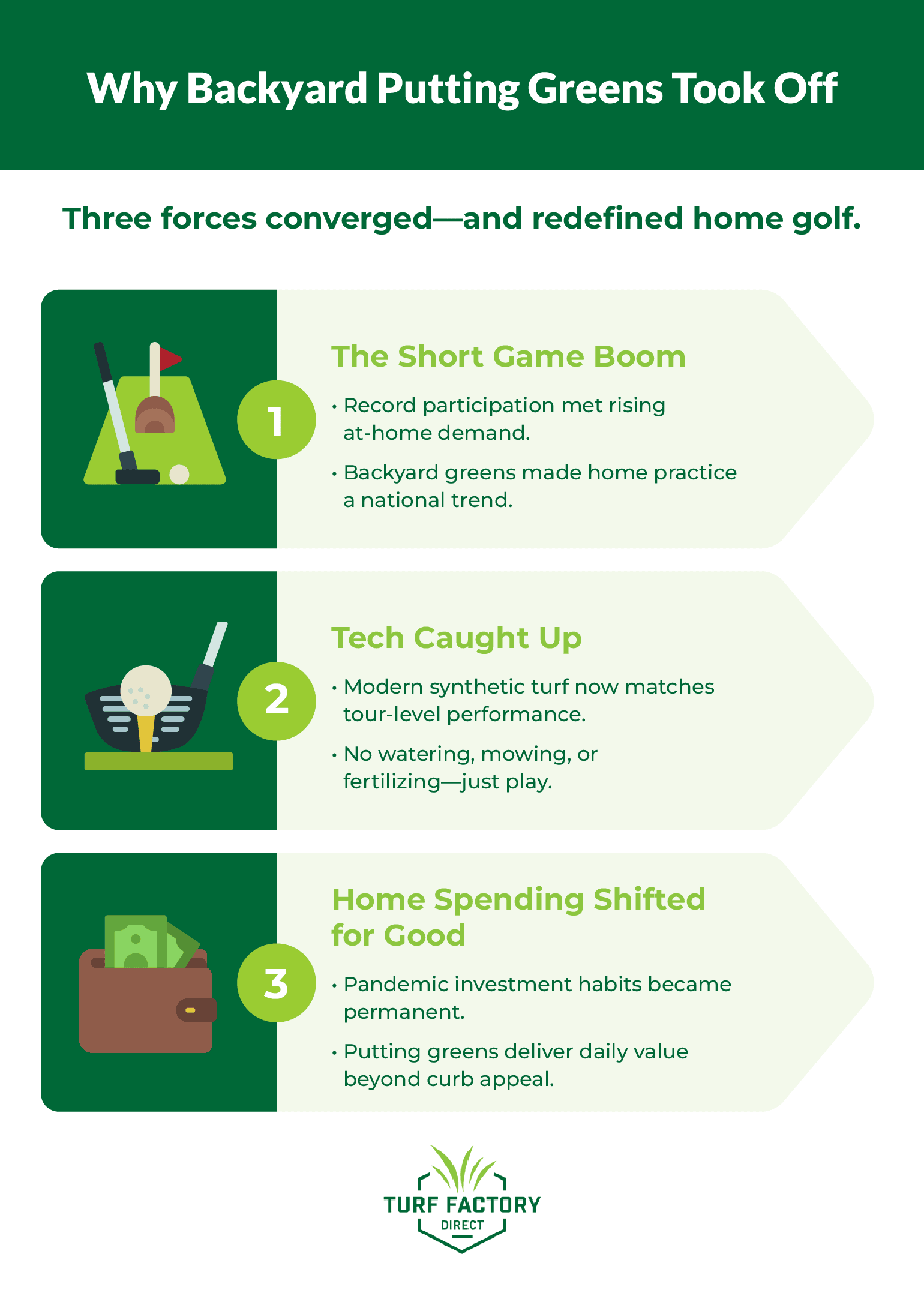
This shift didn’t happen by accident. Three trends intersected to move putting greens from curiosity to legitimate home improvement category.
Golf’s Demographic Expansion Changed the Demand Profile
The game added approximately 1.5 million new participants in 2024—the largest single-year increase since Tiger Woods was at his peak in 2000. Total U.S. golf participation now reaches 47.2 million, up 38% from pre-pandemic levels.¹
The player base is also diversifying in ways that expand household demand. Twenty-eight percent of on-course golfers are now female—a record proportion.⁵ Junior participation has surged 48% since 2019, with 3.7 million young players hitting courses.⁶ This broader demographic means more households where multiple family members see value in a practice green, not just dad sneaking in putting practice before dinner.
Technology Eliminated the Maintenance Barrier
Twenty years ago, artificial putting surfaces were recognizable compromises. Wrong speeds. Unnatural ball roll. Obvious visual artifice. Modern synthetic putting greens replicate bent grass performance closely enough that professional players use them for practice. UV-resistant fibers, engineered drainage systems, and calibrated infill materials have closed the gap between “fake” and “functional.”
The maintenance math changed too. Synthetic greens require no watering, no mowing, no fertilizing, no disease management. In drought-prone regions, the water savings alone justify consideration. In northern climates, year-round playability eliminates seasonal limitations that made natural grass greens impractical.
The Pandemic Recalibrated Priorities
When travel budgets froze, homeowners redirected capital toward permanent property improvements. Outdoor living upgrades—once considered luxury splurges—became the primary outlet for discretionary spending. Unlike pools or elaborate patios, putting greens deliver both recreation value and daily utility for golf-focused households. These spending patterns have persisted well past pandemic restrictions, suggesting a permanent shift in how homeowners allocate improvement budgets.
How American Backyards Evolved
Understanding why putting greens resonate requires context about how outdoor spaces have transformed over seventy years.
Three Eras of Outdoor Living
The 1950s-1970s emphasized decorative uniformity. Lawns were status symbols reflecting postwar prosperity—the greener and more manicured, the better. Backyards primarily served aesthetic purposes: something to admire from the kitchen window, not a space for sustained activity.
The 1980s-1990s pivoted toward leisure infrastructure. Pools, hot tubs, patios, and outdoor kitchens dominated as disposable income grew. These additions required significant investment and ongoing maintenance but delivered social utility. The backyard became a venue for hosting rather than just viewing.
The 2020s ushered in activity-focused design. Outdoor spaces needed to serve purpose beyond occasional entertaining—they needed to deliver regular value. Home gyms, sport courts, and residential putting greens represent this shift toward daily-use practicality.
Multi-Generational Appeal
Residential putting greens serve an unusually broad age range. An eight-year-old learning fundamentals can practice alongside a seventy-year-old refining short game consistency. Few backyard features deliver comparable multi-generational utility. Pools require supervision and have weather limitations. Sport courts favor specific age windows. Elaborate landscaping serves visual rather than interactive purposes.
The practice value compounds over time. Consistent access to a quality putting surface means measurable improvement for committed golfers. Even for casual players, the convenience factor—stepping outside for fifteen minutes versus committing to a course visit—transforms how often practice actually happens.
For homeowners exploring backyard golf green options, the design considerations have evolved significantly from early synthetic installations.
Golf’s Lifestyle Transformation
Golf’s growth story is no longer about country club exclusivity. It’s about mainstream adoption across demographics that historically sat outside the sport.
The Numbers Behind the Boom
The participation data from the National Golf Foundation:
- 28.1 million Americans played on-course golf in 2024—the highest total since 2008.
- 47.2 million total participants including driving ranges, simulators, and entertainment venues.
- 16% growth in traditional golfers over five years.
- Approximately 1.5 million new golfers added in 2024 alone.
Demographic Diversification
The player base is shifting in ways that expand household demand:
- Female participation: 28% of on-course golfers, with nearly 8 million women playing courses in 2024—both record highs.⁵
- Diversity: 25% of golfers are now Black, Asian, or Hispanic, also a record proportion.⁵
- Juniors: 3.7 million young players, up 48% since 2019, with 35% being girls compared to 15% in 2000.⁶
The Lifestyle Integration Pattern
Golf has successfully repositioned from “old money pastime” to “wellness and social activity.” Off-course participation—driving ranges, entertainment venues, indoor simulators—serves as an on-ramp. Record numbers of beginners are transitioning to course play after gaining comfort and competency in more accessible settings.
The aspirational barrier has lowered. Social proof comes through multiple channels: visibility of home golf setups on social media, influencer content that normalizes at-home practice infrastructure, and broader cultural acceptance of golf as inclusive recreation rather than exclusive privilege.
Geographic Patterns
Sunbelt states lead in putting green installations due to year-round usability, but northern markets show growing demand. Synthetic putting green turf eliminates the climate limitations that made natural grass greens impractical outside warm regions. A Minnesota homeowner can now practice in April when their local courses are still thawing.
The National Golf Foundation tracks these participation trends annually through comprehensive industry research.
Market Growth and Investment Reality
The putting green segment has outperformed general landscaping growth, reflecting concentrated demand from golf-engaged homeowners.
Five-Year Market Trajectory
Market data confirms sustained momentum² rather than a pandemic-era spike:
- 2023-2024 valuation: $101-110 million
- Projected 2030 valuation: $160+ million
- Growth rate: 7.1% CAGR
- Comparison: General landscaping industry growing at approximately 4% annually
What Installation Actually Costs
Artificial putting green cost varies dramatically based on size, quality tier, and installation approach. Here’s realistic pricing across the spectrum:
Budget/DIY Tier ($800-$8,000)
Simple flat greens under 400 square feet with basic turf quality and minimal customization. Appropriate for casual practice and family entertainment. A DIY backyard putting green requires significant time investment and some construction capability.
Mid-Range Professional ($8,000-$30,000)
Greens ranging from 400-1,000 square feet with quality turf, multiple pin positions, proper drainage, and reasonable contour work. Professional design and installation with warranty protection. Appeals to serious recreational golfers.
Premium Custom ($25,000-$80,000+)
Large greens exceeding 1,000 square feet with sophisticated design and professional-grade materials throughout. Integration with broader landscape design. Chipping areas, bunkers, and additional features possible.
Cost Factors That Move the Needle
Several variables explain why quotes vary so widely:
Turf quality matters. Professional-grade putting green turf costs more than landscape turf but delivers proper ball roll and longevity. Cutting corners on turf quality undermines the entire purpose.
Site preparation dominates budgets. Grading, drainage engineering, and base work often account for 70-95% of professional installation cost. This labor intensity reflects the precision required for a surface that performs correctly.
Complexity adds up. Contours, multiple pin positions, fringe areas, and integration with existing landscape increase both labor and material costs. A flat rectangle costs less than a green designed to challenge your reads.
Access affects pricing. Difficult site access requiring manual equipment rather than machinery increases installation time and cost.
The Property Value Question
Landscaping improvements can broadly return 100-217% of investment, according to NAR’s 2023 Remodeling Impact Report.⁴ Putting greens fall into a specialized category that requires honest assessment.
Factors that tend to add value:
- Golf-heavy local market (retirement communities, resort areas, country club neighborhoods)
- Quality integration with existing landscape design
- Luxury property positioning where distinctive features command premium
- Professional installation quality rather than obvious DIY
Factors that may limit appeal:
- Non-golf buyer demographics in your market
- Oversized greens consuming usable yard space
- Poor integration with surrounding landscape
- DIY quality issues visible to prospective buyers
The property value calculation depends heavily on whether your eventual buyer matches your profile. Golf-engaged buyers in appropriate markets will pay premium for turnkey practice amenities. Non-golfers may see a liability requiring removal.
Cost Per Use Calculation
A $20,000 professional installation used 200 times annually—roughly every other day—over ten years delivers a cost per session under $10. That’s competitive with driving range fees and dramatically below course green fees. For committed golfers, the convenience factor compounds this value: more frequent practice actually occurs when it requires no commute.
Homeowners evaluating options should explore putting green turf samples before committing to understand quality differences firsthand.
Design, Installation, and Integration
A putting green shouldn’t look dropped into the landscape. It should appear intentional, complementing rather than competing with existing features.
Material Options: The Synthetic Reality
For residential putting greens, the synthetic versus natural question has largely been answered by practical reality. Synthetic turf dominates because maintenance requirements make natural grass impractical for most homeowners.
What Synthetic Turf Delivers:
Performance consistency. Ball roll remains reliable regardless of weather or season. Speed is customizable through infill adjustment, and true roll is maintained without daily mowing.
Year-round playability. No dormancy periods, no weather limitations. Practice happens when you want it to happen.
Minimal maintenance burden. No watering, no fertilization, no chemical treatments, no mowing, no disease management. Expected lifespan runs 10-15+ years with basic care.
Technology has caught up. Fibrillated polypropylene fibers deliver realistic appearance and performance. UV-resistant treatments prevent fading. Engineered drainage handles water without pooling. Infill systems allow speed adjustment as preferences evolve.
Professional-grade putting green surfaces use advanced fiber technology to replicate bent grass characteristics that serious golfers require. For installations requiring precision base work and long-term stability, the TFD Professional Panel system offers an interlocking foundation solution engineered for consistent ball response and efficient drainage.
Natural Grass: The Unvarnished Reality
For homeowners committed to authentic experience despite maintenance demands, here’s what you’re signing up for:
- Daily mowing during growing season at putting height (0.125-0.187 inches)
- Consistent watering requirements
- Fertilization, aeration, and disease management programs
- Climate limitations (bent grass struggles in heat; Bermuda doesn’t survive freezing)
- 5-10 year effective lifespan before complete renovation
- Accumulated maintenance costs over ten years typically exceed synthetic installation costs
Natural grass may cost less initially—but factor in equipment, water, chemicals, time investment, and eventual renovation, and the lifetime cost calculation reverses.
Aesthetic Integration Principles
Scale and proportion. Match green size to available space. A 500-square-foot green in a 2,000-square-foot backyard feels proportionate. The same green in a 5,000-square-foot space may look undersized. Conversely, maximizing every available inch often produces an awkward result.
Color harmony. Quality synthetic turf comes in multiple green tones. Select shading that complements existing landscaping rather than creating obvious contrast. Two-tone options that distinguish putting surface from fringe areas add visual interest and realism. TFD Two-Tone Putt is a premium nylon putting green turf that harmonizes with your landscaping, featuring dual green shades for a natural, realistic appearance.
Transitional elements. Fringe areas, intermediate roughs, and border treatments create visual transition between putting surface and surrounding landscape. Abrupt edges where synthetic turf meets natural grass or hardscape look unfinished.
Contour integration. Natural-looking undulation requires design expertise. Flat greens putt predictably but look artificial. Excessive contouring creates frustration rather than challenge. The goal is subtle break that provides interest without manufactured appearance. See our guide on various integration approaches for golf greens at home.
DIY Versus Professional Installation
Professional installation typically follows a 5-7 day sequence, though complexity and site conditions affect timing.
When DIY Can Work
DIY backyard putting green installation can work for simple, flat designs under 400 square feet when budget constraints are significant and you have construction capability.
What DIY requires:
- Multiple weekends minimum for typical installation
- Equipment rental (plate compactor, turf cutter, specialized tools)
- Learning curve on seam work, infill distribution, and drainage
- No warranty protection for self-installed greens
- Acceptance that results may compromise performance
Common DIY limitations:
- Seam quality often compromises longevity and appearance.
- Drainage engineering requires expertise most homeowners lack.
- Contour work separating good greens from great ones is difficult without experience.
- Mistakes are expensive to correct after installation.
The Professional Value Proposition
Professional installation costs more upfront but delivers advantages that compound over time:
- Design expertise produces better-playing surfaces with appropriate challenge.
- Proper drainage engineering prevents problems that ruin installations.
- Warranty coverage (typically 8-15 years) protects your investment.
- Speed-to-completion measured in days rather than weeks.
- Complex contours and larger greens require professional execution.
The cost difference between DIY and professional often narrows when you factor in equipment rental, material waste from the learning curve, time investment, and the possibility of do-over costs when results disappoint.
Maintenance Reality for Synthetic Greens
The maintenance burden is genuinely minimal. Effective upkeep includes:
Regular debris removal. Leaves, twigs, and organic material should be cleared to prevent decomposition on the surface. A leaf blower handles this in minutes.
Periodic brushing. Restores fiber upright position and redistributes infill. Particularly important in high-traffic areas around cup locations.
Occasional rinsing. Removes dust, pollen, and light debris. A garden hose suffices.
Infill management. Top dressing may need replenishment every 2-3 years depending on use intensity. The TFD Putting Green Top Dressing provides a beautiful green finish, antimicrobial protection, and odor control while TFD Putting Green Silica Sand Infill serves as the essential base layer, applied first at 2-3 lbs per sq ft for weight, stability, drainage, and optimal ball speed.
Rolling for consistency. Maintains speed uniformity across the surface.
What synthetic greens don’t require: mowing, watering, fertilizing, aerating, disease treatment, or seasonal renovation. The ten-year maintenance cost for synthetic typically runs $800-$1,500 total. Natural grass greens accumulate $18,000-$25,000 in maintenance over the same period.
Customization: Matching Your Green to Your Game
A well-designed residential putting green can serve beginners and scratch golfers simultaneously through thoughtful feature selection. Homeowners comparing surface types can browse mini golf and putting course turf options to find materials that balance realism, speed, and durability across various play preferences.
Features for Newer Golfers
- Gentle contours with 2-4% maximum slope
- Larger cup options (regulation 4.25″ plus optional training cups)
- Defined practice zones with distance markers
- Consistent speed throughout (9-10 Stimpmeter reading)
- Straightforward approach lines without severe breaks
Intermediate-Level Challenges
- Variable speed zones (faster near cups, slower at edges)
- Breaking putts requiring read and adjustment
- Multiple pin positions (3-6 cup locations on larger greens)
- Distance variation accommodating 8-15 foot putts plus longer options
- Moderate undulation requiring consistent touch
Advanced Elements to Consider
- Tournament-speed surfaces (11-13 Stimpmeter)
- Complex undulations mimicking challenging course greens
- False fronts and collection areas
- Multiple severe break options
- Integration with chipping areas for full short game practice
Understanding Green Speed
The Stimpmeter measures ball roll distance in feet—higher numbers mean faster surfaces. Context helps calibrate expectations:
- 7-8: Slow by modern standards, typical of municipal courses
- 9-10: Average well-maintained course conditions
- 10-11: Fast, typical of quality private clubs
- 11-12: Very fast, approaching tour conditions
- 12+: Championship speed, requires precise touch
The USGA provides guidelines for green speed measurement and recommended ranges. Speed can be adjusted through brushing, rolling, and infill management.
Expanding Your Practice Options
Putting alone develops only part of your short game. An approach pad allows chipping practice to complement putting work.
Additional enhancements worth considering:
- Ball return systems (manual or automatic)
- Custom flag options for visual interest
- Practice aids integration
- Lighting for evening practice sessions
Is a Backyard Putting Green Right for You?
Assess Your Golf Commitment
Is golf a sustained interest likely to continue, or a current enthusiasm that may fade? Does convenient daily practice access have genuine value for your household? If these answers aren’t clearly affirmative, a putting green may deliver less utility than cost.
Be honest about usage patterns. The homeowner who plays twice monthly and never practices at the course probably won’t transform into a daily practice devotee because a green exists in the backyard. The homeowner who currently practices whenever possible but resents the commute is a better candidate.
Evaluate the Practical Factors
Available space: Minimum functional size is roughly 200 square feet. Comfortable practice requires 400+. Larger greens with multiple features need 800-1,500 square feet. Does your property accommodate appropriate scale without dominating usable outdoor space?
Budget reality: Quality professional installations start around $8,000 and scale from there. DIY can reduce costs but requires capability and acceptance of limitations. Underfunding produces disappointing results.
Maintenance tolerance: Synthetic greens require minimal maintenance, but minimal isn’t zero. Are you prepared for periodic brushing, debris removal, and occasional infill management?
Installation approach: DIY suits simple flat designs under 400 square feet when budget constraints are significant. Anything more ambitious warrants professional installation.
Match Investment to Your Situation
Luxury property in golf-heavy market? Premium installation makes sense. The buyer pool for your property likely includes golf enthusiasts who will value turnkey practice amenities.
Starter home with uncertain tenure? Budget DIY or defer entirely. Significant investment in a feature that may not transfer value to your eventual buyer creates risk.
Forever home regardless of resale? Personal use value matters more than property value calculation. Invest at the level that serves your practice goals.
The Bottom Line
Backyard putting greens have moved from niche curiosity to practical home improvement, driven by pandemic-era priority shifts, golf’s demographic expansion, and synthetic turf technology that finally delivers on performance promises.
The market growth—7.1% annually, projected to exceed $160 million by 2030—reflects sustained demand rather than a temporary spike.² Golf participation itself continues expanding, with record diversity in age, gender, and background among players.⁵
For golf-engaged homeowners with appropriate space and budget, the case has never been stronger. A backyard putting green isn’t just a recreation feature—it’s a daily invitation to improve at something you enjoy, a distinctive property element that signals thoughtful investment, and a gathering point that guests will gravitate toward while ignoring your perfectly manicured flower beds.
The decision comes down to honest self-assessment: Does your golf engagement justify the investment? Can your property and budget accommodate a quality installation? If so, you’ll wonder why you waited.
Order your putting green samples to evaluate quality options and take the first step toward bringing your short game home.
Explore Further
- Bring the Course Home: Replicating a Golf Course Putting Green
- The Pros and Cons of a Raised Putting Green for Homeowners
- Big Fun in Small Spaces: Creative Ideas for a Small Putting Green
References
- National Golf Foundation. “Golf’s State-of-Industry In 3 Minutes.” National Golf Foundation, January 2025.
- Business Research Insights. “Golf Putting Green Market Size, Share, Growth, and Industry Analysis.” Business Research Insights, December 2025.
- HomeAdvisor. “How Much Does a Backyard Putting Green Cost?” HomeAdvisor, 2025.
- National Association of Realtors. “2023 Remodeling Impact Report: Outdoor Features.” National Association of Realtors, March 2023.
- National Golf Foundation. “Golf Participation: Growing & Diversifying.” National Golf Foundation, February 2025.
- National Golf Foundation. “Golf Industry Facts.” National Golf Foundation, 2025.