You line up a six-footer, make a confident stroke — and the ball wobbles left for no reason. Not your read. Not your speed. The surface just doesn’t roll true. That’s the $8,000 problem no one warns you about, and it comes down to buying the wrong turf.
This guide gives you the decision framework for choosing the right backyard golf turf. We’ll break down the three fiber materials you’ll encounter, the five specifications that actually determine how a green plays, and the climate, infill, and installation variables that make or break the final result. By the end, you’ll evaluate any product on the market with the same eye a course superintendent would.
Key Takeaways
- Fiber material is the first decision. Nylon delivers professional-grade ball-roll fidelity and the longest lifespan. Polypropylene costs less upfront but degrades faster under UV exposure. Polyethylene belongs on fringe and chipping areas, not the putting surface.
- What type of turf is best for a backyard putting green? Texturized nylon is the standard for any serious putting surface. Its fiber memory — the ability to spring back upright after compression — delivers the most consistent ball-roll fidelity across thousands of putts. Look for texturized nylon with at least 36 oz/sq.yd. face weight and a pile height in the 3/8″ to 1/2″ range.
- Five specs tell you everything: pile height, face weight, stitch count, backing system, and drainage.
- Infill is the primary speed-control mechanism. More silica sand = faster roll. Less = slower. This is how you tune a green from recreational 8-stimp to competitive 11+ without swapping turf.
- Installation quality matters as much as product quality. A poorly compacted sub-base is one of the most common causes of putting green failure — and the most expensive to fix.
- Climate drives material decisions. UV-heavy regions demand UV-stabilized nylon. High-rainfall regions need top-drain backing rated at 30+ inches per hour. Cold climates require polyurethane backing to survive freeze-thaw cycling.
- The best residential greens are multi-zone: nylon putting surface, polyethylene chipping fringe, optional rough — each zone using a turf type optimized for its specific function.
The Quick-Reference Backyard Golf Turf Decision Framework
| Attribute | Nylon (Texturized) | Polypropylene | Polyethylene |
| Best Use Case | Putting greens, approach shots | Budget putting areas, casual practice | Chipping/fringe areas, landscape integration |
| Ball-Roll Fidelity | Excellent — closest to real bent grass | Moderate — degrades under heavy use | Low-to-moderate — too soft for true roll |
| Stimp Speed Range | 8–12+ (adjustable via infill depth) | 6–9 (less consistent over time) | Not typically rated for putting |
| UV Durability | High — 15+ years with proper stabilization | Low-to-moderate — 5–8 years typical | Moderate — 8–12 years |
| Face Weight Range | 36–56+ oz/sq.yd. | 28–40 oz/sq.yd. | 40–70+ oz/sq.yd. |
| Ideal Pile Height | 3/8″–1/2″ for putting | 3/8″–5/8″ | 1″–1.75″ for fringe/landscape |
| Relative Cost | Higher upfront, lowest cost-per-year | Lowest upfront, highest cost-per-year | Mid-range |
| Infill Requirement | Yes — silica sand for speed tuning | Optional | Typically yes, for stability |
If you want to understand why these specs matter — and how to avoid the most common selection mistakes — read on.
Understanding Turf Fiber Materials: The Foundation of Putting Green Performance
The comparison table shows you what each material does. This section explains why — because understanding the mechanics behind these numbers is what separates a buyer who gets lucky from one who gets it right every time.
Nylon: The Gold Standard for Putting Surfaces
Pick up a nylon turf sample and press your thumb into it. Watch what happens when you release. The fibers snap back to vertical — immediately, completely. That’s resilience memory, and it’s the single property that makes nylon the only serious choice for a putting surface.
Nylon fibers behave like tightly wound springs. When a golf ball compresses the surface on contact, the fibers deflect and return to their exact upright position — maintaining a uniform contact surface putt after putt, season after season. Textile research confirms that nylon fibers can elongate 30–50% under load and recover over 90% of their original length, far exceeding the recovery rates of competing synthetic fibers. This is the same fundamental behavior that makes natural bent grass — the standard turfgrass species for cool-season championship putting greens — so prized: a tight, consistent canopy where the ball rides on top of the fiber tips rather than sinking between blades.
Texturized nylon takes this further. The texturizing process — where raw nylon yarn is heated, crimped, and set — creates micro-surface variation along each fiber strand. Those tiny irregularities mimic the natural grain structure of bent grass, producing subtle directional influence on ball roll that makes the surface feel alive rather than mechanical. It’s the difference between a green that plays like a putting surface and one that plays like carpet.
The practical advantages compound. UV-stabilized nylon delivers a functional lifespan of 15–20 years in direct sunlight — roughly double what polypropylene manages in the same conditions. Its tensile strength — nylon typically delivers 800–1,200 MPa versus 600–900 MPa for polyester-class fibers — resists flattening under repeated foot traffic and ball impact, maintaining consistent stimp readings long after a softer fiber would have matured into an uneven surface.
The price objection is real but misleading. Nylon runs higher per square foot than polypropylene. But spread that cost over 15–20 years versus polypropylene’s realistic 5–8 year lifespan, and nylon’s cost-per-year is actually lower — before you factor in the labor and disruption of tearing out and replacing a failed surface.
For anyone serious about achieving the perfect roll, nylon is the only material that delivers professional-grade putting performance in a residential setting.
Polypropylene: Where It Fits (and Where It Falls Short)
Polypropylene has a place in the synthetic turf world — just not on any putting surface where consistency matters.
Its advantages are straightforward: lowest cost per square foot, lightweight, and a soft hand feel that impresses buyers comparing samples in a showroom. For a casual practice patch in a corner of the yard — a spot for a junior golfer to roll a few putts — polypropylene can work.
The problem shows up in direct sunlight. Polypropylene’s molecular structure makes it particularly susceptible to photooxidation — the process where ultraviolet radiation breaks polymer chains, produces free radicals, and reduces molecular weight, leading to mechanical deterioration. In sun-heavy climates — the Southwest, Southeast, or anywhere with 250+ sunny days per year — fibers begin losing structural integrity within a few years. You’ll see progressive fading first, then brittleness at the fiber tips, then a gradual flattening that creates dead spots where ball roll becomes unpredictable.
The other gap is memory. Polypropylene doesn’t spring back. Under repeated compression from foot traffic and ball impact, fibers progressively lay down — a phenomenon called matting. As fibers mat, the surface becomes uneven, creating lanes and inconsistencies that make practice counterproductive. The ball starts responding to surface defects rather than your stroke.
If your priority is casual practice and cost savings, polypropylene has a role. If your priority is realistic play and longevity, nylon is worth the investment.
Polyethylene: The Fringe and Chipping Specialist
Polyethylene is the material that makes a backyard green look like a golf course — even though it’s not the right choice for the putting surface itself.
Where nylon gives you performance, polyethylene gives you aesthetics. Its softer, wider blade profile comes in multi-tone color blends that closely replicate natural turf grass. It feels right underfoot, moves naturally in wind, and integrates seamlessly with surrounding landscape — which is why it’s the preferred material for chipping green surfaces, fringe zones, and the transitional areas that frame a putting green.
For putting, polyethylene’s softness is its undoing. Wide, pliable blades deflect inconsistently under ball contact, and the ball tends to nestle into fibers rather than ride across them. Roll consistency disappears.
But as a complement to nylon, polyethylene is hard to beat. The best residential greens pair nylon putting turf with polyethylene fringe — course-quality roll on the green, course-quality aesthetics around it. When you’re designing a chipping area that wraps your putting surface, polyethylene’s softer blade provides proper ball reception for chip shots while creating the visual transition between tight putting surface and open yard.
The Five Specifications That Separate Professional Greens from Pretenders
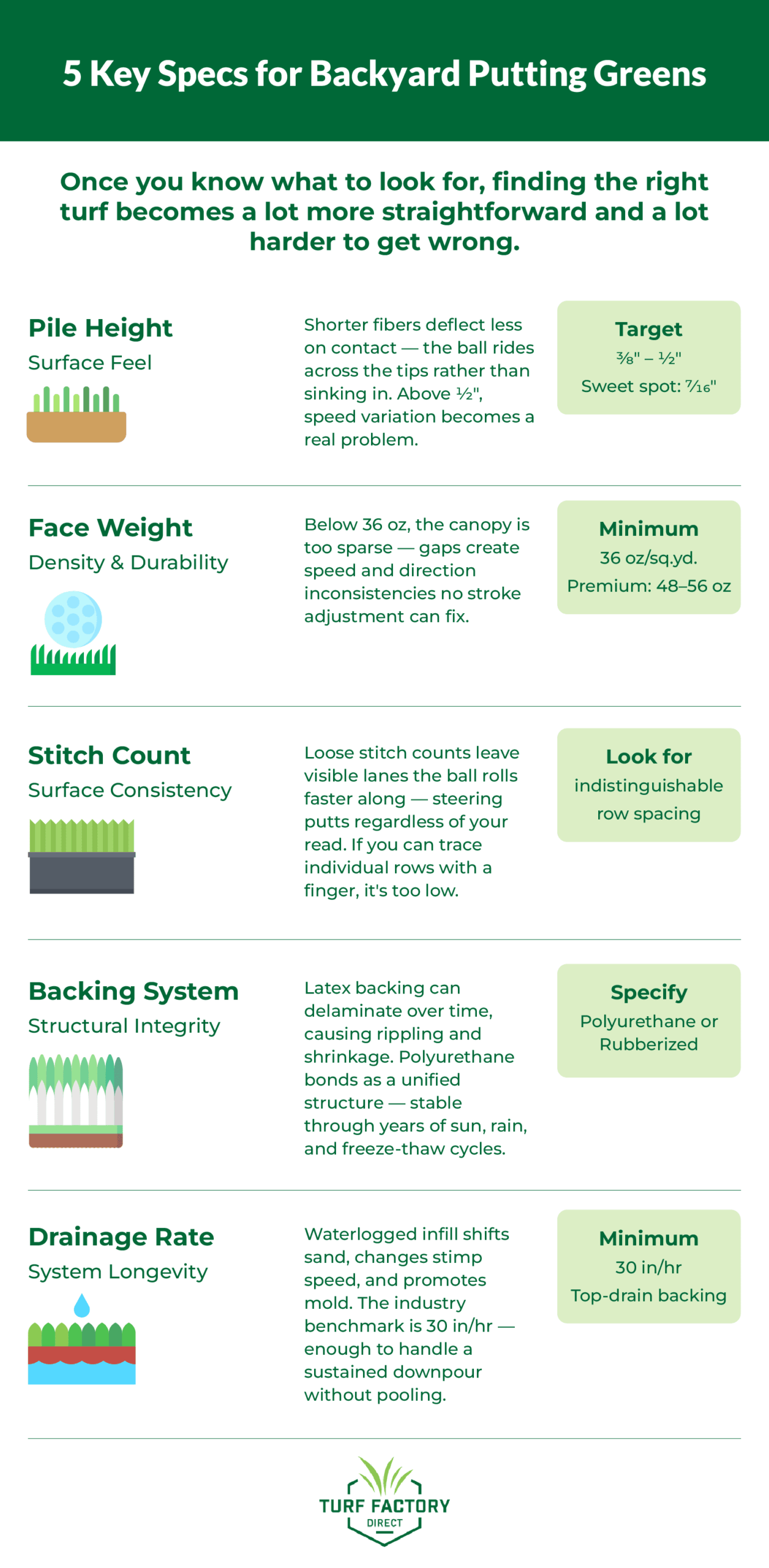
Reading a turf spec sheet is like reading a club fitting chart — once you know what the numbers mean, the right choice becomes obvious. These five specs determine whether a green plays like a professional practice facility or an expensive disappointment.
Pile Height: Why Shorter Means Smoother
Hold a ruler next to a quality putting green sample. The fibers measure about 7/16″ — roughly the thickness of three stacked nickels. That measurement is pile height, and for putting surfaces, shorter is definitively better.
The optimal range is 3/8″ to 1/2″, with 7/16″ the sweet spot most professional installations target. The mechanics are intuitive: shorter fibers deflect less on ball contact, absorb less energy, and produce more predictable forward roll. On a 7/16″ nylon surface, the ball rides across fiber tips with minimal deviation — behaving like it would on a well-maintained natural green cut to tournament height.
Exceed 1/2″ and fiber deflection introduces meaningful speed variation. The ball sinks into the canopy rather than rolling across it, and you lose the consistent surface contact that makes practice productive. Pile heights of 1″ and above belong on fringe, chipping zones, and landscape areas — where softer feel matters more than roll precision.
One nuance worth flagging: pile height doesn’t act alone. The effective playing surface is pile height minus infill depth. On a 7/16″ pile with standard infill, you might have only 1/8″ to 3/16″ of exposed fiber above the infill line — and that sliver is what the ball actually contacts. This interaction is how you fine-tune speed and feel after installation, which is why getting base pile height right matters as the starting point.
To replicate a golf course putting green in your backyard, start with 7/16″ texturized nylon and adjust from there with infill.
Face Weight: The Density-Durability Connection
Face weight measures the total weight of fiber per square yard of turf, expressed in ounces. It’s the single best proxy for how dense and durable a putting surface will feel and perform.
The benchmark for serious putting greens is 36 oz/sq.yd. Below that threshold, there aren’t enough fiber ends per square inch to create a uniform contact surface. Pick up a 28 oz sample and run your fingers across it — it feels thin, almost papery, and you can see backing material between fiber clusters. Those density gaps translate directly to inconsistent ball contact: the ball catches bare spots and fiber clusters differently, producing micro-variations in speed and direction that make precision practice impossible.
At 36 oz, the canopy is dense enough that the ball contacts a consistent surface everywhere on the green. The tactile difference is immediate — 36 oz nylon feels cushioned and substantial, like a well-maintained bent grass surface. Higher face weights (48–56+ oz) push density further and suit high-traffic greens, commercial installations, or homeowners who want maximum durability and the most luxurious feel.
Face weight also correlates with longevity. A denser canopy distributes wear across more individual fibers, so each fiber absorbs less stress per putt, per footstep, per season. A 36 oz green that lasts 15 years under normal use might see 18–20 at 48 oz — not because the fibers are stronger, but because there are more of them sharing the load.
Stitch Count and Turf Density: The Consistency Factor
Face weight tells you how much fiber is present. Stitch count tells you how it’s distributed — and distribution matters just as much for putting performance.
Stitch count measures the number of fiber tufts per unit length along each row. Higher stitch count means tighter spacing, which creates a more uniform surface. For putting greens, you want the highest count the manufacturer offers, because density uniformity is what makes the ball roll true.
Here’s a simple evaluation technique: hold a sample at eye level and look across the surface. If you can see obvious lanes between fiber rows — visible channels where backing shows through — that turf will steer putts unpredictably. The ball rolls faster along those channels and slower across them, creating directional inconsistency that has nothing to do with your stroke.
High-density putting green turf typically features very tight stitch spacing — when you evaluate samples, a dense, uniform surface where individual rows are indistinguishable from each other signals quality construction. If you can trace individual rows with your finger, the count is too low for serious putting.
Backing Systems: The Hidden Foundation
Backing is the spec most buyers never consider — until their turf starts warping, shrinking, or pulling apart at the seams. It’s the invisible specification that prevents visible failures.
Every synthetic turf has two backing layers. The primary backing is the woven or non-woven fabric through which fibers are tufted — it holds the fibers in place. The secondary backing provides structural integrity: dimensional stability, moisture resistance, and the mechanical strength that keeps turf flat and seams tight over time.
For outdoor putting greens, the secondary backing is the critical variable. Three main options:
- Polyurethane backing is the premium choice. It bonds to the primary backing, creating a unified structure that resists moisture penetration, dimensional change across temperature swings, and tuft pull-out. The result: flatness and seam integrity that hold through years of sun, rain, and freeze-thaw cycling. The TFD Nylon 36 UR is built on this principle — 24 oz polyurethane secondary backing providing superior dimensional stability in widths up to 15 feet.
- Latex backing costs less but tolerates less. Latex can become permeable to moisture over time, which may lead to delamination — the secondary backing separating from the primary — resulting in rippling, shrinking, or buckling that worsens each season.
- Rubberized action backing provides excellent dimensional stability with a slightly softer feel underfoot. Particularly effective where the turf sees heavy foot traffic alongside putting use.
Drainage: Protecting Your Investment from Below
A perfectly specified turf surface over poor drainage is a countdown to failure. Water undermines every other specification you’ve selected, and drainage is the defense.
Synthetic greens use one of two approaches:
- Top-drain systems allow water to permeate directly through the backing into the sub-base — common in nylon greens and requiring a backing engineered for permeability.
- Side-drain systems channel water laterally to perimeter drains, effective for smaller greens but potentially creating temporary surface water during heavy rain.
The industry benchmark for residential turf permeability is 30 inches per hour. That rate handles a sustained downpour without pooling. For regions with frequent heavy rainfall (Gulf Coast, Pacific Northwest, mid-Atlantic), you want higher rates and a sub-base designed to move water away quickly.
Poor drainage triggers a cascade: waterlogged infill changes stimp speed unpredictably, standing water creates conditions for mold and mildew in the infill layer, and prolonged moisture exposure degrades even polyurethane backing over time. Good drainage isn’t just about playing in the rain — it’s about protecting the long-term performance of every component in the system.
Climate and Environmental Factors: Matching Turf to Your Region
A green that performs beautifully in Scottsdale may struggle in Seattle — not because of the product, but because climate variables interact with material properties in ways that matter. Choosing the right backyard golf turf depends partly on where you live.
UV Resistance and Sun-Heavy Climates
UV stabilization isn’t optional for outdoor putting greens — it’s structural. Without adequate stabilizers incorporated during fiber manufacturing, ultraviolet radiation progressively degrades any synthetic polymer: color fades, fibers turn brittle, and eventually the surface fractures under normal use.
The degradation rate varies dramatically by material. Nylon holds up best under sustained UV exposure, followed by polyethylene, with polypropylene trailing significantly. In high-UV environments — Desert Southwest, Southern California, Florida, Texas — this hierarchy becomes decisive. A polypropylene green in Phoenix may show visible degradation within a few years. A UV-stabilized nylon green in the same spot can maintain structural and aesthetic integrity for 15+ years.
When evaluating turf for sun-heavy climates, look for manufacturers who specify UV stabilization on the product data sheet as a primary feature, not a footnote. Products designed for outdoor putting green turf applications should lead with UV resistance specs.
Drainage Demands in Wet and Humid Regions
In high-rainfall regions, drainage isn’t just about surface playability — it’s about the health of the entire system. Water sitting in the infill layer shifts sand granules, creates anaerobic conditions that promote mold and mildew, and can undermine the compacted sub-base over time.
For the Pacific Northwest, Gulf Coast, or any region averaging 40+ inches of annual rainfall, prioritize top-drain backing systems with verified permeability rates above 30 inches per hour. Pair this with a sub-base that includes a dedicated drainage layer — crushed aggregate over a geotextile membrane — to move water through the turf and away from the site efficiently.
In humid climates, antimicrobial infill additives can extend maintenance intervals and help prevent the musty odor that develops when organic material decomposes in a warm, moist infill layer.
Freeze-Thaw Cycles and Cold Climate Considerations
Cold climates add a variable most putting green guides ignore: dimensional cycling. When temperatures swing above and below freezing repeatedly, materials expand and contract. Inferior backing systems can struggle to absorb this stress — they may warp, buckle, and eventually delaminate as adhesive bonds fatigue from repeated movement.
Polyurethane backing earns its premium here. Its bond with the primary backing creates a unified structure that flexes together rather than pulling apart, maintaining flatness through hundreds of freeze-thaw cycles per season.
Infill behavior matters too. Silica sand doesn’t absorb water, so it’s naturally freeze-thaw resistant — granules don’t expand when temperatures drop. But if organic debris accumulates in the infill layer and retains moisture, that moisture freezes and creates localized heaving. Regular brushing and debris removal is particularly important in cold climates for this reason.
For snow and ice management: a soft-bristle push broom or leaf blower handles light snow safely. Metal shovels, de-icing chemicals, and any snow-removal method that contacts fibers directly should be avoided. Rock salt and chemical deicers degrade turf fibers and backing materials and should never touch a synthetic putting green.
Designing Your Green: Aesthetics, Layout, and Landscape Integration
A great backyard putting green delivers two things at once: performance that sharpens your short game and aesthetics that make the neighbors stop and stare over the fence. These goals aren’t competing — they’re complementary when you plan correctly.
Color, Texture, and Visual Realism
The “plastic green rectangle” look is the most common aesthetic failure in residential putting green installations. It’s also entirely preventable.
Dual-tone and multi-tone turf options exist specifically to solve this. By blending two or more shades — typically an olive-green base with a brighter field green highlight — these products replicate the natural color variation in real grass. From even a modest distance, a well-chosen natural-looking dual-color putting green becomes visually indistinguishable from a professionally maintained natural surface.
The other half of visual realism is the edge. A nylon putting green that abruptly meets lawn or mulch bed looks like what it is — a synthetic insert. Fringe turf creates a graduated transition from the tight putting surface to the surrounding yard, replicating the way course greens blend into their surroundings. The result is an installation that feels intentional and integrated rather than dropped into place.
Shape, Contour, and Multi-Use Space Planning
Evaluate your space practically: total available area, sun exposure through the day, natural slope and drainage direction, sight lines from your home. A green that catches afternoon shade from a mature tree will dry unevenly after rain and may need different UV consideration across its surface — factors that inform both material and drainage decisions.
The most functional residential greens are multi-zone installations: nylon putting surface at the center, polyethylene chipping fringe enabling approach shots around it, optional rough zones for a complete short-game circuit. Each zone uses a different turf type optimized for its specific function — which is exactly why understanding fiber material differences matters for the whole project.
Even modest contour makes a difference. Elevation changes of 2–4 inches across a putting surface add meaningful practice variety and can be built into the sub-base during installation. The turf conforms to whatever surface profile you create beneath it — no specialized product required.
Matching Turf to Surrounding Landscape
Your green should look like it belongs in your yard.
Realistic fringe for putting greens creates that visual bridge. Fringe at 1″+ pile height in a field green color wraps the putting surface and transitions naturally into existing lawn, hardscape, or garden beds. For greens bordered by natural grass, matching fringe color to your existing lawn species creates the most convincing integration.
Heavy-weight nylon fringe turf at 69 oz face weight offers the premium option — durable enough for foot traffic around the green while maintaining a soft, natural appearance that pairs beautifully with stone borders, timber edging, or adjacent planting beds.
Infill: The Unsung Hero of Ball-Roll Performance
Most buyers obsess over the turf and treat infill as an afterthought. That’s backwards. Infill is the primary mechanism you have for controlling how your green actually plays — it’s the difference between a surface you tolerate and one you love.
What Infill Does and Why It Matters
Infill serves three functions: it provides weight and stability to keep turf flat and anchored, it supports fibers in their upright position for a consistent contact surface, and — most importantly — it controls speed.
The mechanics are straightforward. Infill fills the space between backing and fiber tips. Add more, and the effective playing surface rises relative to the tips. Less fiber exposed above the infill line means less ball contact, less friction, faster roll. Reduce infill, and more fiber is exposed — friction increases, surface plays slower.
This is how you tune a synthetic green from a recreational pace (around 8 stimp) to a competitive pace (11+) without changing the turf product. Most recreational golfers encounter greens measuring between 8 and 10 on the Stimpmeter, while PGA Tour events typically run at about 12. It’s also how you adjust for seasons — slightly more infill in summer when heat softens fibers and slows the surface, slightly less in cooler months when fibers stiffen and the surface naturally quickens.
Silica Sand and Top Dressing: Choosing the Right Infill Material
Putting green silica sand infill is the standard for synthetic putting greens. Rounded granules distribute evenly between fibers, providing consistent weight and predictable speed characteristics. Silica is inert — it won’t decompose or harbor bacteria — doesn’t absorb water, and maintains its particle size indefinitely. Those properties make it the reliable foundation of your green’s speed profile.
Putting green top dressing is a finer-grained material for surface-level speed adjustments and maintenance refreshes. Where silica sand establishes base speed, top dressing handles precise, incremental changes at the surface — fine-tuning versus gross adjustment.
Most residential installations use silica sand as the primary infill during installation and keep top dressing on hand for seasonal adjustments. For maximum speed-control precision, using both in combination gives you the most versatile tuning range available.
Adjusting Infill for Your Play Style
This is where spec knowledge becomes competitive advantage: you can tune your green to match exactly how you want to practice.
Competitive golfers chasing tournament conditions should build infill depth to achieve stimp readings in the 10–12 range. A fast, punishing surface that exposes every flaw in your distance control — exactly the kind of practice that translates when it matters.
Recreational players benefit from lower infill depths producing stimps in the 8–9 range. Slower, more forgiving, and still delivering meaningful improvement to your short game without the frustration of a surface that punishes casual practice.
There’s a chipping interaction worth knowing. Less infill means more exposed fiber, which creates a softer landing that better receives chip and pitch shots. If your green does double duty for putting and approach work, look for adjustable speed putting green products designed for infill-based tuning. These give you the most versatility — dial up infill for fast putting practice, dial back for softer chipping reception.
Ready to see these specs in action? Browse our complete putting green turf selection to compare products by fiber type, face weight, and backing system.
Installation: Professional vs. DIY and Getting It Right Either Way
The finest turf on the market will underperform on a bad foundation. And the foundation variable that matters most isn’t the turf itself — it’s the six inches of material underneath it.
Site Assessment and Sub-Base Preparation
The sub-base is half the installation. Everything above — turf, infill, performance — depends on what you build below.
Start with the basics: evaluate natural slope and drainage direction, identify underground utilities and irrigation lines, map sun exposure patterns, and plan material access routes for turf rolls and aggregate delivery. Most residential backyards have some natural slope, which is actually desirable — you need grade for drainage. Work with existing contours rather than fighting them.
Sub-base preparation follows a non-negotiable sequence: excavate to depth (typically 3–4 inches for residential installations), lay a geotextile weed barrier, install compacted crushed aggregate (Class II road base or decomposed granite), and grade to a smooth, even surface with minimum 1–2% slope for drainage. The aggregate must be mechanically compacted — hand tamping doesn’t cut it for anything beyond a small practice patch. Inadequate compaction is one of the most common causes of post-installation settling, pooling, and turf failure.
The site-assessment mistakes that haunt homeowners: ignoring existing drainage patterns (water goes where it always went, regardless of what you put on top), underestimating excavation depth, and skipping perimeter edging — without proper edge containment, sub-base and turf shift over time.
Professional Installation vs. DIY: An Honest Comparison
Professional installation delivers precision that’s genuinely difficult to replicate without experience: laser grading for surface trueness, seamless seam joining invisible during play, calibrated infill distribution, and edge anchoring that prevents long-term movement.
DIY makes sense in specific scenarios: smaller greens under 200 square feet, homeowners with construction or landscaping experience, simpler layouts without complex contours, and projects where savings justify the learning curve.
Five common DIY mistakes that compromise performance:
- Inadequate sub-base compaction. The critical one. A poorly compacted base settles unevenly over 6–12 months, creating dips and humps that destroy ball-roll consistency. Fixing it usually means removing the turf entirely and starting over.
- Incorrect infill depth. Too little and the surface is slow and grabby. Too much and the ball skids rather than rolls. Calibration requires patience, a consistent ball-roll test, and ideally a stimp meter.
- Poor seam joining. Visible or raised seams create ridges that steer putts — making practice counterproductive. Clean seaming demands specific adhesive, proper tape, and careful fiber tucking.
- Skipping edge anchoring. Without perimeter nailing or trenching, turf edges curl, lift, and shift — creating trip hazards and allowing infill to migrate off the green.
- Ignoring drainage grade. A dead-level sub-base pools water. Even the smallest green needs 1–2% slope to drain.
DIY is absolutely viable for the prepared homeowner. But cutting corners on sub-base prep will cost more in the long run than a professional installer would have.
Maintaining Your Green for Long-Term Performance
A synthetic putting green needs far less attention than natural grass — we’re talking about 15 minutes a month, not hours every weekend.
- Monthly: Brush fibers with a stiff-bristle broom to prevent matting and redistribute pile. Check infill depth in high-traffic zones and redistribute as needed. Clear organic debris — leaves, pollen, seed pods — before it decomposes in the infill layer. Rinse the surface with a garden hose to flush dust and fine particles.
- Seasonally: Inspect for UV wear (color shift or fiber brittleness, particularly south-facing areas). Top up infill where play or weather has thinned it. Check seam integrity and address any lifting edges. In fall, increase debris removal to prevent leaf accumulation from trapping moisture.
The return on that small effort is significant. A well-maintained nylon green easily exceeds 15 years of service — many reach 20+. Neglect the maintenance, and that same green shows meaningful performance degradation in 8–10 years. Fifteen minutes a month buys you an extra half-decade of play.
From Specs to Products: Finding Your Putting Green Turf
You now understand what each specification means and why it matters. Here’s where that knowledge meets actual products.
For the Serious Putting Surface
- TFD Putting Elite — 36 oz texturized nylon, 7/16″ pile height. Our most popular putting green turf and the baseline standard for serious residential putting greens. Suitable for novice through competitive players. Texturized nylon fiber delivers consistent ball-roll fidelity with proven UV durability.
- TFD Two-Tone Putt — 36 oz nylon, dual-color blending for natural aesthetics, rubberized action backing for dimensional stability, 7/16″ pile height. The choice for homeowners who refuse to compromise visual realism for putting performance.
- TFD Nylon 36 UR — 36 oz texturized nylon, 7 oz primary backing + 24 oz polyurethane secondary backing for superior structural stability. Available in 12′ and 15′ widths — fewer seams on larger greens, which means better surface trueness where it matters most.
- TFD Nylon Putt Extreme — A premium competition-level putting surface. Textured yarns, multi-directional surface, UV stabilized, top-drain backing. Speed and spin adjustable via infill depth — the most versatile turf for golfers who want precision control over practice conditions.
- TFD Birdie Putt Elite — A realistic putting and approach shot surface that replicates both true roll and approach-shot mechanics. UV stabilized with side-drain backing. A strong choice for golfers who want a combined putting and chipping practice surface in one installation.
For Chipping Areas and Fringe
- TFD Elite Fringe — An ideal chipping green surface for approach shot practice around your putting green.
- TFD Supreme Fringe — 1 1/8″ pile height, field green color, dual backing system. Pairs perfectly with Putting Elite and Two-Tone Putt for realistic fringe for putting greens that completes the course-like appearance.
- TFD Supreme Turf — Nylon fibers at 69 oz face weight, 1 1/8″ pile height, 23 oz urethane backing. Durable, soft, heat-reducing. Excellent as heavy-weight nylon fringe turf around a putting green for maximum longevity.
Infill and Maintenance Products
- TFD Putting Green Silica Sand Infill — Standard infill for speed calibration and fiber support.
- TFD Putting Green Top Dressing — Fine-grain material for surface-level speed adjustments and maintenance refreshes.
Building Your Backyard Golf Sanctuary the Right Way
Every spec in this guide points to the same pattern: materials engineered for their specific purpose, installed on a foundation that supports them, and maintained with a modest routine that protects your investment. Explore our full range of putting green turf products to find the exact match for your project.
Still comparing? Order free samples and feel the difference for yourself before you commit.