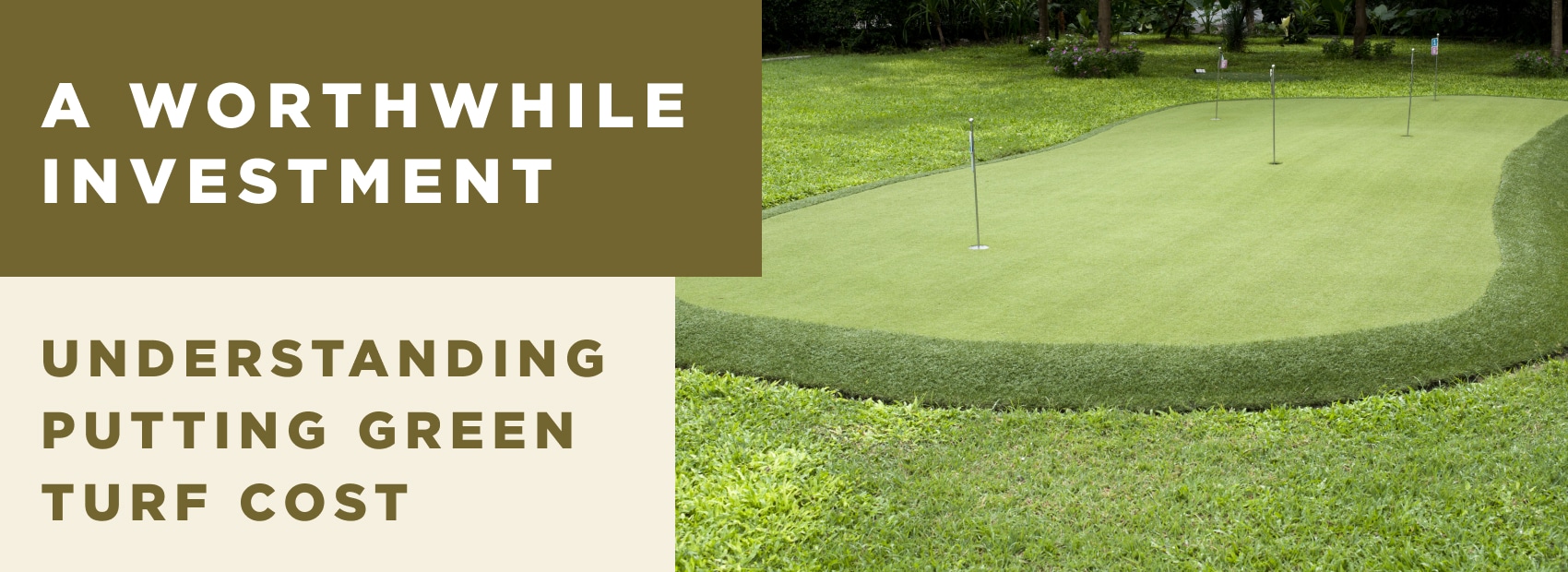
Putting green turf runs $2 to $8 per square foot for materials.¹ A complete DIY installation—base, drainage, infill, and turf—costs $5 to $15 per square foot. Professional installation ranges from $15 to $40 or more per square foot.² For a typical backyard green of 200 to 500 square feet, expect total project costs between $2,000 and $15,000.
| Cost Category | Price Range |
| Turf Material Only | $2–$8 per sq ft |
| Complete DIY Installation | $5–$15 per sq ft |
| Professional Installation | $15–$40 per sq ft |
| Typical Residential Project (200-500 sq ft) | $2,000–$15,000+ |
Those ranges are wide for a reason. Your final putting green turf cost depends on four things: how big you build, what material you choose, how much base prep your site needs, and which custom features you add. This guide breaks down each factor so you can estimate your project accurately—and invest with confidence rather than hope.
Key Takeaways
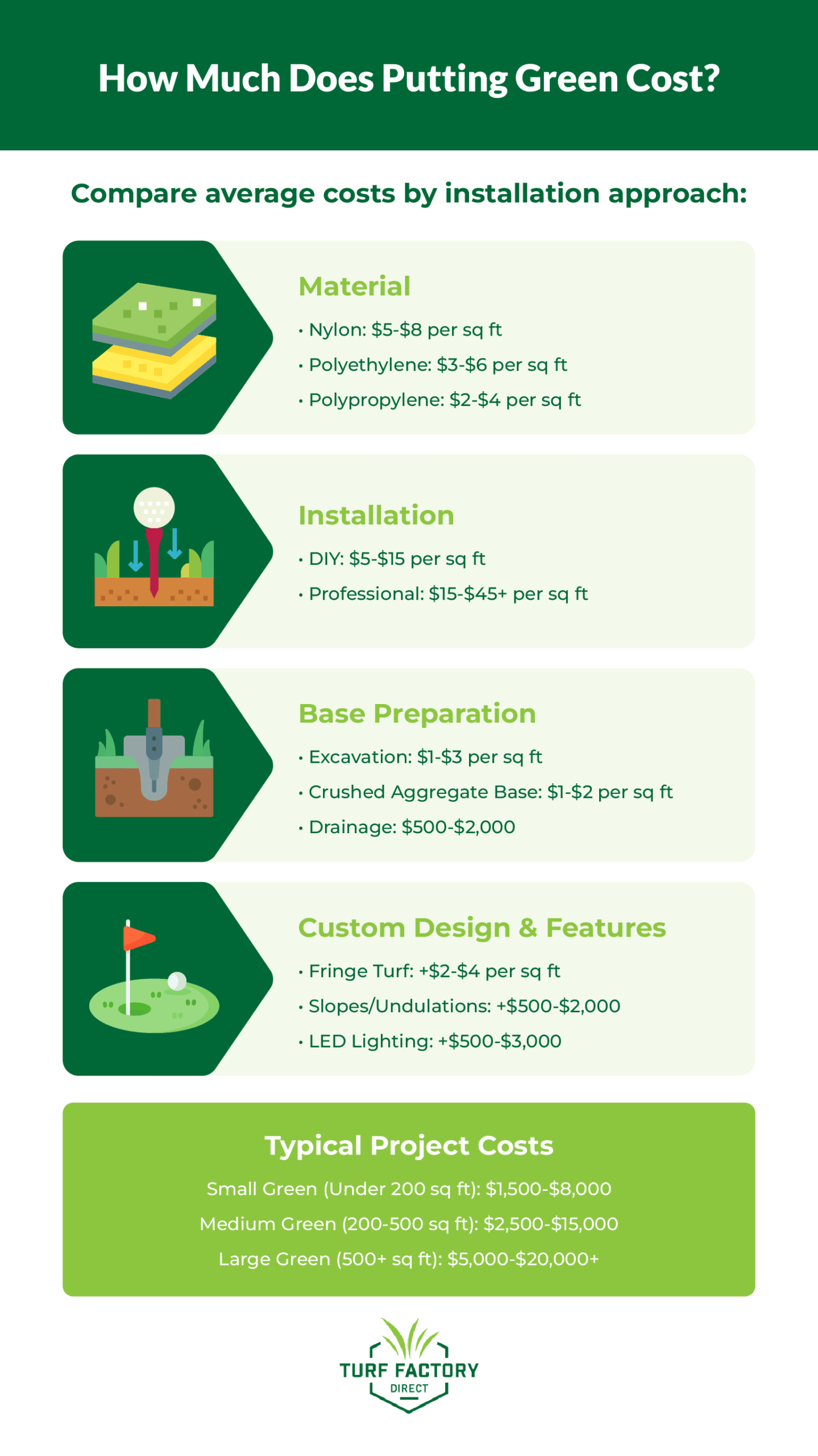
- Material costs alone run $2–$8 per square foot depending on turf type; nylon ($5–$8) delivers professional-grade performance, while polypropylene ($2–$4) suits casual use.
- DIY installation costs $5–$15 per square foot total, saving 40–60% compared to professional work—but requires 20–40 hours of labor and carries risk of costly mistakes.
- Professional installation costs $15–$40 per square foot and includes design, proper execution, and warranty protection (typically 5–10 years).
- Base preparation is non-negotiable. Skipping proper excavation, aggregate, and drainage leads to settling, water damage, and premature failure.
- Quality turf pays for itself. Premium nylon at $7/sq ft over 20 years costs less annually than budget polypropylene at $3/sq ft over 5–8 years.
- Size matters for per-square-foot pricing. Larger greens (500+ sq ft) benefit from economies of scale, dropping costs significantly per square foot.
- Budget 10–15% contingency for delivery, permits, and unexpected site conditions.
Why Backyard Putting Greens Are Worth the Investment
The Growing Appeal Among Homeowners
A hundred practice putts before work. Evening games with friends, drinks in hand. A backyard that looks like it belongs in a magazine spread. These aren’t fantasies—they’re Tuesday night at homes with putting greens.
The numbers reflect this shift: golf participation topped 28 million players in 2024, marking a seventh consecutive annual increase.³ Total golf participation—including off-course activities—climbed to 47.2 million in the U.S., up 38% from pre-pandemic 2019.³ Meanwhile, over 3.35 million golfers maintained a USGA Handicap Index in 2024, up 30% since 2020.⁴ The global artificial turf market reached $3.75 billion in 2024, with projections to hit $5.77 billion by 2033.⁵
The growing trend of backyard putting greens reflects a shift in how homeowners view outdoor space. Lawns that once sat unused now serve a purpose. And unlike natural grass putting surfaces—which demand constant watering, mowing, and chemical treatments—synthetic greens deliver consistent performance with minimal upkeep.
Understanding Cost as Investment, Not Expense
The most expensive putting green is the one you have to replace in five years.
Quality turf installed correctly lasts 15 to 20 years. Run those numbers: a $7,500 professional installation on a 300-square-foot green works out to $375 per year. That’s $31 per month for unlimited practice access—less than a single round at most courses.
Cheap materials and shortcuts save money upfront. They cost more in the long run. Every experienced installer has stories of remediation projects that cost double the original budget because someone tried to save $2,000 on base prep.
The investment mindset asks different questions. Not “how little can I spend?” but “what delivers the best value over 15 years?”
4 Key Factors That Shape Your Putting Green Cost
These four factors account for virtually all the variation in putting green pricing. Understanding them transforms you from shopper to informed buyer.
Factor 1: Square Footage and Project Size
Bigger greens cost less per square foot. That’s not a sales pitch—it’s math. Installation labor and base preparation have fixed minimums regardless of surface area. A 150-square-foot green requires almost as much setup work as a 300-square-foot green.
Size-Based Pricing:
| Project Size | DIY Cost/Sq Ft | Professional Cost/Sq Ft | Typical Total |
| Small (under 200 sq ft) | $8–$15 | $25–$40 | $1,500–$8,000 |
| Medium (200–500 sq ft) | $6–$12 | $18–$35 | $2,500–$15,000 |
| Large (500+ sq ft) | $5–$10 | $15–$28 | $5,000–$20,000+ |
How much space do you actually need? For serious practice, plan for 15 to 20-foot putts—that covers most scenarios you’ll face on the course. A 12-by-25-foot green (300 square feet) provides room for multiple cup positions and genuine practice variety. Casual golfers focused on entertainment often find 150 to 200 square feet works fine.
For a 500-square-foot backyard putting green, expect to pay $2,500 to $5,000 for quality DIY work, or $7,500 to $17,500 professionally installed with custom features.
Factor 2: Turf Type and Material Quality
Three materials dominate the putting green market. Each serves different priorities—and different budgets. Understanding artificial turf terminology helps you compare options intelligently.
Nylon: $5–$8 per square foot
The choice for golfers who care about ball roll performance. Nylon delivers the truest ball roll, highest durability, best resistance to matting, and significantly reduced off-line deviation compared to other materials. The USGA’s Stimpmeter, developed in the 1970s and made available to course superintendents in 1978, remains the standard for measuring green speed.⁶ Nylon is what you’ll find on professional practice greens and country club facilities. If your goal is replicating course conditions at home, nylon is the answer. Expect 15–20 years of consistent performance with proper maintenance.
Polyethylene: $3–$6 per square foot
The sweet spot for most residential installations. Polyethylene offers excellent ball roll, good durability, and a softer feel underfoot than nylon. It won’t match a tour-quality practice green, but it’ll improve your putting—and it costs 30 to 40 percent less than nylon. Plan on 15 to 20 years of use.
Polypropylene: $2–$4 per square foot
Budget-friendly with budget-friendly performance. Polypropylene works for casual entertainment greens where practice isn’t the priority. It’s less durable, more prone to matting, and delivers less consistent ball roll. Five to eight years is a realistic lifespan for outdoor installations. You’ll spend less now; you’ll replace it sooner.
| Material | Price Range | Lifespan | Ball Roll | Best For |
| Nylon | $5–$8/sq ft | 15-20+ years | Truest | Serious practice, performance focus |
| Polyethylene | $3–$6/sq ft | 15-20 years | Very Good | Balanced performance and value |
| Polypropylene | $2–$4/sq ft | 5-8 years | Adequate | Casual use, entertainment |
Factor 3: Base Preparation and Drainage
This is where DIY projects fail—and where shortcuts become expensive mistakes.
A putting surface is only as good as what’s underneath it. Skimp on base prep and you’ll have drainage problems, uneven surfaces, and a green that deteriorates years before it should.
What proper base preparation requires:
- Excavation: $1–$3 per square foot. Removing 3 to 4 inches of existing soil creates room for aggregate base and allows proper drainage. For a 300-square-foot green, figure $300 to $900—or 4 to 8 hours of serious digging.
- Crushed Aggregate Base: $1–$2 per square foot. A 2 to 3-inch layer of crushed rock provides stability and drainage. This layer must be compacted to 95% density using a plate compactor—not a hand tamper.⁷ Insufficient compaction causes settling, uneven surfaces, and premature failure.
- Drainage: $500–$2,000. If your site holds water, you need drainage infrastructure. French drains, channel drains, or perforated pipe systems prevent water from pooling under the turf. Standing water creates odor, promotes mold and bacterial growth, and destroys turf from below. Clay soil or low-lying sites push toward the higher end of this range.
What happens when you skip base prep:
The turf looks fine for six months. Then low spots appear. Water pools after rain. Ball roll becomes inconsistent. By year two, you’re looking at complete removal and reinstallation—at which point you’ve spent more than doing it right would have cost.
Factor 4: Custom Features and Design Complexity
A flat rectangle with one cup is the simplest build. It’s also the least interesting to practice on—and the least visually compelling.
Custom features add cost. They also add value. The question is which features matter for your goals.
Common Add-On Costs:
| Feature | Added Cost | Consider If |
| Fringe Turf | +$2–$4/sq ft | Visual appeal and property aesthetics matter |
| Slopes/Undulations | +$500–$2,000 | You want serious practice variety |
| LED Lighting | +$500–$3,000 | Evening use or entertainment is a priority |
| Multiple Cup Positions | +$50–$150 each | You want practice variety (3+ recommended) |
| Chipping Area | +$1,000–$3,000 | Full short game practice is the goal |
| Sand Bunker | +$2,000–$5,000 | You’re building a complete practice facility |
How to prioritize: If you’re building for practice, invest in multiple cups and undulations first—these create the varied scenarios that build skill. Fringe and aesthetic features look great but don’t improve your game. When budget is tight, performance beats decoration.
DIY vs. Professional Installation: An Honest Cost Comparison
This decision determines the largest portion of your budget. Get it right and you either save significantly or achieve professional-grade results. Get it wrong and you pay twice.
What DIY Putting Green Cost Really Looks Like
DIY saves 40 to 60 percent, if you execute well. A failed DIY project requiring professional remediation costs more than hiring pros from the start.
Realistic DIY Budget (300 sq ft green):
| Item | Cost Range |
| Putting Green Turf | $900–$2,400 |
| Crushed Aggregate (delivered) | $200–$400 |
| Landscape Fabric | $50–$100 |
| Infill Material | $100–$200 |
| Edging/Borders | $100–$300 |
| Cup and Flag Sets (3) | $75–$150 |
| Seaming Tape and Adhesive | $50–$100 |
| Equipment Rental | $150–$300 |
| Total | $1,625–$3,950 |
That’s $5 to $13 per square foot—roughly half to one-third the professional price.
What the numbers don’t show:
- Time: 20 to 40 hours of labor. Spread across weekends, that’s 3 to 6 weeks of your life.
- Learning curve: Invisible seams take practice. Proper compaction requires technique. Clean edges demand patience. Your first installation won’t be your best work.
- Risk: Visible seams. Drainage problems. Settling. Issues that may not appear for months but require expensive fixes.
DIY tends to work well for: Handy homeowners with landscape experience, smaller projects under 300 square feet, flat sites with good natural drainage, and people with realistic time expectations.
Resources for measuring artificial turf help you calculate quantities correctly—because running short mid-project is a frustrating and expensive mistake.
The Value of Professional Putting Green Installation
Professional installation costs more because you’re buying certainty. Expertise, efficiency, and accountability come with the price.
What $15–$40 per square foot typically includes:
- Design consultation. Professionals assess your site, discuss your goals, and recommend materials and features that match your needs.
- Speed. What takes a homeowner 30-plus hours takes a professional crew 1 to 2 days.
- Proper execution. The right equipment, experienced hands, and correct techniques—done right the first time.
- Warranty protection. Most professional installers offer 5 to 10-year workmanship warranties. If something fails, you have recourse.
Consider hiring professionals if: Your site has slopes, drainage issues, or difficult access. You want undulations or complex contours. Your project exceeds 400 square feet. You value your weekends. You want accountability if something goes wrong.
Hidden Costs to Budget For
Plan for these before they surprise you:
All projects:
- Delivery fees: $100–$300
- Permits: Varies by municipality
- Soil disposal: Excavated material needs somewhere to go
DIY specifically:
- Equipment rental adds up
- Running short on materials mid-project
- Potential remediation if things go wrong
Professional installation:
- Change orders for scope modifications
- Upcharges for difficult site access
Smart approach: Add 10 to 15 percent contingency to your calculated budget. This absorbs surprises without derailing your project.
Maximizing Your Return on Investment
A putting green is a 15 to 20-year asset. Decisions made now determine whether you’re still enjoying it in year 15—or replacing it in year 8.
Why Quality Turf Pays for Itself
The math favors premium materials when you factor in lifespan.
Budget polypropylene at $3 per square foot lasting 6 years = $0.50 per square foot annually.
Quality nylon at $7 per square foot lasting 20 years = $0.35 per square foot annually.
The premium material costs less per year—before accounting for the hassle and waste of early replacement.
Beyond longevity, quality turf maintains consistent performance. Budget materials roll true initially, then develop flat spots, matting, and inconsistency. Premium turf performs the same in year 12 as year 2.
The advantages of artificial turf extend beyond golf: zero watering, no mowing, no chemicals, year-round use. Value that compounds every season.
Smart Budgeting Strategies
- Prioritize wisely. Quality turf and proper base preparation determine long-term success. Economize on decorative features—premium edging and elaborate fringe—if budget is tight.
- Phase your build. A great 250-square-foot green now beats a compromised 400-square-foot green. Add chipping areas, lighting, or expanded features in year two or three.
- Time strategically. Installers often offer off-season discounts from November through February. Flexible timelines can mean real savings.
- Sample first. Turf varies dramatically in feel, appearance, and ball roll. Order putting green samples and compare options in your actual lighting before committing.
Maintenance: Protecting Your Investment
Synthetic putting greens need minimal care compared to real grass.
- Weekly: Brush fibers to prevent matting. Remove leaves and debris.
- Monthly: Check infill distribution. Rinse to remove dust and pollen.
- Annually: Inspect seams and edges. Top up infill as needed.
- Budget $100 to $350 yearly for maintenance, including brushes, infill top-ups, and occasional professional cleaning.
Quality installation pays dividends here too. Proper drainage prevents odor and mold. Good seaming prevents separation. Adequate infill doesn’t need constant replenishment.
Your Path Forward
You now understand what drives putting green costs: project size, material choice, base preparation, and custom features. You know the difference between DIY ($5–$15 per square foot) and professional installation ($15–$40 per square foot). You have a framework for choosing your path.
The gap between a putting green you love for 20 years and one you regret in 3 isn’t budget—it’s informed decision-making.
Next steps:
- Measure your space. Calculate square footage based on how much green your practice goals and property can accommodate.
- Set your priorities. Separate performance features (multiple cups, undulations) from aesthetic upgrades (lighting, fringe).
- Request samples. Feel the difference between materials before committing.
- Get professional quotes if considering that route. Compare 2 to 3 installers. Ask specifically about warranty coverage.
Ready to move forward? Browse our complete putting green turf collection or request your samples to compare quality firsthand.
References
- “How Much Does Artificial Grass Cost in 2025?” HomeAdvisor, Angi Inc., 26 June 2025.
- “How Much Does It Cost to Install a Backyard Putting Green in 2025?” HomeAdvisor, Angi Inc., 22 June 2025.
- “Golf’s State-of-Industry In 3 Minutes.” National Golf Foundation, 18 Jan. 2025.
- Dzurita, Andrew. “Golf Scorecard Provides a 2024 Snapshot of the Recreational Game.” USGA, 17 Dec. 2024.
- “Artificial Turf Market Size, Share, Trends Analysis 2033.” IMARC Group, 2024.
- United States Golf Association. “STIMPMETER® Instruction Booklet.” USGA, 2012.
- Synthetic Turf Council. Suggested Guidelines for the Essential Elements of Synthetic Turf Systems. Revised Nov. 2011.