Selecting the right putting green company comes down to three factors: turf quality, installer expertise, and supplier support. Evaluate fiber type, density, and ball roll carefully. Verify installer portfolios with completed local projects. Confirm warranty terms, maintenance guidance, and sample availability before signing anything. These three pillars work together—premium turf poorly installed fails just as surely as expert installation with inferior materials disappoints.
This guide covers each evaluation pillar in detail: assessing turf performance without relying on marketing claims, separating skilled putting green installers from general landscapers, and identifying suppliers who function as partners rather than vendors. You’ll learn specific red flags and practical tests to perform before committing.
The difference between a green that delivers and one that disappoints traces back to decisions made before any turf was ordered.
Key Takeaways
- Evaluate three interconnected pillars: Turf quality (fiber type, density, ball roll), installer expertise (verified portfolio, proper base construction), and supplier support (warranty coverage, maintenance guidance, sample availability).
- Request physical turf samples before purchasing—no image conveys fiber density, underfoot feel, or ball roll quality like hands-on evaluation.
- Verify installer experience by requesting photos of projects 2–3 years old and speaking with references about long-term performance.
- Prioritize written warranties of 8 years minimum; municipal codes in several jurisdictions require this as the standard.
- Target 50+ oz/sq yard face weight and 30+ inches/hour drainage rate as baseline quality specifications.
- Quality synthetic greens last 10+ years when properly built and maintained, according to USGA guidelines.
- Avoid deposits exceeding 30% of total project cost; stagger payments tied to completion milestones.
The Three Pillars of Putting Green Company Selection
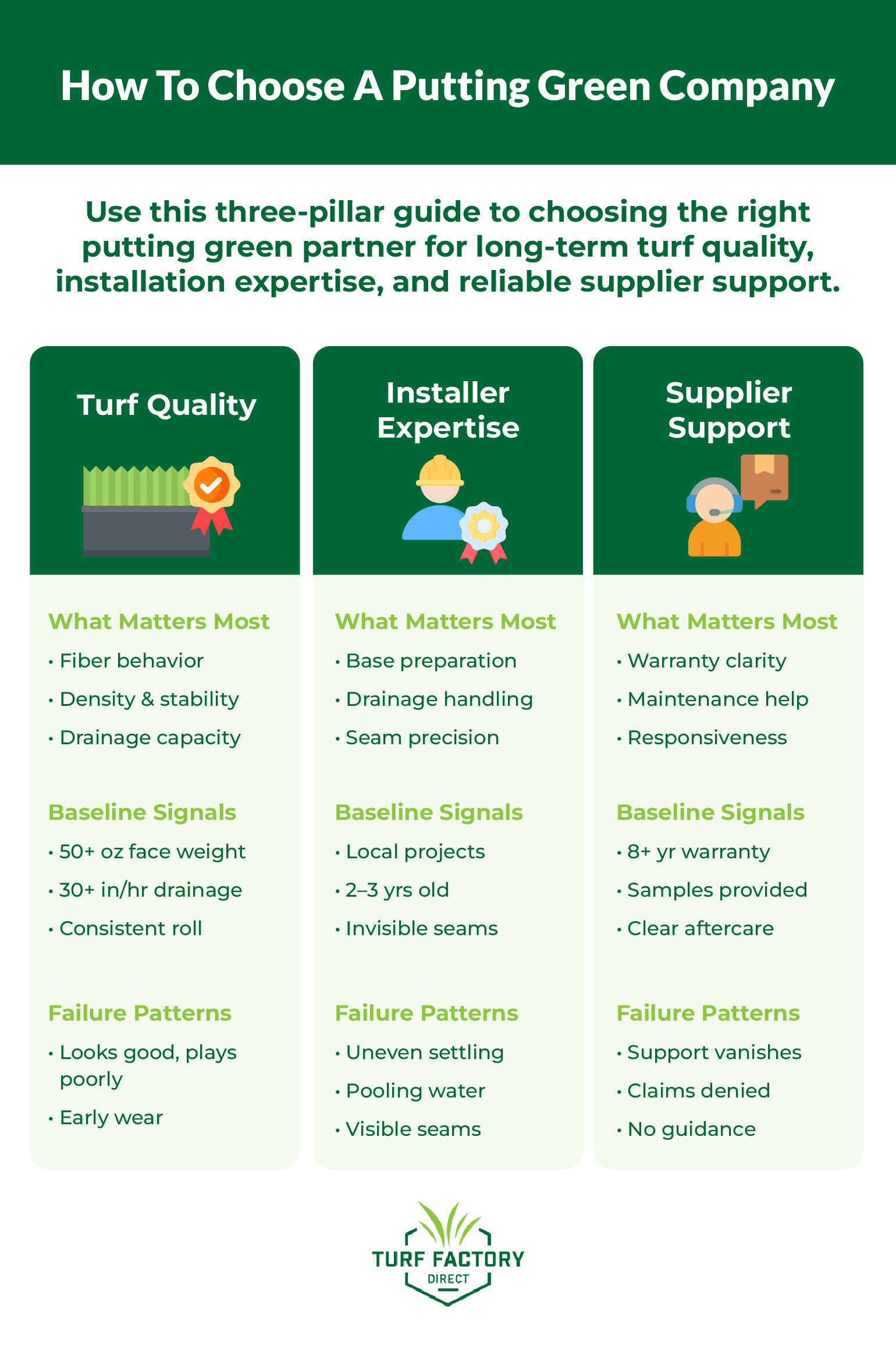
Before examining specifics, understand how these evaluation criteria interconnect. Weakness in any single pillar undermines the whole project.
- Turf quality sets your performance ceiling. Fiber type, density, and construction determine ball roll, surface consistency, and how long those characteristics last. The best installer cannot overcome fundamentally inferior materials.
- Installer expertise determines whether that ceiling gets reached. Proper base construction, drainage, seam placement, and contouring demand specialized knowledge general landscapers rarely possess. The majority of putting green complaints trace to installation problems, not material defects. The turf gets blamed, but the base failed.
- Supplier support affects everything from selection through years of ownership. Pre-sale guidance shapes choices. Installation resources influence success. Post-installation support—warranty service, maintenance products, technical assistance—determines whether small issues stay small.
| Pillar | What “Good” Looks Like | Red Flags |
| Turf Quality | Samples readily available, specs fully disclosed, warranty in writing | No samples, vague descriptions, “trust us” answers |
| Installer Expertise | Local portfolio with 2+ year-old projects, references provided willingly, detailed process explanation | Stock photos, won’t share references, rushes to quote |
| Supplier Support | Clear warranty terms, maintenance guidance, 24-48 hour response time | Fine-print warranties, no aftercare resources, slow replies |
A supplier with excellent turf but no installation guidance leaves you hunting for qualified installers independently. An installer with impressive credentials but limited material access constrains your options. Strength across all three pillars positions your project for success.
Understanding Your Putting Green Requirements
Clear requirements prevent wasted time and mismatched recommendations. Define priorities before contacting suppliers.
Defining Your Putting Green’s Purpose
Purpose drives every subsequent decision.
- Recreational and family use prioritizes durability over tour-level performance. These greens see foot traffic from non-golfers, potential pet activity, and mixed use patterns. Moderate ball speed works fine. Look for multi-use ratings and strong UV resistance.
- Serious practice demands consistent ball roll that transfers to course performance. According to the USGA Stimpmeter Instruction Booklet, stimpmeter readings on American golf courses generally range from 7 feet to 12 feet. If improvement is the goal, your green needs to behave like the greens you play on.
- Professional-grade training calls for USGA-spec construction: multiple cup positions, approach zones for chipping, variable slopes for diverse practice scenarios. These projects require installers experienced with commercial or club-level work.
Many homeowners sit in hybrid territory—serious about improvement but with family members wanting casual access. This calls for durable performance turf (nylon handles varied use better than polypropylene) and design that includes both challenging and forgiving zones.
The growing popularity of backyard putting greens reflects this shift toward home-based practice.
Determining Size, Layout, and Design Preferences
Size determines practice quality. Too small, and you’re limited to straight 4-footers. Properly sized, you practice the full range of situations you face on course.
- Minimum viable practice (200–400 sq ft): Basic putting with limited break. Workable if space constrains you, but recognize the limitations.
- Meaningful practice range (500–800 sq ft): Multiple cup positions, some contouring for breaking putts, varied distances. A 15′ × 40′ layout (600 sq ft) accommodates 3–4 cups with 10–20 foot opportunities.
- Comprehensive practice (1,000+ sq ft): Approach zones, significant undulation, multiple simultaneous users, course-like variety. Serious golfers with available space find this level transforms practice quality.
Beyond square footage, undulation creates realistic breaks but requires skilled installation for proper drainage. Fringe areas add chipping options and visual appeal but increase costs. Multiple cup positions (typically 3–5 for residential) multiply variety without requiring more space.
Complexity affects both budget and installer requirements. Simple flat greens suit capable DIYers. Multi-tier designs with significant contours demand specialists who understand how water moves across shaped synthetic surfaces.
Setting a Realistic Budget for Your Synthetic Putting Green
Understanding cost components matters more than fixating on total price.
Typical allocation:
- Turf materials: 35–45%
- Base materials (aggregate, drainage): 15–25%
- Labor/installation: 50–60%
- Accessories (cups, flags, edging): 5–10%
Labor accounts for roughly 50% to 60% of the total cost of installing synthetic turf. For a 500-square-foot residential putting green, expect $7,500 to $20,000 installed—varying by turf quality, site conditions, and regional labor rates. DIY installation can save 40–60% but demands proper equipment, physical capability, and significant time investment in base preparation.
Avoid evaluating on price alone. A $6,000 quote against a $12,000 quote for identical scope means either missing scope or cut corners. Shortcuts in materials or installation emerge within 2–3 years as uneven settling, drainage problems, or premature wear.
For detailed breakdowns by project type, see our putting green turf cost guide.
Aligning with Your Vision
Beyond specifications, the right company listens to what you actually want.
Quality suppliers ask questions before pushing products. They want to understand your goals, constraints, and expectations. One-size-fits-all recommendations—”this is our most popular option”—suggest a company more interested in moving inventory than solving your specific needs.
Customization worth discussing: two-tone turf for visual contrast, logo inlays, fringe textures complementing your landscape, integration with existing hardscape or outdoor living areas.
For inspiration, explore how homeowners are replicating golf course putting greens at home.
With requirements clear, you’re ready to evaluate companies claiming they can deliver.
Evaluating Putting Green Turf Quality and Product Options
Turf forms the surface you’ll interact with for years. Understanding quality differences prevents expensive regrets.
Understanding Turf Fiber Types and Performance Characteristics
Three fiber types dominate the residential market, each with distinct profiles.
- Nylon delivers the fastest, most consistent ball roll and superior durability. Its stiffness creates predictable response across the entire surface. Nylon’s superior memory—its ability to spring back after compression—maintains consistent ball roll even after years of use. That consistency matters for practice that transfers to course performance. The tradeoff: nylon commands premium pricing as the most expensive synthetic turf material.
- Polypropylene offers solid performance at lower cost. Ball roll is good but slightly less consistent than nylon, particularly as turf ages. Fiber memory diminishes faster under heavy traffic. Polypropylene is the least durable option, degrading faster than nylon or polyethylene—making it best suited for homeowners who play occasionally rather than practice seriously.
- Polyethylene appears primarily in blended applications—fringe material surrounding nylon or polypropylene putting surfaces. Its softer feel suits areas where comfort matters more than ball performance. Pure polyethylene putting greens are rare; the fiber doesn’t support the fast, true roll golfers expect.
| Fiber Type | Best For | Ball Roll | Durability | Cost |
| Nylon | Serious practice, high traffic | Fastest, most consistent | Excellent (10+ years) | Higher |
| Polypropylene | Budget-conscious, moderate use | Good, diminishes with age | Moderate | Lower |
| Polyethylene | Fringe areas, blended surfaces | Variable | Good for non-putting areas | Mid-range |
For serious golfers prioritizing ball roll, nylon options like TFD Nylon 36 UR or TFD Nylon Putt Extreme deliver professional-grade performance. Budget-conscious projects succeed with quality polypropylene like TFD Poly Putt. Homeowners prioritizing aesthetics appreciate two-tone options like TFD Two-Tone Putt.
Key Specifications That Affect Playability
Beyond fiber type, specifications determine actual performance. Understanding them lets you read spec sheets critically.
- Pile height (fiber length) controls ball speed. Putting turf ranges from 0.5″ to 0.75″. Shorter pile generally rolls faster than longer pile—exact speeds depend on infill depth and fiber density. Match your target speed to conditions you’re practicing for.
- Face weight indicates density—yarn amount per square yard. Higher face weight means more durable turf with better coverage. Target 50+ oz/sq yard for putting greens.
- Backing quality provides structure. Quality backing resists stretching, blocks moisture penetration, and holds fibers securely. Polyurethane coatings indicate premium construction. Ask about antimicrobial treatment for outdoor durability.
- Drainage rate matters critically outdoors. Backing that allows water to percolate at a rate of at least 30 inches per hour prevents pooling that affects play and erodes the base. High-rainfall regions may require more. Ask about testing methodology—reputable manufacturers document drainage rates.
- Infill requirements affect feel and performance. Most putting greens need silica sand to stabilize fibers and tune ball speed. Infill depth affects stimpmeter readings—more infill slows the surface, less speeds it up. Quality suppliers specify infill recommendations for each product.
Why Requesting Turf Samples Matters
Photos and specs tell part of the story. Physical samples tell the rest.
No image conveys fiber density, underfoot feel, the sound of a ball rolling across the surface, or subtle quality differences. Samples do.
Reputable suppliers make this easy—request putting green samples to compare options before committing. Treat willingness as a filter: confident companies want you to experience their products. Reluctance signals quality concerns.
Evaluating samples:
- Roll a ball across on a flat surface. Does it track straight?
- Examine the backing. Substantial with clean construction, or flimsy?
- Tug gently on fibers. Do they hold, or release easily?
- Compare 2–3 samples. Differences become obvious side-by-side.
- Leave samples outside several days to observe UV response.
Ten minutes with samples often reveals more than hours studying specifications.
Warranty and UV Resistance Considerations
Warranty terms reveal manufacturer confidence. Strong warranties signal products built to last; heavily caveated warranties suggest shortcuts somewhere.
Quality putting green turf typically carries 8–15 year warranties covering what actually goes wrong: UV fading, fiber degradation, backing failure. Read documents carefully. Many warranties exclude “commercial use”—problematic if you host regular golf gatherings—or require specific maintenance to remain valid.
UV resistance deserves attention for outdoor installations. Sun exposure degrades synthetic fibers, fading color and diminishing performance. Quality turf includes UV stabilizers rated for your climate. Ask about testing standards and expected fade timelines. Cheaper turf skimps on UV protection, showing noticeable fading within 3–5 years rather than the 8–10 year horizon quality products achieve.
The warranty question worth asking: “What’s your claim process, and what percentage get approved?” Direct answers with high approval rates mean backing their products. Evasion suggests warranties designed for marketing, not protection.
Vetting Artificial Turf Installer Expertise
Installation determines whether your investment reaches its potential. Even premium turf fails when installed improperly.
Why Installation Quality Makes or Breaks Your Green
A frequent regret among putting green owners isn’t the turf they chose—it’s the installer they hired.
Inadequate base preparation creates uneven settling. Balls break where they shouldn’t. Poor drainage causes pooling during rain and subsurface erosion over time. Visible seams disrupt roll and worsen as turf ages. Improper contouring creates dead spots. These problems emerge gradually, often past any warranty period.
Quality synthetic putting green installation starts with a properly prepared aggregate base, compacted for drainage, with geotextile barriers preventing weed intrusion and base contamination. Industry standard for residential installations is typically 3–4 inches, with 4–6 inches recommended for heavy traffic or cold climates. Shortcuts—thinner base, inadequate compaction, skipped barriers—save installers time while creating problems you’ll inherit.
Evaluating Experience and Specialization
General landscapers install patios and planting beds. Putting greens require specialized knowledge they likely lack.
Questions to ask:
- “How many putting greens have you installed in the past 2 years?” — Double-digit numbers indicate regular practice. One or two projects means learning on your job.
- “Do you specialize in synthetic turf, or is this one service among many?” — Specialists stay current. Generalists may use outdated methods.
- “What training or certifications do your installers have?” — Professional development signals commitment. Some manufacturers offer certification—ask about relevant training.
- “Walk me through your base preparation process.” — Listen for specifics: excavation depth, aggregate type, compaction methods, drainage provisions. Vague answers like “we use a good base” suggest inexperience.
Reviewing Portfolios and Past Projects
Portfolios separate verified capabilities from marketing claims.
Request photos of projects 2–3 years old, not just fresh installations. Time reveals quality. Proper installations look good at year three. Poor ones show settling, visible seams, and wear patterns.
What to evaluate:
- Seams: Should be invisible. The professional standard: if you see seam lines from 3 feet away, the work is substandard.
- Edges: Where turf meets hardscape or landscape, transitions should be clean without lifting or gaps.
- Contours: Slopes should appear intentional and smooth, not lumpy.
- Overall finish: Does it look professionally completed or DIY?
Request addresses of local projects. Drive-by verification is standard practice—reputable artificial turf installers expect this. Reluctance to share locations raises questions about whether portfolio photos represent actual work.
Checking References and Reviews
References reveal what portfolios can’t: how installations hold up, how issues get handled, whether homeowners would choose the same installer again.
Questions for references:
- “How does the green perform after [X months/years]? Has ball roll stayed consistent?”
- “Any issues during installation? How were they resolved?”
- “Have you needed repairs or maintenance support since?”
- “Knowing what you know now, would you hire them again?”
Listen for specifics. Vague positivity tells less than detailed observations.
Online reviews supplement calls but require interpretation. Patterns matter more than isolated experiences. Consistent complaints about the same issues—scheduling, communication, workmanship—indicate systemic problems. Reviews mentioning putting greens specifically carry more weight than general landscaping feedback.
Understanding the Installation Process
Familiarity with proper process helps you recognize professional methodology versus shortcuts.
Standard installation sequence:
- Site assessment and design — Evaluating space, discussing goals, proposing design addressing drainage and landscape integration.
- Excavation and grading — Removing material to depth (typically 5–7″ below finish), rough grading for drainage direction.
- Base installation — 3–4″ crushed aggregate for residential (4–6″ for heavy traffic), installed in lifts and compacted. This takes time done right; rushed base work fails.
- Drainage integration — French drains, channels, or systems as conditions require.
- Turf layout and seaming — Positioning to minimize seams, precise cutting, seaming techniques creating invisible joints.
- Infill and brushing — Silica sand worked to specified depth, thoroughly brushed for even distribution.
- Final inspection — Testing drainage, ball roll, seams, and edges with client present.
For DIY-inclined homeowners, products like TFD Putting Elite are designed specifically for residential self-installation.
Assessing Supplier Support and Partnership Quality
The relationship extends beyond purchase. Support quality affects satisfaction for years.
What “Supplier Support” Actually Means
Support encompasses every interaction from inquiry through ownership.
- Pre-sale: Consultation availability, product guidance for your situation, technical question response, sample provision. Quality support feels educational, not salesy.
- Installation: Whether you hire pros or DIY—guides, videos, technical assistance, and recommendations for local installers if you decide the project exceeds your capabilities.
- Post-installation: Warranty service, maintenance guidance, product recommendations, responsiveness when questions arise.
Transactional sellers focus on closing. True partners invest in your success because satisfied customers generate referrals.
Evaluating Communication and Responsiveness
Pre-sale communication predicts post-sale support. Slow responses while pursuing your business means slower responses after getting your money.
Test early. Email 3–4 specific questions about products, installation, and warranty. Note:
- Response time (quality suppliers: 24–48 hours)
- Answer quality (specific vs. generic)
- Product knowledge (real understanding vs. marketing recitation)
- Follow-up handling (equally thorough?)
Phone accessibility matters. Can you reach someone knowledgeable, or does every call route to voicemail?
Maintenance Guidance and Resources
Putting greens need minimal but specific maintenance. Quality suppliers equip you with clear guidance.
Standard requirements:
- Regular brushing keeping fibers upright and infill distributed
- Debris removal (leaves, organic matter promoting algae)
- Periodic infill replenishment as sand compacts
- Occasional deep cleaning for high-use areas
According to USGA guidance on backyard putting greens, today’s synthetic putting greens should have a lifespan of 10 years or more if they are well built and well maintained. Algae, UV damage, and other environmental factors will hasten degradation, so routine maintenance matters.
Ask what resources suppliers provide. Written guides? Videos? Climate-specific schedules? Access to maintenance products?
Proper maintenance includes periodic top dressing with products like putting green top dressing for optimal ball roll, and quality silica sand infill maintaining fiber stability.
Warranty Support and Issue Resolution
Documents specify terms. Actual support determines whether terms have meaning.
Ask directly: “How do you handle warranty claims?” Listen for process specifics. “We take care of customers” means nothing. “Submit photos through our portal; we respond within 72 hours with assessment” describes actual process.
Ask for claim statistics. Approval percentage? Average resolution time? Companies confident in products and support answer directly. Poor handlers evade.
Warranty support reveals values more clearly than marketing. Companies fighting valid claims prioritize short-term margin over reputation. Companies honoring commitments build trust justifying premium pricing.
Comparing Quotes and Making Your Final Decision
With evaluation complete across all three pillars, compare specific proposals and select your partner.
What a Professional Quote Should Include
Detailed quotes reflect professional operations. Vague quotes indicate unclear scope or poor planning.
Quote components:
- Itemized materials — Turf product, price per square foot, total footage, infill type and quantity, base materials, edging, accessories. Verify pricing independently.
- Labor breakdown — Installation separated from materials. Site prep itemized if conditions require significant excavation.
- Site preparation — If removing concrete, landscape, or hardscape, costs should be explicit.
- Timeline — Start date, milestones, expected completion. Professionals estimate accurately.
- Warranty terms — Documented, matching discussion. Not verbal promises.
- Payment schedule — Reasonable: deposit (10–30%), progress payments at milestones, final upon completion. According to the Better Business Bureau, most deposits should range between 10–30% of total project cost, and homeowners should avoid contractors asking for more than half upfront.
Red Flags in the Selection Process
Warning signs during evaluation predict problems during execution.
- Pressure to sign immediately — “Price only good today” suggests desperation, not quality.
- Unwillingness to provide samples — No legitimate reason exists for quality suppliers to avoid this.
- No local references or portfolio — Experience claims should be verifiable.
- Verbal-only warranties — “We stand behind our work” is not a warranty. Written terms with specific coverage are.
- Quotes significantly below market — 40% below others for identical scope means missing scope or cut corners.
- Poor communication during sales — Expect worse after they have your money.
The Value of Building a Long-Term Relationship
Company selection begins a relationship, not a transaction.
Your green needs attention over its lifespan. Infill replenishment. Minor repairs. Perhaps expansion. Eventually replacement. A supplier who knows your project handles these smoothly. Starting fresh with new vendors means re-explaining everything repeatedly.
The “partner” framing isn’t marketing language. It recognizes that ownership works best as an ongoing relationship with a company invested in your long-term satisfaction.
Your Next Step: Starting Your Putting Green Project
You now understand how to evaluate putting green companies across the three pillars determining success. The knowledge gap has closed. What remains is action.
Start by Requesting Samples
Physical evaluation matters more than any research. Specs describe turf; samples reveal it.
Request Turf Factory Direct putting green samples and feel quality differences firsthand. Roll a ball. Compare backing, density, and construction. This low-commitment step delivers high-value insight shaping every decision that follows.
Exploring Your Options
See how Turf Factory Direct’s lineup aligns with specific goals:
| Your Situation | Recommended Starting Point |
| Serious golfer, performance priority | TFD Nylon 36 UR or TFD Nylon Putt Extreme |
| Indoor/simulator setup | TFD Golf Sim Pro |
| Budget-conscious quality | TFD Poly Putt |
| DIY residential project | TFD Putting Elite |
| Aesthetic priority (two-tone) | TFD Two-Tone Putt |
| Commercial/club application | TFD Birdie Putt Elite |
Browse our complete putting green turf selection to explore all options.
The Right Partner Makes the Difference
Choosing a putting green company means evaluating three interconnected factors: turf quality delivering consistent ball roll, installer expertise transforming materials into performance, and supplier support extending beyond the sale. Excellence across all three creates a green that sharpens your game for years. Weakness in any one undermines the investment.
This is the standard Turf Factory Direct upholds. The right company provides samples willingly, shows verified local projects, explains the process in detail, and answers questions thoroughly. We treat your project as a relationship beginning, not a transaction ending.
Ready to move forward? Request a custom quote for your project here.
Have questions before you begin? Contact our team for expert support.