Pre-made putting greens are a legitimate practice tool for casual putting, portability, and tight budgets — but they hit a performance ceiling that custom-built greens simply don’t have. If your goal is repeating a consistent stroke on a flat surface, a quality pre-made green will serve you well for years. If your goal is reading breaks, controlling speed across variable slopes, and practicing the kind of putts that actually show up on a golf course, you’ll outgrow a pre-made surface faster than you think.
That’s not a knock on pre-made greens. It’s the same reason a driving range net in the garage doesn’t replace a round at your home course — different tools serve different stages of commitment. The right choice comes down to five variables: ball-roll fidelity, slope versatility, durability and lifespan, total cost over time, and how your living situation shapes what’s practical.
Key Takeaways
- Ball-roll fidelity is the biggest differentiator. Custom greens use higher-density nylon fibers and calibrated infill systems that can be tuned to realistic Stimpmeter speeds (up to 13 feet), while pre-made greens roll at a fixed, often inconsistent speed.
- Slope design is the biggest training differentiator. Pre-made greens offer one or two fixed breaks; custom greens can incorporate multi-directional contours, tiers, and compound breaks that build transferable green-reading skill.
- Pre-made greens cost $150–$500 upfront and last two to five years. Custom installations range from $3,000–$15,000+ but are engineered for 15–20+ years of use.
- Total cost of ownership often favors custom over a 10-year horizon. A $300 budget kit replaced every three years costs $1,200 over a decade — and never advances past flat-surface practice.
- Your living situation is often the deciding factor. Renters and those moving within 1–3 years should choose pre-made. Homeowners staying 5+ years get compounding value from custom.
- A middle ground exists. Professional-grade turf rolls installed DIY-style deliver better performance than a kit with some portability if plans change.
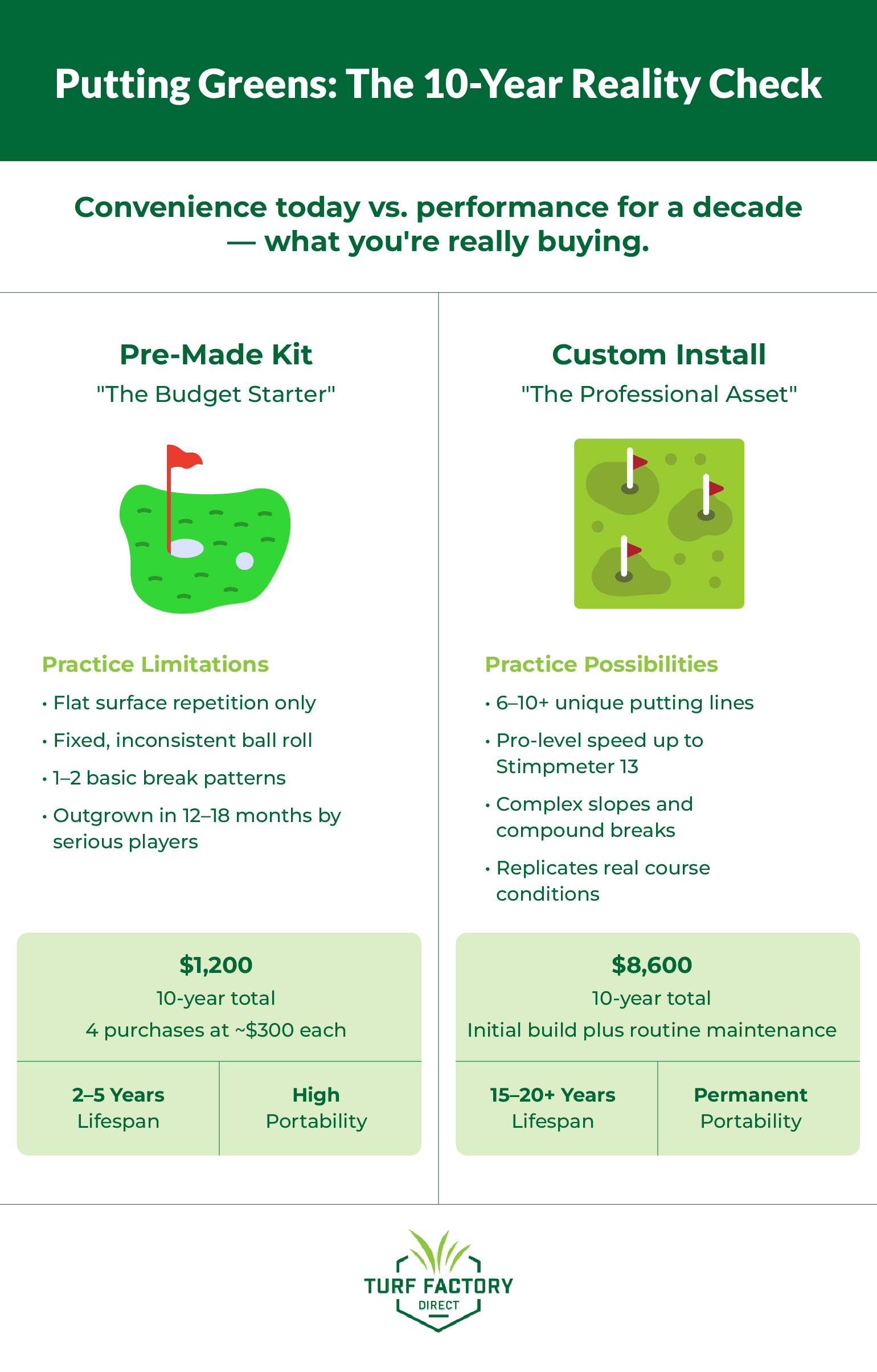
What follows is a straight comparison across each of those variables and what actually matters for your game. But first, let’s look at what’s driving the pre-made putting green boom in the first place.
Why Portable and Modular Putting Greens Are Surging in Popularity
More people are playing golf now than at any point in the last decade — on-course participation topped 28 million in 2024, the seventh consecutive annual increase, according to the National Golf Foundation — and a surprising number of them have figured out something the pros have always known: putting accounts for roughly a third of all strokes in a round, making the putting green one of the fastest places to find improvement. Combine that with the home-improvement mindset that took hold in 2020 and never really faded — median household renovation spending rose over 33% from 2020 through 2024 — and you get a market that was ready-made for pre-made greens.
The appeal is straightforward: a functional putting surface delivered to your door and ready to use in under an hour, with zero excavation, no contractor scheduling, and no permit headaches. For renters, apartment dwellers, and golfers who might relocate within a few years, that convenience isn’t a minor perk — it’s the whole point.
The products have kept pace with the demand. Pre-made greens have evolved from the flimsy novelty mats of a decade ago into reasonably engineered practice surfaces with denser turf fibers, improved backing systems, and more realistic undulations. The entry point typically falls between $150 and $500 for a quality kit, making it accessible to golfers who aren’t ready — or don’t need — to commit $3,000 to $15,000+ for a custom installation.
Not everyone needs a custom build. That’s worth saying plainly. For the growing number of golfers bringing practice home, a pre-made green can be a perfectly rational choice — whether it’s a portable putting green for an apartment or one of the many putting green options for a yard — as long as you understand what you’re getting and where convenience starts to fall short.
So if pre-made greens are flying off shelves, what exactly arrives in the box — and where does “convenient” start to mean “compromise”?
The Case for Pre-Made Greens: Where Convenience Delivers
Setup and Portability: Unbox, Unroll, Putt
The strongest argument for a pre-made putting green is speed to play. Most kits require nothing more than a flat surface and ten to fifteen minutes of your time. Unroll, position the cups, putt. No sub-base preparation, no drainage planning, no waiting three weeks for a contractor’s schedule to open up.
That simplicity translates directly into flexibility. A renter in a 600-square-foot apartment can set up a 4×10 rollout green in their living room, get in thirty minutes of stroke work after dinner, and stow it in a closet before bed. A homeowner with a two-car garage can lay a larger surface across the floor and have a year-round practice space regardless of weather. And if you move next year, the green rolls up and goes with you — something a $10,000 custom installation will never do.
For golfers whose living situations are in flux — renters, military families, anyone in a transitional housing period — portability isn’t a bonus feature. It’s the deciding factor.
Upfront Cost: The Budget-Friendly Entry Point
The front-end math favors pre-made, and it isn’t close. Here’s how the tiers break down:
Quick Cost Snapshot: Pre-Made vs. Custom
| Category | Pre-Made Kit | DIY with Quality Turf | Professional Custom Install |
| Typical Price Range | $150–$500 | $500–$2,000 | $3,000–$15,000+ |
| Installation Time | 15–60 minutes | 1–3 days | 1–3 weeks |
| Tools Required | None | Basic hand tools, utility knife | Professional equipment |
| Included Components | Turf surface, cups, flags, sometimes alignment guides | Turf rolls, cups (sub-base materials separate) | Complete build: sub-base, drainage, turf, contouring, cups, fringe |
No professional labor means no labor costs — which typically represent around half of a custom installation’s total price. No excavation means no disposal fees for removed soil. The budget conversation starts and ends at the kit price.
For a golfer who plays a couple times a month and wants to groove a consistent stroke, that $200–$400 investment delivers genuine practice value without the kind of financial commitment that requires a household conversation. For a deeper breakdown of home putting green cost across all tiers, this cost guide covers the full spectrum.
What Comes in the Box: Standardized Features and Limits
A typical pre-made putting green kit includes a turf surface in a standard size — commonly 4×10, 5×12, or 3×9 feet — with one or two pre-formed undulations, two to three cup inserts, flags, and occasionally a ball return track or alignment aids.
The turf itself is usually a medium-density polypropylene or nylon-blend fiber at a pile height in the 12–15mm range. That’s adequate for basic putting practice, but “standardized” is the operative word: the fiber density, backing weight, and infill (if any) are chosen for manufacturing consistency and cost efficiency, not for replicating a specific course condition.
Slopes on pre-made greens are typically gentle, single-direction breaks — enough to introduce a basic curve to your putt but limited to one or two break patterns across the entire surface. You’ll learn that particular break well. That has real practice value. But it won’t build the green-reading versatility that transfers to courses you haven’t memorized.
Most quality kits hold up well for two to five years of regular use before showing meaningful wear — fiber flattening, UV fading if used outdoors, backing degradation. Polypropylene-based surfaces, the most common material in budget kits, typically fall in the three-to-five-year range with proper care. That’s a reasonable lifespan relative to the investment, though it becomes a different calculation when you zoom out to a five- or ten-year time horizon.
Pre-made greens check a lot of boxes for convenience — but once you start rolling putts on a well-built custom surface, the gap between a kit and a purpose-built green becomes something you can feel with every stroke.
The Case for Custom Putting Greens: Where Quality Separates
Ball-Roll Fidelity: The Performance Gap You Can Feel
Drop a ball on a pre-made green and give it a firm putt. Now do the same on a well-built custom surface. The difference isn’t subtle. On the custom green, the ball tracks true — no wobble off the face, no skid through inconsistent fibers, no dead spots where the roll just dies. That consistency has a name in the industry: ball-roll fidelity.
It measures how closely a synthetic turf putting surface replicates the behavior of a real putting green — the evenness of speed, the trueness of the roll line, and how the ball responds to break and grain. It’s the single biggest differentiator between pre-made and custom, and it starts with what the turf is made of.
Custom putting greens use shorter-pile, higher-density fibers — typically nylon monofilament at pile heights ranging from around 10mm to 15mm, with significantly higher fiber counts per square inch than pre-made kits. That density is what creates a true, consistent roll. When the fibers are packed tightly enough, the ball rides on top of the surface rather than nestling into gaps between blades, eliminating the wobble and unpredictable skid that cheaper surfaces produce.
Then there’s the infill system. Custom greens use carefully calibrated sand or sand-rubber blends that control speed and firmness — proper infill placement is critical for maintaining consistent Stimpmeter speeds and preventing surface depressions over time. Stimpmeter — the device the USGA developed to standardize green speed measurement — rates putting surfaces on a scale where readings on American courses generally range from 7 to 12 feet, with typical PGA Tour events coming in around 12. A well-built custom green using sand-filled nylon turf can be tuned to replicate speeds close to 13 feet on the Stimpmeter, offering genuine tour-level performance. Pre-made kits roll at whatever speed their fixed construction produces, with no ability to adjust — and that speed is often inconsistent across the surface due to manufacturing variation.
For golfers serious about transferring practice to the course, that fidelity gap is everything. A surface that rolls at a consistent, realistic speed trains your touch in a way that translates directly. A surface with dead spots and inconsistent roll can actually work against you — you start adjusting your stroke to compensate for the turf rather than building feel that works on real greens.
For a deeper dive into what it takes to replicate course-quality conditions at home, this guide on building a course-quality putting green covers the technical details.
Slope and Contour Design: Beyond Flat and One-Bump
If ball-roll fidelity is the biggest performance differentiator, slope design is the biggest training differentiator. And it’s where the gap between pre-made and custom opens into a canyon.
A pre-made green gives you one break to read. Maybe two. You’ll practice that break until you can sink it in your sleep — which feels like progress, right up until you step onto an actual green with a compound left-to-right break over a subtle ridge and realize you’ve been training one specific muscle memory that doesn’t generalize.
A custom green can give you six to ten distinct putting lines across the same surface. Multi-directional slopes, tiers, ridges, and compound breaks are engineered into the sub-base during construction, creating a practice surface that mirrors the kinds of reads you’ll face on an actual course. Subtle undulations that force you to read grain direction. Speed changes across elevation transitions. Those tricky double-breaking putts that separate single-digit handicaps from everyone else.
Some golfers replicate specific holes from their home course or famous tournament greens — the false front at TPC Sawgrass’s island green, the deceptive ridgeline on Augusta’s 12th. That level of targeted practice simply isn’t possible with a pre-made surface.
The training distinction matters: varied contour practice builds green-reading skill, not just green-reading memory for one specific break pattern. That’s the kind of improvement that shaves strokes across every round, on every course you play.
Design Freedom: Size, Shape, and Landscape Integration
Pre-made greens come in rectangles. Your backyard probably isn’t one.
Custom greens can be designed around existing landscape features — wrapping around a patio, flowing along a pool edge, tucking into an L-shaped corner between the house and the fence. The shape, size, and feature placement (cup positions, fringe zones, chipping areas, bunker lips) are all determined by your space, your goals, and your imagination rather than by a manufacturer’s standard mold.
That flexibility extends to the practice experience itself. A low-handicap player who wants fast, severely undulating surfaces for tournament prep gets a fundamentally different green than a mid-handicapper who wants gentler breaks with a large chipping apron for short-game work. Both are custom. Neither is available off a shelf.
Then there’s the aesthetic dimension that most product pages don’t mention. A well-designed custom green integrates into your landscaping as a deliberate feature — fringe turf, natural borders, grade transitions that look like they belong. It reads as architecture. A rolled-out mat on a patio, regardless of quality, reads as equipment.
For advice on making smaller spaces work, this article on creative ideas for a small putting green is worth a look.
Built to Last: Durability and Long-Term Value
A professionally installed custom putting green is engineered from the ground up — literally. The build starts with excavation, grading, and compaction of a structural sub-base (typically crushed aggregate topped with decomposed granite), followed by a drainage layer that prevents water pooling and structural shifting. The turf is then stretched, seamed, and secured over that base with professional-grade adhesives and anchoring systems.
That construction produces a surface designed for a lifespan of 15 to 20 years or longer with routine maintenance. The USGA notes that today’s synthetic putting greens should last 10 years or more when well built and well maintained, and high-quality UV-stabilized nylon turf — which resists fading and fiber breakdown far longer than the polypropylene blends common in pre-made kits — routinely extends that functional life to 15–20 years. Maintenance is straightforward: occasional brushing to keep fibers upright, periodic infill top-offs, and basic debris removal.
Compare that to a pre-made green’s typical two-to-five-year useful life, and the sticker price starts telling a different story — one we’ll break down in the next section.
A well-built custom green is a landscape asset that adds to your property. A worn-out mat is something you throw away.
If you’re leaning toward custom, requesting a design consultation is the fastest way to get a realistic quote tailored to your specific space and goals.
Custom greens clearly outperform on quality and longevity — but the decision isn’t purely about performance. It’s about matching the right solution to your specific situation.
Pre-Made vs. Custom Putting Greens: A Side-by-Side Breakdown
Performance vs. Convenience: What You Gain and What You Give Up
This is where feelings meet facts. Here’s how the two categories compare across the metrics that actually affect your practice and your game:
Feature-by-Feature Comparison: Pre-Made vs. Custom Putting Greens
| Feature | Pre-Made Green | Custom Green |
| Ball-Roll Realism | Moderate — consistent enough for stroke practice, but speed varies across the surface and doesn’t replicate real green conditions | High — tunable Stimpmeter speed, consistent roll, realistic ball response to break and grain |
| Slope Options | 1–2 pre-formed breaks, single direction, fixed gradient | 6–10+ distinct putting lines, multi-directional breaks, compound contours, ridges, tiers |
| Practice Variety | Limited — same putts, same breaks, same reads | Extensive — different lines, speeds, and challenges across the surface |
| Green-Reading Training | Minimal — reinforces one specific break pattern | Significant — builds transferable green-reading skill across varied contours |
| Stimpmeter Adjustability | None — fixed speed determined by construction | Full — infill system allows tuning to match specific course speeds |
| Size/Shape Options | Standard rectangles (4×10, 5×12, etc.) | Unlimited — designed to fit any space, shape, or landscape |
| Setup Time | 15–60 minutes, no tools | 1–3 weeks professional installation |
| Portability | High — rolls up, moves with you | None — permanent landscape feature |
| Typical Lifespan | 2–5 years | 15–20+ years |
Think of it as a “practice ceiling.” Every pre-made green has a point where it stops improving your game — you’ve mastered its breaks, grooved your stroke on its speed, and additional practice time yields diminishing returns. A custom green raises that ceiling dramatically because the surface itself is complex enough to keep challenging you as your skills sharpen.
That distinction matters less for a golfer who plays a few times a month and wants to stay sharp. It matters enormously for a golfer who’s actively trying to lower their handicap.
Total Cost of Ownership: Pre-Made Kits vs. Custom Installation
The sticker price on a pre-made kit looks like a clear win — and for a single purchase cycle, it is. But the putting green you buy today isn’t the last money you’ll spend on practice surfaces, and the total cost over five to ten years often tells a very different story.
Total Cost of Ownership Over 10 Years
| Scenario | Year 0 | Year 3 | Year 6 | Year 9 | 10-Year Total |
| Budget Pre-Made Kit ($300) | $300 | $300 (replacement) | $300 (replacement) | $300 (replacement) | $1,200 |
| Premium Pre-Made/DIY ($1,200) | $1,200 | $1,200 (replacement) | — | $1,200 (replacement) | $3,600 |
| Custom Installation ($8,000) | $8,000 | $200 (maintenance) | $200 (maintenance) | $200 (maintenance) | $8,600 |
The budget kit scenario assumes replacement every three years — optimistic for heavy use, realistic for moderate. The premium tier stretches closer to five-year cycles. The custom installation carries a higher upfront number but minimal ongoing cost, because maintenance on a properly built green runs a couple hundred dollars per year for infill top-offs and occasional professional brushing.
The math gets more interesting when you factor in “upgrade regret” — the pattern where a golfer buys a budget kit, outgrows it in 12–18 months, buys a better one, outgrows that, and eventually invests in custom anyway. By that point, the cumulative spend on pre-made surfaces is money that never went toward the solution they actually wanted.
None of this means custom is right for everyone. A golfer who genuinely needs a portable, temporary solution gets better value from a single quality pre-made kit than from a custom build they can’t take with them. The point is to run the numbers honestly — including replacements — before committing either way. For detailed pricing across all tiers, this putting green turf cost breakdown covers the numbers.
Portability vs. Permanence: Matching the Solution to Your Living Situation
This is often the deciding factor that overrides everything else, and it deserves a straightforward framework:
Choose pre-made if you rent, lease, or expect to move within 1–3 years. No amount of performance advantage justifies a permanent installation in a home you don’t own or won’t occupy long enough to recoup the value. A quality pre-made green is the smart play here, full stop.
Choose custom if you own your home and plan to stay 5+ years. The investment has time to deliver its value — both in daily practice and in the property enhancement that comes with a professionally designed landscape feature. Custom greens built with quality materials and proper sub-base engineering don’t just hold up; they can genuinely strengthen property appeal at resale.
The middle ground exists. High-quality turf rolls — not pre-packaged kits, but the same professional-grade turf used in custom installations — can be purchased and installed DIY-style with basic tools and a weekend of effort. You won’t get the engineered sub-base or complex contouring of a professional build, but you’ll get dramatically better turf quality than a kit, with some portability if your plans change. For a walkthrough of the DIY putting green installation process, this guide covers it step by step. And if you want to feel the difference between turf grades before committing any money, ordering samples takes the guesswork out of the material question.
Not sure which approach fits your situation? Our team can walk you through the options based on your space, budget, and timeline.
Once you understand the trade-offs, the decision usually comes down to three questions about your specific situation.
How to Choose the Right Putting Green for Your Game
Three Questions Worth Asking Before You Buy
1. What’s my primary practice goal?
If you want basic stroke repetition and distance control — the kind of short game practice that keeps your fundamentals sharp between rounds — a pre-made green can absolutely deliver that value. The surface is consistent enough to build muscle memory for a smooth, repeatable stroke, and the repetition alone will show up in your scores.
If your goals extend to green-reading, speed control, break judgment, and the kind of short-game precision that separates mid-handicaps from low-handicaps, a custom green is the upgrade that matters. Varied contours, realistic speeds, and genuine training complexity produce transferable skill — the kind you carry onto unfamiliar greens at courses you’ve never played.
2. What’s my living situation and timeline?
Renting or moving within one to three years? Pre-made or a portable roll is the practical call. You’ll get legitimate practice value without sinking money into something you’ll leave behind.
Homeowner staying five years or more? Custom delivers compounding value — your practice improves, your property improves, and the per-year cost drops with every season of use.
3. What’s my real budget — including replacements?
Calculate total cost over five to ten years, not just the upfront number. A $300 kit replaced three times over a decade costs $1,200 — and you never graduate beyond flat-surface practice. A $1,200 premium kit replaced twice costs $3,600 — approaching custom territory without the custom performance.
Factor in the cost of “upgrade regret.” If there’s any chance you’ll outgrow your first purchase within two years, the honest budget conversation is about where you’ll end up, not where you’re starting.
The Verdict: Which Type of Golfer Are You?
Choose pre-made if you’re a casual putter who wants basic practice on a budget, you rent or may move soon, or you want a portable indoor/outdoor option with zero construction. Pre-made greens are a legitimate tool for the right use case. The golfer who uses one consistently will absolutely putt better than the golfer who practices on nothing.
Choose custom if you’re serious about improving your short game, you own your home and want a permanent practice and entertainment feature, or you’ve already outgrown a basic mat and want a surface that challenges you. Custom is the investment that pays dividends in both game improvement and property value — the difference between maintaining your current level and actively building a better one.
Not sure yet? That’s exactly the kind of decision Turf Factory Direct’s team helps golfers work through every day.
Your Next Step
The best putting green is the one that matches where you are right now — your budget, your living situation, your goals — while leaving room for where your game is headed. Whether that’s a quality pre-made surface that gets you practicing tonight or a custom build that challenges you for the next two decades, the only wrong choice is the one you make without understanding the trade-offs.
Ready to explore custom? Browse our putting green turf options or request a quote to get a design consultation tailored to your space and goals.
Want to feel the turf first? Order a sample to see and touch the difference between turf grades before committing.
Still comparing options? Contact our support team — we’ll walk you through the options based on your budget, space, and practice priorities.