


Picture this: 6 AM, coffee steam rising, and you’re sinking putts in your backyard before the world wakes up. No fifteen-minute drive. No waiting for the practice green to clear. Just you, your putter, and fifty square feet of perfectly contoured turf that’s yours alone.
The common assumption that size determines putting green quality is wrong. A 50-square-foot green designed with intention will sharpen your stroke faster than a sprawling installation where practice becomes aimless wandering. The constraint forces focus, and focus builds skill.
This guide gives you the exact framework professionals use to transform forgotten corners, narrow side yards, and even rooftops into practice facilities that actually improve your game. Strategic planning first, then creative configurations, then the enhancement features that separate functional from exceptional.
Key Takeaways
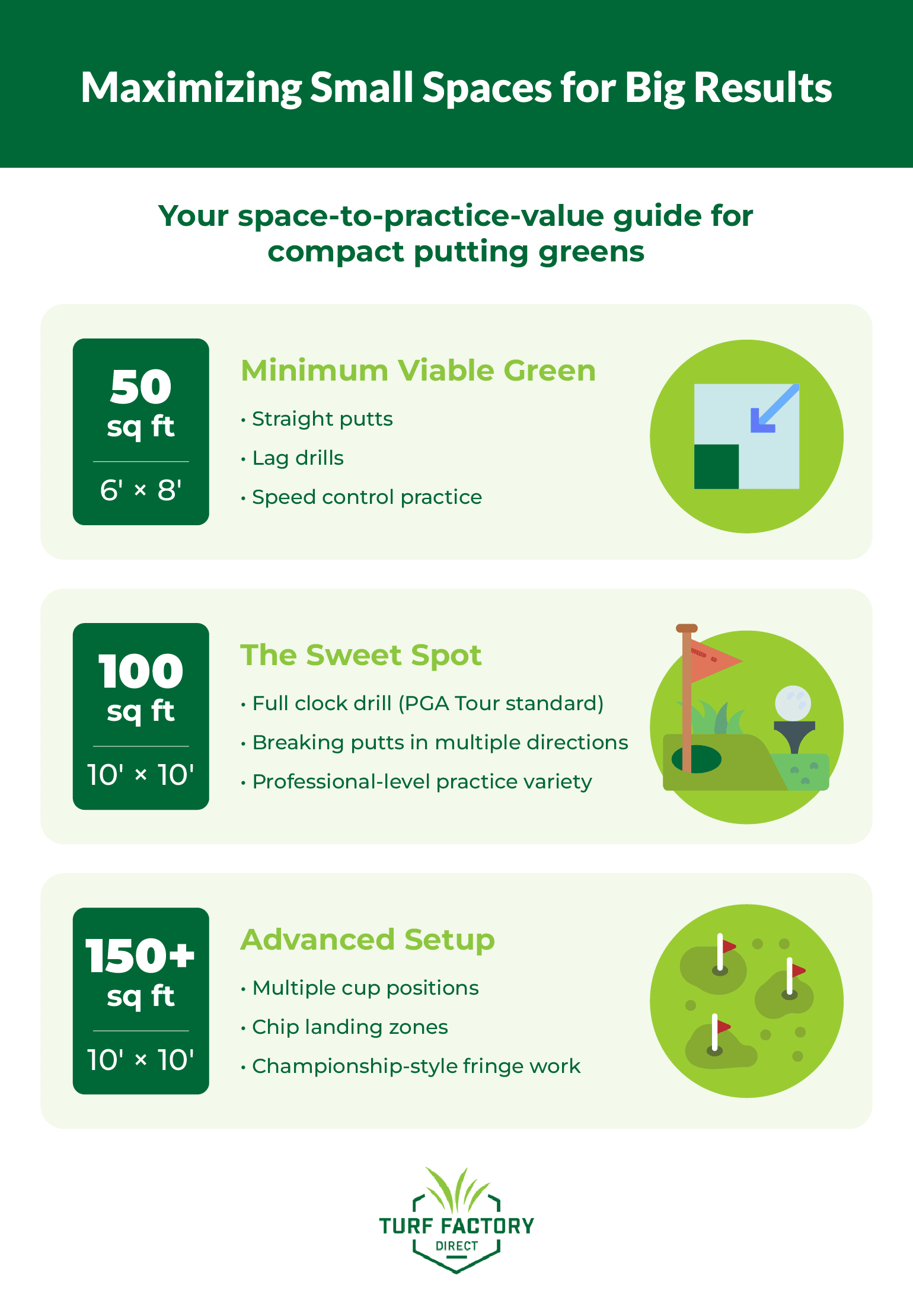
- Minimum viable space: 50 square feet (6’×8′) handles straight putts and lag drills; 100 square feet (10’×10′) unlocks the clock drill and meaningful break practice.
- Budget reality: Professional installations run $15-40 per square foot, with most 100 sq ft projects landing between $2,000-$2,500.
- Lifespan value: Quality nylon turf lasts 10-15 years with proper installation, delivering exceptional long-term ROI.
- Design priorities: Proper drainage trumps everything—skipping base preparation guarantees premature failure regardless of turf quality.
- Configuration flexibility: L-shapes, side yard strips, and multi-level designs can maximize practice value in spaces traditional rectangles can’t fit.
- Practice upgrade: The clock drill favored by PGA Tour players requires just 100 square feet, bringing professional-level practice home.
Quick Reference
| Element | Detail |
| Minimum viable space | 50-100 sq ft (6’×8′ for straight putts; 10’×10′ for breaking putts and clock drills) |
| Cost range | $15-40 per square foot installed |
| Installation time | 1-2 days (professional) to one weekend (DIY) |
| Top configurations | Corner L-shape, side yard strip, multi-level design |
| ROI | 6-month payback factoring time savings; $2,400+ annual value |
Planning Your Small Putting Green Ideas for Maximum Impact
Grab a shovel before you’ve planned properly and you’ll build an expensive mistake. Professional designers follow a specific framework for spaces under 200 square feet—and the principles matter more at small scales, where every decision gets magnified.
Understanding Space Limitations and Opportunities
A 6-by-8-foot rectangle—48 square feet—is the minimum that qualifies as a putting green rather than a practice mat. At this size, you can work on lag putts and speed control. Straight-line fundamentals. Useful, but one-dimensional.
The real threshold sits at 100 square feet. That 10’×10′ footprint unlocks the clock drill: position markers arranged around a central cup, a routine described by Golf.com as “probably THE most common drill” seen among PGA Tour players. Multiple distinct angles. Multiple different reads. One drill that’s impossible on anything smaller, and it transforms practice from repetition into genuine skill-building.
Space Size vs. Practice Value
| Square Footage | Dimensions | What You Can Practice |
| 50 sq ft | 6’×8′ or 5’×10′ | Straight putts, lag drills, speed control |
| 75 sq ft | 7.5’×10′ | Gentle breaks, four-position practice |
| 100 sq ft | 10’×10′ | Full clock drill, multiple break directions |
| 150 sq ft | 10’×15′ or L-shape | Multiple cups, approach chip landing zone |
| 200+ sq ft | Flexible | Championship-style practice with fringe work |
Five Steps Before You Measure
- Map your sunlight. Adequate direct sun daily keeps synthetic fibers healthy—mold and mildew thrive in permanent shade. That north-facing corner behind the garage? Probably not your spot.
- Follow the water. Your yard already has drainage patterns. Find where runoff naturally flows and work with gravity, not against it. Fighting existing drainage doubles your base preparation costs.
- See constraints as features. The retaining wall becomes a natural backstop. Mature trees create shaded “hazard” areas. Fence lines define boundaries without buying edging. What looks like an obstacle might be free infrastructure.
- Call before you dig. Dial 811, the FCC-designated national call-before-you-dig number. A putting green installed over a septic line or buried electrical isn’t just a code violation—it’s a future catastrophe requiring complete reconstruction.
- Know your soil. Sandy ground drains beautifully with minimal prep. Clay demands 4-6 inches of compacted aggregate to prevent pooling and shifting. The dirt under your feet determines half your budget.
Designing for Maximum Functionality
Professional designers work from a ratio of roughly 60% putting surface, 30% fringe, 10% features and borders. On a 100-square-foot footprint, that means about 60 square feet of true putting surface. Sounds small until you realize that thoughtful contours make those 60 square feet feel like a full practice facility.
Contour Math Made Simple
A 2% slope means 2 inches of elevation change across 100 inches—about 8 feet. On a 10-foot putt, that creates roughly 2.4 inches of total break. Enough to demand aim adjustment. Not so severe that reading becomes guesswork.
| Skill Level | Recommended Slope | The Feel |
| Beginner | 1-2% | Subtle break, builds confidence |
| Intermediate | 2-3% | Noticeable movement, requires adjustment |
| Advanced | 3-3.5% max | Challenging reads, tour-realistic |
A common DIY mistake: abrupt transitions. A slope that changes direction over 12 inches creates a speed bump, not a putting surface. Contours need to flow across 3-4 feet minimum. Think rolling terrain, not stairs.
Making Small Spaces Play Big
Position your cup off-center—roughly 40% from one edge—and you’ve instantly created practice variety. Short uphill putts from one direction. Longer downhill breakers from another. Eight to twelve distinct angles from a single cup placement, rotated monthly to prevent wear patterns and keep your practice honest.
If kids or older family members will share the green, keep maximum slopes under 2.5% and carve out at least one flat 4’×4′ section. A green that frustrates beginners becomes a solo activity. One that welcomes all skill levels becomes a gathering place.
Setting Realistic Budget and Timeline Expectations
Small putting green projects typically cost between $15-40 per square foot installed, a range confirmed across multiple industry sources including HomeAdvisor and Angi:
Cost Breakdown per Square Foot
| Component | Range | Notes |
| Base preparation | $3-5 | Excavation, grading, compacted aggregate |
| Quality putting turf | $8-12 | Nylon preferred for high-traffic small greens |
| Drainage system | $2-4 | French drain or direct runoff channel |
| Cups and flags | $50-150/hole | Regulation cups recommended |
| Optional lighting | $500-2,000 total | Path lights to full illumination |
| Total installed | $15-40 | Regional labor creates the range |
For a 100-square-foot green, expect $1,500-$4,000 total. Most quality installations land between $2,000 and $2,500.
Timeline Reality
Full DIY with basic landscaping experience: one weekend plus a few evenings. Professional crews on straightforward sites: one to two days. Complex elevated installations or difficult drainage situations add time on either approach.
The ROI Calculation
The “$2,400 annual savings” figure breaks down like this:
Practice three times weekly. Value your time at $30/hour. Eliminate 30-minute round trips to a practice facility. That’s $4,680 in time savings alone—money you never see because it’s measured in hours rather than dollars, but it’s real. Add actual fee savings (even a modest $50 monthly practice allocation equals $600/year) and your $2,000 installation pays for itself before summer ends.
The less quantifiable returns—stress relief on demand, family activity space, property value that appraisers increasingly recognize—don’t fit spreadsheets but might matter more.
Budget $200-400 annually for maintenance: brushing tools, infill replenishment, occasional repairs. Quality turf isn’t maintenance-free, but it’s close.
Explore Putting Green Options →
Creative Design Configurations for Limited Spaces
The gap between a cramped practice mat and an engaging backyard putting green comes down to configuration. These three approaches have transformed spaces as small as 75 square feet into facilities that golfers actually use daily.
Corner and Side Yard Transformations
The L-Shape Advantage
Corner installations turn 90-degree angles from awkward obstacles into assets. An L-shaped configuration—6 feet by 12 feet with a 6’×6′ perpendicular extension—delivers over 100 square feet in space that couldn’t fit a traditional rectangle.
Place your cup at the L’s intersection and you’ve created natural variety without trying: breaking putts from both wings, straight approaches from the tips, built-in alignment targets. The shape that seemed like a compromise becomes the feature.
Side Yard Strips
That neglected corridor between your house and the fence—four feet wide, fifteen feet long, currently growing weeds? It’s a lag putting paradise waiting for permission.
Minimum width: 4 feet (tight but functional). Optimal: 6 feet (comfortable stance and stroke). Length matters more than width for these installations. Twenty feet of straight putting surface with subtle undulations builds the distance control that saves strokes from outside 15 feet—the skill most amateurs neglect because it’s boring to practice. Until it’s ten steps from your kitchen.
Case Example
An 85-square-foot corner behind the garage. Shaded until noon. Clay soil. Surrounded by established rhododendrons the homeowner refused to remove.
The configuration: L-shaped, 7’×8′ primary section with 4’×5′ extension wrapping the corner. Six-inch raised base to improve drainage over clay and catch afternoon sun. The rhododendrons? They became natural “rough” borders requiring zero additional landscaping budget.
Single cup positioned at the L-intersection. Full clock drill capability in space the homeowner had written off as unusable.
Total cost: $2,200 installed. Practice frequency: daily, up from twice-monthly course visits.
Diagonal Installation
Square lots feel larger when features break from property lines. A 10’×10′ green installed at 45 degrees presents as a diamond, creating a depth illusion that makes tight spaces feel more generous than their footprint suggests.
Border Plants That Behave
Choose compact species that won’t send roots under your base or drop debris on your surface: dwarf mondo grass, compact boxwood, creeping thyme, low ornamental grasses. Anything that sheds leaves, berries, or seeds becomes a daily cleanup chore that eventually wins—you’ll stop practicing rather than keep sweeping.
Elevated and Multi-Level Solutions
When ground space doesn’t exist, look up.
Deck Installations
According to the International Residential Code (IRC), residential decks must be designed to support a minimum live load of 40 pounds per square foot (psf) plus a dead load of 10 psf, for a combined total of about 50 psf. Most putting green systems weigh approximately 15–25 psf when saturated with water, which is well within typical load limits. However, always verify your deck’s structural rating before installation, especially for older or elevated decks.
Key requirements for elevated greens: waterproof membrane beneath the entire installation, drainage channels directing water away from framing, edge containment preventing runoff stains, access points for inspecting deck condition underneath. Skip any of these and you’re building a rot factory.
Rooftop Greens
Flat commercial roofs and engineered residential roof decks handle putting greens beautifully. The considerations multiply: wind exposure (secure all edges, consider cup covers), building code compliance, professional structural assessment. This isn’t DIY territory, but the results can be spectacular.
Stepped Greens for Sloped Yards
Two 50-square-foot tiers connected by a 6-inch step turns grade challenges into features. Uphill putts from the lower level, downhill from above. Each tier drains independently, simplifying water management on difficult sites. Visual drama as a bonus.
Integrated Landscape Approaches
The best compact putting green designs look like they’ve always belonged—not green rectangles dropped onto lawns.
Invisible Edges
Rather than borders announcing where turf ends, professional installations blur the transition. Fringe turf (slightly longer pile) flows into natural grass or groundcover. Flagstone steppers emerge from putting surface into planting beds. The green becomes part of the landscape instead of interrupting it.
Working With What Exists
Existing patios provide free chipping backstops. Retaining walls become uphill targets. Flagstone paths transform into approach lines. Every hardscape feature you don’t have to build is money saved and integration earned.
Seasonal Realities
Freeze-thaw climates demand proper base drainage—ice heaving destroys surface consistency. Quality installations handle Pacific Northwest rain, Upper Midwest cold, and Southwest heat equally well, but only when the base is right. Summer consideration: turf surface temperatures can reach as high as 150-169°F in direct afternoon sun. Plan shade access or accept that midday July practice means hot feet.
Enhancing the Putting Experience
The gap between a backyard putting green and a practice facility you’ll use daily comes down to three things: surface quality, strategic features, and thoughtful amenities.
Surface Selection and Installation
Stimp Ratings Decoded
The Stimpmeter measures how far a ball rolls (in feet) when released from a standardized ramp at a consistent angle. Higher numbers mean faster greens.
| Rating | Equivalent | Recommendation |
| 7-8 | Slow municipal course, heavy dew | Too slow for meaningful practice |
| 9-10 | Well-maintained public course | Sweet spot for home greens |
| 10-11 | Quality private club | Serious players with maintenance commitment |
| 12+ | Tour conditions | Often counterproductive—rewards tentative strokes |
Most home putting surfaces play 9-10 fresh from installation. This speed is correct for most players. Chasing tour speeds backfires more often than it helps: ultra-fast surfaces punish confident strokes and ingrain the yips. Practice green speed should match the courses you actually play.
Nylon vs. Polypropylene
| Factor | Nylon | Polypropylene |
| Durability | Superior—holds shape under heavy use | Good, shows wear patterns faster |
| UV resistance | Excellent | Moderate—fades sooner |
| Cost | 20-30% premium | Budget-friendly |
| Memory resistance | High—bounces back | Develops permanent impressions |
| Best for | Small greens under 100 sq ft | Larger installations with dispersed traffic |
On small greens, every inch sees daily foot traffic. Polypropylene shows wear patterns within two to three years that nylon resists for a decade or more, with high-grade materials lasting 10-15 years. The premium pays for itself.
Looking for a professional-grade putting surface? The TFD Golf Sim Pro offers a smooth, durable nylon fiber with cushioning foam backing for ideal ball roll and reduced sound. Available in multiple standard sizes and backed by a 10-year warranty, it’s an excellent choice for small putting greens.
Discover the TFD Golf Sim Pro Turf →
Face Weight Translation
Target 40-60 ounces per square yard. Below 40, surfaces feel thin and balls skip unpredictably. Above 60, you’re paying for density that doesn’t improve performance. Quality manufacturers hit this window consistently.
The Seaming Problem
Seams are ridges waiting to ruin ball roll. Standard turf comes in 15-foot widths, meaning any green under 15 feet wide should be cut from a single piece. No seams, no problems.
For L-shapes or irregular configurations, plan cuts so seams land in fringe areas where imperfections matter less. Never run a seam across a primary putting line. This single detail separates installations that look professional from obvious DIY jobs.
Adding Challenge and Variety
The Clock Drill
Position markers arranged in a circle around a central cup. Putt from each position, moving clockwise only after making the previous one. Miss and restart from position one. Goal: complete the full rotation without a miss.
On a 100-square-foot green with thoughtful contours, each position presents a different challenge. Uphill. Downhill. Left-to-right. Right-to-left. Tour players practice this drill regularly. Now you can too, before breakfast.
Five Tour-Proven Drills to Consider
Gate Drill: Two tees set one ball-width wider than your putter head, two feet ahead of the ball. Stroke through the gate. Builds face control.
Ladder Drill: Markers at 10, 15, 20, and 25 feet. Roll balls to stop within two feet of each marker, progressing through the ladder. Develops lag feel.
One-Hand Drill: Dominant hand only, three-foot putts. Eliminates wrist breakdown and grooves proper release.
Eyes Closed: Set up to a four-foot putt, close your eyes, stroke. Shifts awareness from visual dependence to feel.
3-6-9 Pressure: Make three consecutive putts from three feet, then three from six, then three from nine. Any miss restarts the entire sequence. Simulates tournament nerves.
Multiple Cups
Two or three cups at different elevations transform static practice into routing. Create a “course” by putting to each in sequence, keeping score. Competition—even against yourself—accelerates learning faster than mindless repetition.
Monthly Rotation
Move your cup position weekly for a month. By day thirty, you’ve practiced angles you’d never encounter repeating the same setup. Document positions to recreate configurations that challenged you productively.
Creating Atmosphere and Extending Usability
Lighting Options
| Type | Investment | Best For |
| Solar path lights | $50-150 | Evening atmosphere |
| Low-voltage LED spots | $200-500 | Targeted illumination |
| Integrated cup lights | $100-200 | Nighttime play, dramatic effect |
| Full flood lighting | $1,000-2,000 | Year-round evening practice |
Even basic solar lights extend your usable hours into evening—valuable during short winter days when daylight disappears before dinner.
Weather Protection
Shade sails can reduce surface temperatures by up to 27°F ($100-400). Retractable awnings ($500-2,000) offer adjustable coverage. Permanent pergolas ($2,000+) create outdoor room ambiance. Match investment to climate and usage patterns.
Social Considerations
Hosting putting competitions? 150 square feet is minimum for comfortable two-person play. Add seating—a bench, a pair of Adirondack chairs—adjacent to the green and your practice facility becomes an entertainment venue.
Family-Safe Modifications
Foam-lined cup edges prevent pinched fingers. Softer fringe turf around the perimeter cushions tumbles. Removable obstacles store away when young children play. Maximum slopes under 2.5% prevent frustration and falls. A green designed for all ages gets used by everyone.
Your Practice Facility Awaits
That forgotten corner behind your garage, the narrow strip along your fence, the rooftop you’ve never used—each holds potential for daily practice that no golf facility membership can match for convenience.
Fifty to one hundred square feet. A few thousand dollars. One weekend of work or a day with professional installers. The return: morning putts with coffee, evening competitions with friends, a short game that improves because practice happens daily instead of whenever schedules align. The math works out quickly when time savings compound, and the lifestyle upgrade defies calculation entirely.